[masterthesis] Eine Feldstudie zum Einsatz von problembasierten Lernvideos in einem offenen Mathematikunterricht

Thomas hat nun seine Masterarbeit erfolgreich verteidigt und dabei diese schöne Präsentation verwendet. Wer an der Arbeit an sich interessiert ist, der kann diese hier bestellen oder einfach unter https://itug.eu nachlesen:

Klicken Sie auf den unteren Button, um den Inhalt von www.slideshare.net zu laden.

Inhalt laden

[interview] OER – „Das steigert die Sichtbarkeit“

In der Ausgabe 07/2014 der duz-deutschen Universitätszeitung hat man mich zum Thema OER interviewt und auch hinterfragt warum die TU Graz eine Open-Content-Strategie hat bzw. warum man solch Projekte wie L3T machen soll. Was herausgekommen ist kann man nachlesen und ich hoffe ich habe es soweit auf den Punkt gebracht.

[Artikel „Mit der Lizenz zum Lernen“]

[Interview „Das steigert die Sichtbarkeit“]

OER-Camp in Köln

Das OER-Camp in Köln ist eine echte Rarität in der Barcamp-Szene, immerhin wird es von einer Stadtverwaltung organisiert. Und dann auch noch zum Thema OER! Natürlich finden wir das bei L3T und im BIMS auch Klasse und unterstützen das Camp am 25. Oktober 2014 auch diesesmal mit einigen gedruckten OER (u.a. drei Bände der O3R-Reihe). Vielleicht gibt’s dann ja eine Print-OER-Tombola? Oder eben ein paar Give-Aways und Ansichtsexemplare. Obwohl: Im Web kann man sich das alles eh anschauen – und nutzen … 🙂

Unser Paket schaut dieses Jahr so aus:

OERcamp

Coffe Lecture über Open Educational Resources

Im Rahmen des Monats für freie Bildung haben Michael Kopp und ich eine Coffee Lecture gehalten. Also ja, wir sind wirklich in ein Grazer Kaffeehaus gegangen und haben uns den Fragen der Studierenden und sonstigen Interessierten gestellt und zwar rund um die Themen Open Educational Resources und iMOOX.
Die 1,5h kann man hier nachsehen – wir sagen nochmals danke für die Möglichkeit:

YouTube

Mit dem Laden des Videos akzeptieren Sie die Datenschutzerklärung von YouTube.
Mehr erfahren

Video laden

schule.tugraz.at

schule.tugraz.at
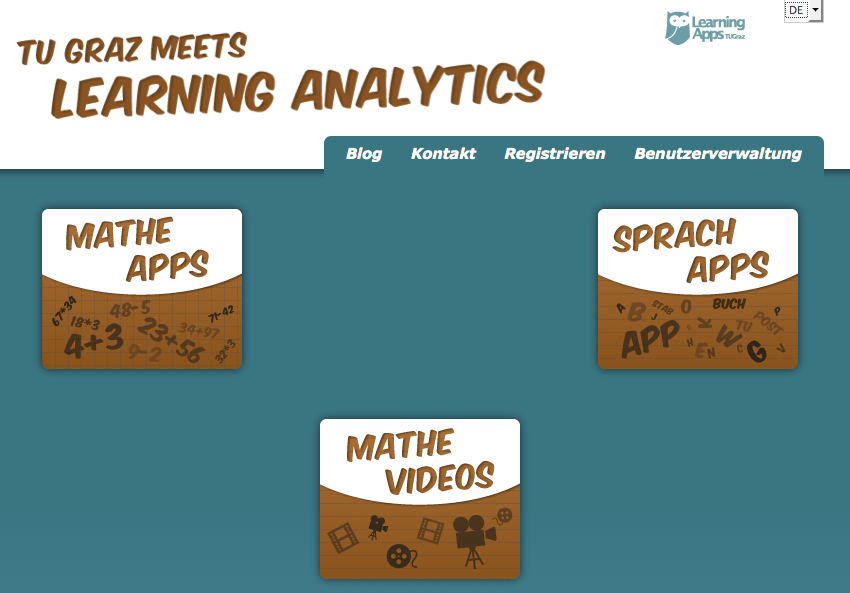
Rechtzeitig zum Schulbeginn haben wir nun endlich alles umgestellt und unsere Aktivitäten im Bereich Schule und Learning Analytics gebündelt. Ab sofort steht die Seite schule.tugraz.at zur Verfügung und bündelt den Einmaleins-Trainer, den Additions- und Subtraktionstrainer, den mehrstelligen Multiplikationstrainer, sowie auch die Apps für den Lesestest und der Buchstabenpost.
Wir hoffen, dass das Angebot auch weiterhin noch ausgebaut werden kann (zumindest wird von den Studierenden im Hintergrund fleißig gearbeitet) und freuen uns natürlich auch auf Rückmeldungen 🙂 .


This is my last blogpost for the next two weeks – I will go for vacation with my family. In the meanwhile have a pleasant time and come back with me on 18th of August 🙂


[publication] Learning with Mobile Devices Perceptions of Students and Teachers at Lower Secondary Schools in Austria

Our contribution at this year ED-MEDIA conference in Tampere, Finnland about „Learning with Mobile Devices Perceptions of Students and Teachers at Lower Secondary Schools in Austria“ is now online available. The slides have alreday been published here.
Abstract:

This publication aims to report on the findings of a study of readiness for integrating mobile phones in secondary schools (grade 5 – 8) in Austria. Surveys are used to examine the ownership and usage of mobile phones of kids of the age from 10 to 14 years, teachers and additionally teacher candidates. Findings indicate that gathered data show the reality outside school and the lack of readiness of teachers and teacher candidates. Educators and school authority need to take a serious approach to accepting 21st century technology. It can be summarized that the educational system has to be adapted to today’s and tomorrow’s technologies. Issues based on the research and compared with data from the recent JIM Study are discussed: Youth and mobile technologies, school – demands and challenges-, teacher education and Bring Your Own Device (BOYD).

Learning with Mobile Devices Perceptions of Students and Teachers at Lower Secondary Schools in Austria by Martin

Klicken Sie auf den unteren Button, um den Inhalt von www.scribd.com zu laden.

Inhalt laden

Reference: Grimus, M. & Ebner, M. (2014). Learning with Mobile Devices Perceptions of Students and Teachers at Lower Secondary Schools in Austria. In Proceedings of World Conference on Educational Multimedia, Hypermedia and Telecommunications 2014 (pp. 1600-1609). Chesapeake, VA: AACE.

[iPhone] Real Expense Tracker

Bildschirmfoto 2014-06-22 um 17.50.36Im Rahmen unserer Vorlesung „Mobile Applications 2014“ ist die App Real Expense Tracker entstanden. Damit sollten sämtliche Ausgaben in der Zukunft nachvollziehbar sein 🙂 :

Real Expense Tracker gibt Ihnen einen Überblick über ihre Ausgaben. Es ermöglicht Ihnen einfach ihre
Ausgaben zu protokollieren, sie zu beschreiben und sie über Monate und Jahre zu analysieren
und zu verfolgen. Diese Daten werden einfach per iCloud auf allen ihren Geräten synchronisiert.

  • Wählen Sie eine Kategorie
  • Geben Sie die ausgegebene Geldsumme ein
  • Drücken Sie „Sichern“
  • Wertvolle Funktionen:

    • hinzufügen einer Ausgabe
    • wählen einer Kategorie
    • hinzufügen einer Beschreibung, Datum, Titel (Name) der Ausgabe
    • bearbeiten und löschen existierender Ausgaben
    • extrem einfache Benutzerschnittstelle, auch für jeden leicht bedienbar
    • Suchfeld um bestimmte Ausgaben zu finden
    • iCloud Sync, somit können sie auch von anderen Apple-Geräten darauf zugreifen
    • grafische Darstellung mittels Diagramme
    • und vieles mehr

    [Link zur App]

    [publication] MOOCs Completion Rates and Possible Methods to Improve Retention – A Literature Review

    Our contribution at this year ED-MEDIA conference in Tampere, Finnland about „MOOCs Completion Rates and Possible Methods to Improve Retention – A Literature Review“ is now online available. The slides have alreday been published here.
    Abstract:

    Many MOOCs initiatives continue to report high attrition rates among distance education students. This study investigates why students dropped out or failed their MOOCs. It also provides strategies that can be implemented to increase the retention rate as well as increasing overall student satisfaction. Through studying literature, accurate data analysis and personal observations, the most significant factors that cause high attrition rate of MOOCs are identified. The reasons found are lack of time, lack of learners’ motivation, feelings of isolation and the lack of interactivity in MOOCs, insufficient background and skills, and finally hidden costs. As a result, some strategies are identified to increase the online retention rate, and will allow more online students to graduate.

    MOOCs Completion Rates and Possible Methods to Improve Retention – A Literature Review by Martin

    Klicken Sie auf den unteren Button, um den Inhalt von www.scribd.com zu laden.

    Inhalt laden

    Reference: Khalil, H. & Ebner, M. (2014). MOOCs Completion Rates and Possible Methods to Improve Retention – A Literature Review. In Proceedings of World Conference on Educational Multimedia, Hypermedia and Telecommunications 2014 (pp. 1236-1244). Chesapeake, VA: AACE.

    [iPhone] CalcMan

    Bildschirmfoto 2014-06-22 um 17.37.54Im Rahmen unserer Vorlesung „Mobile Applications 2014“ ist die App CalcMan entstanden. Wir haben uns an das Arcadegame Pacman orientiert mit dem Unterschied, dass man zuerst eine einfache Rechnung lösen muss um die Monster fressen zu können. Hoffe es macht Spaß 🙂 :

    Das Konzept eines Retro-Spiels vereint mit Rechenaufgaben. Unser Spiel, basierend auf dem sehr bekannten PacMan erweitert dessen Funktionen um einen Rechenteil, der es Kindern ermöglicht, auf einfache und lustige Weise rechnen zu lernen.
    Das Spiel läuft fast gleich wie das Original ab, mit dem einzigen Unterschied, dass auf dem Spielfeld eine Rechnung angezeigt wird, und man die richtige Lösung fressen muss. Wird die falsche Lösung gefressen, verfolgt einen ein zusätzlicher böser Geist.
    Die App bietet neben drei verschiedenen Schwierigkeitsgraden Highscores und eine gut gestaltete Oberfläche.

    [Link zur App]

    [publication] Support of Video-Based lectures with Interactions – Implementation of a first prototype

    Our contribution at this year ED-MEDIA conference in Tampere, Finnland about „Support of Video-Based lectures with Interactions – Implementation of a first prototype“ is now online available. The slides have alreday been published here.
    Abstract:

    In general videos have a more or less consuming character without any interaction possibilities. Due to this fact a web-based application is developed which offers different methods of communication and interaction to a certain learning-video. This should help attendees to avoid that they become tired and annoyed. The lecturer is able to use interactions to omit whether learners are able to understand the content of the video. For instance the developed web-application offers the possibility to add multiple-choice-questions at predefined positions. Furthermore there are many different kind of analysis as for example a detailed attention-profile. In this publication the implementation of a first prototype is described as well as a first field study which points out that learners? interactions and engagements increased arbitrarily.

    Support of Video-Based lectures with Interactions – Implementation of a first prototype by Martin

    Klicken Sie auf den unteren Button, um den Inhalt von www.scribd.com zu laden.

    Inhalt laden

    Reference: Wachtler, J. & Ebner, M. (2014). Support of Video-Based lectures with Interactions – Implementation of a first prototype. In Proceedings of World Conference on Educational Multimedia, Hypermedia and Telecommunications 2014 (pp. 562-571). Chesapeake, VA: AACE.