[publication] Mobile Seamless Learning – Die nahtlose Integration mobiler Geräte beim Lernen und im Unterricht #mlearning #research

Unser Beitrag zu „Mobile Seamless Learning – Die nahtlose Integration mobiler Geräte beim Lernen und im Unterricht“ im Handbuch Mobile Learning ist nun erschienen.

Zusammenfassung:

Mobile Geräte möglichst nahtlos beim Lernen und im Unterricht zu integrieren, ist eine Zielsetzung des Mobile Seamless Learning. Genau genommen soll das Lernen in unterschiedlichen Räumen – inner- und außerhalb des Klassenzimmers, im physischen wie auch im virtuellen Raum, möglichst einfach gelingen. In diesem Beitrag wird die Entwicklung des Mobile Seamless Learning-Ansatzes sowie seine Bedeutung skizziert. Fünf konkrete Einsätze, die dem Mobile Seamless Learning-Ansatz zugeordnet werden, geben Einblick in die praktische Realisierung in unterschiedlichen Lernkontexten. Schließlich werden wichtige Erfahrungen zusammengefasst und Empfehlungen für eigene Umsetzungen gegeben.

[Original-Beitrag @ Springer]

[Draft @ ResearchGate]

Zitation: Schön, S., Ebner, M. (2018) Mobile Seamless Learning – Die nahtlose Integration mobiler Geräte beim Lernen und im Unterricht. In: Handbuch Mobile Learning. de Witt, C. & Gloerfeld, C. (Ed.). S. 283 – 302. Springer. https://doi.org/10.1007/978-3-658-19123-8_15

[publication] Gamification in MOOCs: A Review of the State of the Art #tugraz #MOOC #research

Our contribution at this year EDUCON conference is about „Gamification in MOOCs: A Review of the State of the Art„. We took a close look to current research studies about game elements in MOOCs and summarized the result.

Abstract:

A Massive Open Online Course (MOOC) is a type of online learning environment that has the potential to increase students‘ access to education. However, the low completion rates in MOOCs suggest that student engagement and progression in the courses are problematic. Following the increasing adoption of gamification in education, it is possible that gamification can also be effectively adopted in MOOCs to enhance students‘ motivation and increase completion rates. Yet at present, the extent to which gamification has been examined in MOOCs is not known. Considering the myriad gamification elements that can be adopted in MOOCs (e.g., leaderboards and digital badges), this theoretical research study reviews scholarly publications examining gamification of MOOCs. The main purpose is to provide an overview of studies on gamification in MOOCs, types of research studies, theories applied, gamification elements implemented, methods of implementation, the overall impact of gamification in MOOCs, and the challenges faced by researchers and practitioners when implementing gamification in MOOCs. The results of the literature study indicate that research on gamification in MOOCs is in its early stages. While there are only a handful of empirical research studies, results of the experiments generally showed a positive relation between gamification and student motivation and engagement. It is concluded that there is a need for further studies using educational theories to account for the effects of employing gamification in MOOCs.

[Draft version @ ResearchGate]

Reference: Khalil, M., Wong, J., de Koning, B. B., Ebner, M., & Paas, F. (2018). Gamification in MOOCs: A Review of the State of the Art. In proceedings of the 2018 IEEE Global Engineering Education Conference (pp. 1635-1644). Santa Cruz de Tenerife, Canary Islands, Spain

[publication] It’s in your pocket: A MOOC about programming for kids and the role of OER in teaching and learning contexts #imoox #mooc #tugraz

Our publication about „It’s in your pocket: A MOOC about programming for kids and the role of OER in teaching and learning contexts“ at this year Open Education Global Conference in Delft got published right now.

Abstract:

Programming is considered as an essential skill in the 21st century. Visual programming languages and age-appropriate development environments allow an easy entry into this field. Nevertheless, it is very challenging to bring those skills in a very short time frame to schools, to their teachers, and to school children themselves. Therefore, Graz University of Technology started a Massive Open Online Course named “Learning to code: Programming with Pocket Code” which is intended to teach coding skills to school children as well as teachers in a very fast, flexible and effective way. The learning content within the course is published under an open license to allow the reuse, modification and dissemination of the materials in different teaching and learning contexts. In this research work, we will present structure and concept of the MOOC. A special emphasis will be given on how the MOOC can be used in school and on the fact, that the content can be disseminated in a variety of ways.

[Link to article @ ResearchGate]

[Link to article @ Conference Proceeding Database]

Reference: Grandl, M., Ebner, M., Slany, W., Janisch, S. (2018) It’s in your pocket: A MOOC about programming for kids and the role of OER in teaching and learning contexts.In: Conference Proceeding Open Educational Global Conference 2018. p. 9. Delft, Netherlands

[publication] Transferring learning dashboards to new contexts: experiences from three case studies #LearningAnalytics #STELA

Our publication about „Transferring learning dashboards to new contexts: experiences from three case studies“ at this year Open Education Global Conference in Delft got published right now.

Abstract:

This papers focuses on the use of learning dashboards in higher education to foster self-regulated learning and open education. Students in higher education have to evolve to independent and lifelong learners. Actionable feedback during learning that evokes critical self-reflection, helps to set learning goals, and strengthens self-regulation will be supportive in the process. Therefore, this paper presents three case studies of learning analytics in higher education and the experiences in transferring them from one higher education institute than the other. The learning dashboard from the three case studies is based on two common underlying principles. First, they focus on the inherent scalability and transferability of the dashboard: both considering the underlying data and the technology involved. Second, the dashboard use as underlying theoretical principles Actionable Feedback and the Social Comparison Theory. The learning dashboards from the case studies are not considered as the contribution of this paper, as they have been presented elsewhere. This paper however describes the three learning dashboards using the general framework of Greller and Drachsler (2012) to enhance understanding and comparability. For each of the case study, the actual experiences of transferability obtained within a European collaboration project (STELA, 2017) are reported. This transferability and scalability is the first-step of creating truly effective Open Educational Resources from the Learning Analtyics Feedback dashboards. The paper discusses how this collaboration impacted and transformed the institutes involved and beyond. The use of open education technology versus proprietary solutions is described, discussed, and translated in recommendations. As such the research work provides insight on how learning analytics resources could be transformed into open educational resources, freely usable in other higher education institutes.

[Link to article @ ResearchGate]

[Link to article @ Conference Proceeding Database]

Reference: De Laet, T., Broos, T., van Staalduinen, J.-P., Ebner, M., Leitner, P. (2018)Transferring learning dashboards to new contexts: experiences from three case studies. In: Conference Proceeding Open Educational Global Conference 2018. p. 14. Delft, Netherlands

[publication] Orthography Training with IDeRBlog-an Open Educational Resources Practice #iderblog #oer #learninganalytics

Our publication about „Orthography Training with IDeRBlog-an Open Educational Resources Practice“ at this year Open Education Global Conference in Delft got published right now.

Abstract:

The article depicts the blogging platform IDeRBlog as an example of an Open Educational Resources Practice. The exercise databases of IDeRBlog are focussed in the context of orthography training. After briefly outlining Open Educational Resources an overview on how the exercises were researched and reviewed according to an established quality framework is given. This is followed by the Analysis of missing exercises and the creation of IDeRBlog exercises by the project team.

[Link to article @ ResearchGate]

[Link to article @ Conference Proceeding Database]

Reference: Gros, M., Aspalter, C., Ebner, M., Ebner, M., Steinhauer, N., Adolph, H., Ankner, L., Biermeier, S., Cormann, M., Edtstadler, K., Ernst, S., Gabriel, S., Goor, G., Huppertz, A., Irmag, K., Leitner, P., Martich, S., Taraghi, B., Ullmann, M. & Wintschnig, M. (2018) Orthography Training with IDeRBlog-an Open Educational Resources Practice. In: Open Education Global Conference 2018: OEGlobal2018. Van Valkenburg, W. & Schuwer, R. (Hrsg.). Delft University of Technology, 5 S.

[video] What is Open Peer Review?

Openess is one of the most important movements of our society. Consequently, we should also rethink the whole process of Peer-Review. My colleague Tony Ross-Hellauer, from the Know-Center here in Graz, explains just in few minutes „What is Open Peer Review?“. Enjoy the video:

YouTube

Mit dem Laden des Videos akzeptieren Sie die Datenschutzerklärung von YouTube.
Mehr erfahren

Video laden

[imoox] Start: Learning to Code – Programming with Pocket Code #imoox #pocketcode

Pocket CodeWe are happy, because the first round in englisch language starts today. The MOOC „Learning to Code: Programming with Pocket Code“ is explicitly aimed at schoolchildren. But be aware that we do not want to train the whole world as computer scientists. On the contrary, we simply want people to understand how the world of tomorrow works, so that they can help shape the world of tomorrow. So register and join it for free.

There are many prejudices and fears about programming. With the help of Pocket Code, particularly children will gain initial experience with programming. A simple and visual user interface enables a playful implementation of your own ideas.

The course is designed for children and young people (age group 10-14 years) as well as teachers of all subjects. The main content includes creating your own games, interactive animations and apps with Pocket Code. At first, the structure and functionality of the app get presented. The participants learn how to use basic programming concepts such as conditionals, variables, events or parallelism. It is up to the children whether they take the course on their own or together with their parents.

[Link to the MOOC]

How can you join? Simply at any time, just register at iMOOX for free and go to the course page and join – have fun.

YouTube

Mit dem Laden des Videos akzeptieren Sie die Datenschutzerklärung von YouTube.
Mehr erfahren

Video laden

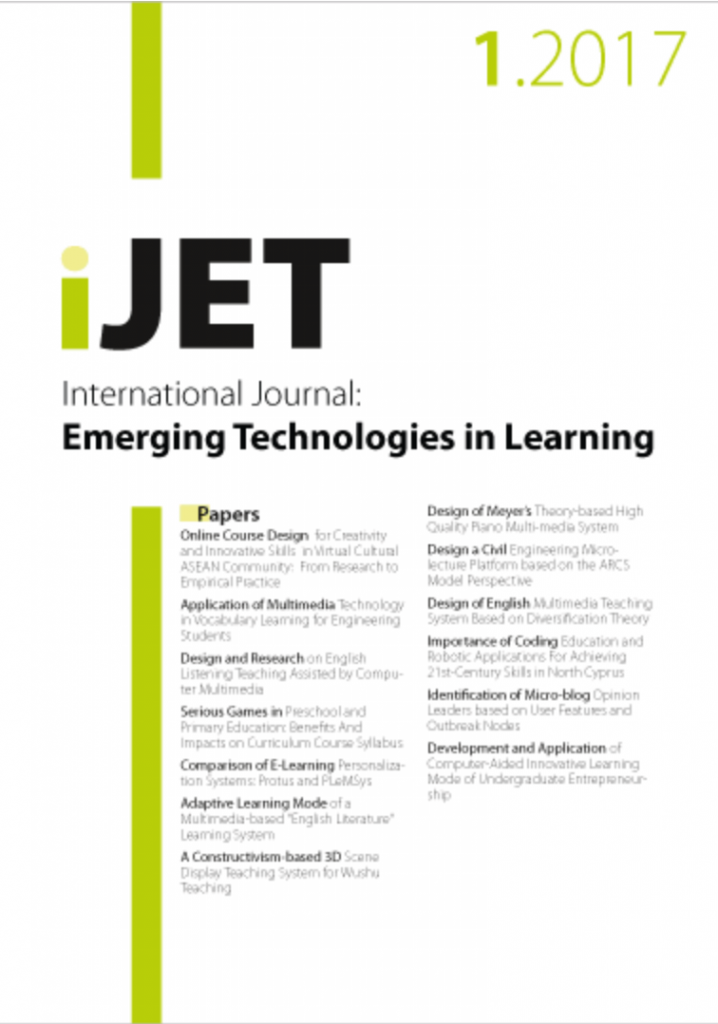
[ijet, journal] Journal of Emerging Technologies in Learning Vol. 13 / No. 6 #ijet #research

Issue 13(6) of our journal on emerging technologies for learning got published. Enjoy the readings as usual for free :-).

Table of Contents:

  • The Analysis of Digital Maturity of Schools in Croatia
  • Development of WebGL-based Virtual Teaching Platform for Mold Design
  • Improved Adaptive Genetic Algorithm for Course Scheduling in Colleges and Universities
  • MOOC Teaching Mode of News Transmission Based on Network Audio Data Decoding Technology
  • Information Communication Technology Use among Students in Inclusive Classrooms
  • Construction of Real-time Interactive Mode-based Online Course Live Broadcast Teaching Platform for Physical Training
  • Automatic Composition of Instructional Units in Virtual Learning Environments
  • Exploration and Practice on Course Teaching in Plastic Injection Mold
  • Students Acceptance of Google Classroom: An Exploratory Study using PLS-SEM Approach
  • Model of Incorporation of Emerging Technologies in the Classroom (MIETC)
  • A Teaching Model of Urban and Rural Planning Curriculum Integrating Virtual Simulation Technology
  • A Space Design Teaching Model Using Virtual Simulation Technology
  • Construction of Multifunctional Video Conversion-based Multimedia Teaching System for College Basketball
  • An Interaction Theory-based New Distance Teaching Model for Cross Talk
  • The Augmented Reality for Teaching Thai Students about the Human Heart
  • In MOOCs we Trust: Learner Perceptions of MOOC Quality via Trust and Credibility
  • Factors affecting Successful Implementation of eLearning: Study of Colleges and Institutes Sector RCJ Saudi Arabia

[Link to Issue 13/6]

Nevertheless, if you are interested to become a reviewer for the journal, please just contact me :-).

[publication] 1×1 Trainer with Handwriting Recognition

Our publication about „1×1 Trainer with Handwriting Recognition“ got published in the International Journal of Interactive Mobile Technologies (iJIM). We described our successful app, which has been firstly announced already here.

Abstract:

Nowadays, computers and mobile devices play a huge role in our daily routines; they are used at work, for private purposes and even at school. Moreover, they are used as support for different kinds of activities and task, like for example, learning applications. The interaction of these applications with a computer is based on predefined input methods, whereas a touchscreen facilitates direct input via handwriting by using a finger or a pen. This paper deals with the invention of a mobile learning application, which is supposed to facilitate children’s learning of simple multiplication. The aim of this paper is to collect the data of children’ experiences using interactive handwriting on mobile devices. In order to gain this data, a school class of the school “Graz-Hirten” was tested and afterwards for evaluational purposes interviewed. The results of these usability tests have shown that children perceived handwriting via finger on screen as quite positive.

[Full text @ ResearchGate]

[Full text @ iJIM]

Reference: Rabko, M., Ebner, M. (2018) 1×1 Trainer with Handwriting Recognition. International Journal of Mobile Technologies (iJIM). 12/2. pp. 69-79. https://doi.org/10.3991/ijim.v12i2.7714

[mooc] Gratis Online-Kurs zur Datenschutzgrundverordnung #DSGVO #imoox

Heute tritt die Datenschutzgrundverordnung in Europa in Kraft und hinterlässt bei vielen Anwenderinnen und Anwerndern offene Fragen. Es freut uns daher, dass es uns noch rechtzeitig gelungen ist, einen Online-Kurs (MOOC) zur Datenschutzgrundverordnung auf iMooX anzubieten. Einen herzlichen Dank gibt es neben dem vielen HelferInnen im Hintergrund vor allem auch Prof. Forgo von der Universität Wien der sich bereit erklärt hat, für die Lernvideos zur Verfügung zu stellen und in 9 Lektionen einen Überblick über die Eckpfeiler der Verordnung zu geben.
Der MOOC selbst richtet sich primär an Bedienstete von österreichischen Hochschulen ist aber grundsätzlich sehr allgemein gehalten. Darüber hinaus ist er zweisprachig, also sowohl auf deutsch als auch englisch verfügbar:

Hierbei handelt es sich um eine Basisschulung für Bildungseinrichtungen zur Datenschutz-Grundverordnung (DSGVO). Ab 25.05.2018 gilt die DSGVO und kommt zur Anwendung. Sie soll das Datenschutzrecht EU-weit vereinheitlichen und zu mehr Transparenz führen. Die DSGVO regelt unter anderem, wie die (ganz oder teilweise) automatisierte (= computerbasierte) Verarbeitung personenbezogener Daten dokumentiert werden muss. Die DSGVO ist nicht mit 25.05.2018 abgeschlossen sondern wird uns für die nächsten Jahre begleiten.

Die Schulung soll Ihnen eine überblickshafte Einführung in die rechtlichen Aspekte der DSGVO geben. Der iMoox Kurs beinhaltet neun kurze Einheiten zu je ca. 10 Minuten mit Folien und Kontrollfragen.

[Link zum Online-Kurs / gratis Anmeldung]