Die Folien zu meiner heutigen Keynote bei der Moodle Moot in Lübeck sind nun online verfügbar. Wie immer freue ich mich über Rückmeldungen:
Klicken Sie auf den unteren Button, um den Inhalt von www.slideshare.net zu laden.

Digitale Lehre an und rund um der Technischen Universität Graz
Die Folien zu meiner heutigen Keynote bei der Moodle Moot in Lübeck sind nun online verfügbar. Wie immer freue ich mich über Rückmeldungen:
Klicken Sie auf den unteren Button, um den Inhalt von www.slideshare.net zu laden.
Our publication about „Leveraging Learning Analytics in a Personal Learning Environment using Linked Data“ for the Bulletin of the Technical Committee on Learning Technology is now online available.
Abstract:
We report on the reflection of learning activities and revealing hidden information based on tracking user behaviors with Linked Data. With in this work we introduce a case study on usage of semantic context modelling and creation of Linked Data from logs in educational systems like a Personal Learning Environment (PLE) with focus on reflection and prediction of trends in such systems. The case study demonstrates the application of semantic modelling of the activity context, from data collected for over two years from our own developed widget based PLE at Graz University of Technology. We model learning activities using adequate domain ontologies, and query them using semantic technologies as input for visualization which serves as reflection and prediction medium as well for potential technical and functional improvements like widget recommendations. As it will be shown, this approach offers easy interfacing and extensibility on technological level and fast insight on trends in e-learning systems like PLE.
Reference: Softic, S., De Vocht, L., Taraghi, B., Ebner, M., Mannes, E. Van Der Walle, R. (2014) Leveraging Learning Analytics in a Personal Learning Environment using Linked Data, Bulletin of the Technical Committee on Learning Technology, Volume 16, Issue 4, pp. 10-13
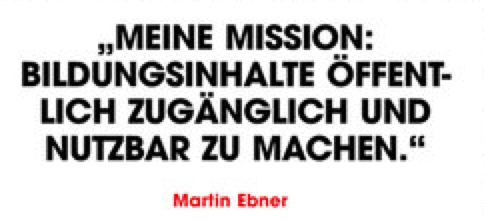 … so zitiert mich das neue MediaMagazin des Mediamarktes in der Ausgabe 01/2015. Auch haben Sie das Interview abgedruckt, welches bereits Ende letzten Jahres im Saturn Magazin war. Ich hoffe, dass dadurch weitere Bevölkerungsteile auf uns bzw. iMooX aufmerksam werden und sich daran beteiligen.
Hier geht es zur [Online Version] des Magazin und hier zur [.pdf Version]
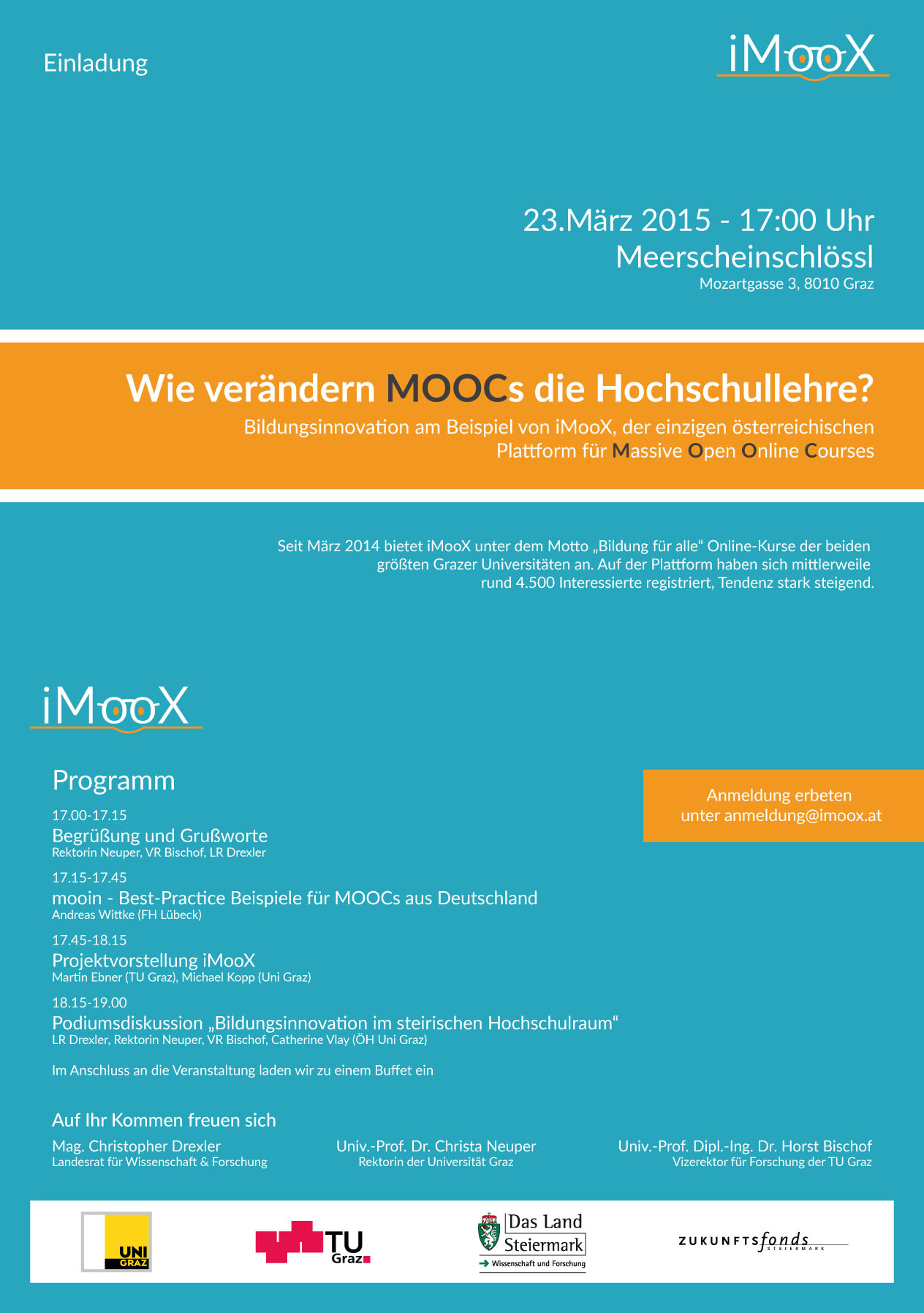
Es freut uns sehr, dass wir am 23.3.2015 zu einen Symposium rund um unsere iMooX Initiative laden können. Nicht nur, dass das Land Steiermark und die Leitungsebenen mit uns über die Möglichkeiten von MOOCs in der Hochschullehre diskutieren, es hat uns auch Andreas Wittke zugesagt einen externen Input und die Sicht aus Deutschland einzubringen. Die Veranstaltung ist kostenlos, bitte einfach kurz unter anmeldung@imoox.at anmelden.
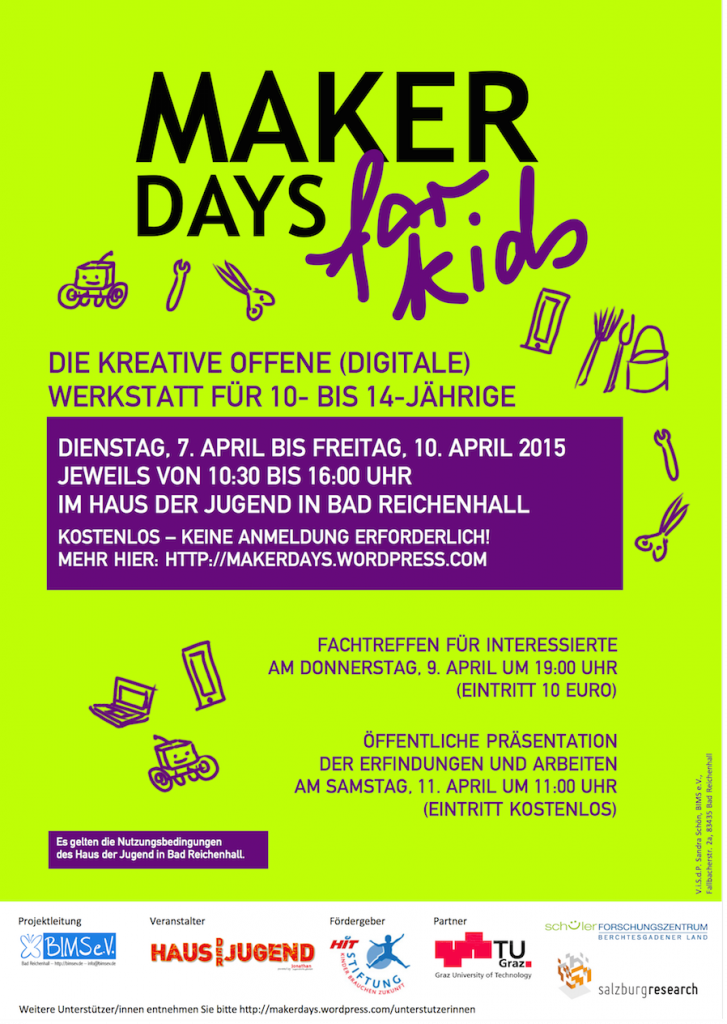
Unter der Leitung des BIMS e.V. finden vom 7.April 2015 – 10.April 2015 die ersten deutschen Makerdays für Kinder statt. Wir freuen uns zusammen mit vielen anderen als Kooperationspartner dabei sein zu dürfen und laden auch hiermit viele Kinder ein mitzumachen.
Also hinkommen und mitmachen, es wird sicher lustig, interessant, kreativ, spannend, und, und, …
Due to our strong research in technology enhanced learning and beyond at Graz University of Technology the „Center for Research in Computer Science on Teaching and Learning (CCSTL)“ has been founded. Here all activities in the area of computer science in relation to teaching and learning are listed as well as all groups working on it.
My contribution is mainly to the „e-Learning Software Development Group“ which follows the idea to develop software, bring it to the learner, gather experiences and redevelop according to their needs.
The group concentrates its research activity on
- Novel architectural and technological solutions for e-Learning such as Ajax, Reverse Ajax, Cloud Computing, Web Services, Content Delivery, WEB API and similar.
- Educational content authoring, structuring and reusing such as eBooks, Semantic & Logical Hypermedia Composites, SCORM, etc.
- New eLearning scenarios such as Life Long Learning, MOOCs and training on the working place.
Im Rahmen des Seminars „AK Technology Enhanced Learning“ haben wir unter anderem vier Kapitel von L3T behandelt. Als Seminararbeit wurde die Aufgabe gestellt, die im Kapitel vorhandenen Übungsfragen zu beantworten. So haben wir nun ein Ergebnis für die Kapitel „Bildungstechnologien im Sport„, „Game-Based Learning„, „Multimediale und interaktive Materialien“ und „Technologieeinsatz in der Schule“ vorliegen, welches wir gerne teilen:
Klicken Sie auf den unteren Button, um den Inhalt von www.slideshare.net zu laden.
We got an invitation to introduce iMooX at the 3rd SIG meeting of Eduhub. Here you can find the whole program of the meeting:
In the 3rd SIG meeting we will focus on MOOC platforms. We will discuss questions such as the aspects that need to be considered when choosing a MOOC platform. We will compare existing MOOC platforms concerning their features and costs. Privacy issues in MOOCs are also a topic that we will look at: Who owns the data and what is done with it? In a final step we will consider questions such as creating a SwissMOOC platform in terms of benefits and costs, and discuss a possible “MOOCization” of existing LMS such as Moodle.
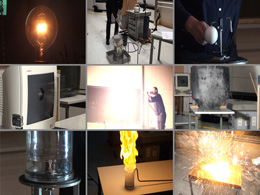 Es freut uns, dass wir einen weiteren neuen iMooX-MOOC „Aha-Erlebnisse aus der Experimentalphysik Teil 2“ ankündigen können. Damit setzen wir den bereits erfolgreich gelaufenen Online Kurs fort und können schon so viel verraten, dass es wieder weitere hoch spannende physikalische Experimente gibt:
Für ein ausgewähltes Publikum wurde im Sommer 2014 eine speziell hierfür entwickelte Experimentalvorlesung abgehalten, in deren Rahmen 40 Experimente aus unterschiedlichen Gebieten der Experimentalphysik gezeigt wurden. Unter den Titeln „Beschleunigte Körper“, „Brennbare Gase“, „Hochspannung“ und „Vakuum“ wurden für den hier angebotenen Kurs Experimente ausgewählt, mithilfe derer die zugrundeliegende Physik anschaulich dargestellt und erklärt wird.
Also dann gleich hier anmelden 🙂
Nachdem ich leider die fünfte Einheit krankheitsbedingt absagen musste, war die letzte Einheite quasi eine doppelte. Wir beschäftigten uns im Seminar „Ausgewählte Kapitel aus Technology Enhanced Learning“ diesemal mit Interaction Design. Hier die Folien zu den Gruppenarbeiten:
Klicken Sie auf den unteren Button, um den Inhalt von www.slideshare.net zu laden.