
Ein von mir vertretene These ist nachwievor, dass die großen Sozialen Netzwerke erst dann wirklich genutzt werden, wenn ein entsprechendes mobiles Gerät (meistens eben ein Mobiltelefon) vorhanden ist. Also dass erst durch das ubiquitäre Dabeisein, ständig-on-sein usw. tatsächlich Mehrwerte in der Nutzung entstehen können.
Diese Grafik über mehrer Umfragen untermauert dies eigentlich ganz gut:
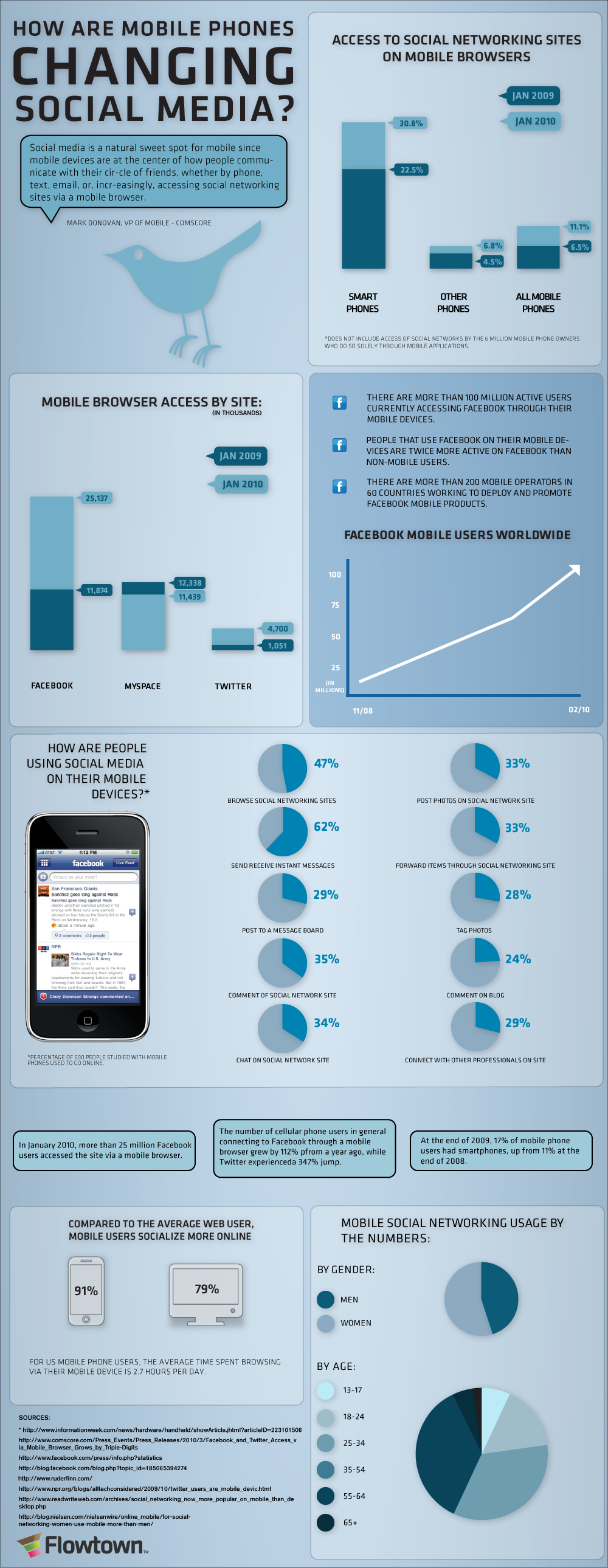
(via Flowtown)
[publication] M-Learning in the Field
Our publicaton „M-Learning in the Field: A Mobile Geospatial Wiki as an Example for Geo-Tagging in Civil Engineering“ pulblished in the book „Looking Toward the Future of Technology-Enhanced Education“ is as Draft Version online available.
Abstract:
In subjects such as Civil Engineering, Architecture, Geology etc., education is mostly based on visual information. For example, in Civil Engineering every building can be seen as a unique object at a certain location. During the education of Civil Engineers many field based studies and excursions take place, however, not only the images but also geographical coordinates are essential. Wikis have been in use for collaborative learning for more than ten years. Mobile phones provide access to them from nearly everywhere. The availability of those technologies has led to rapid advances in the area of m-Learning and the possibility to apply challenging constructive educational concepts. Consequently, in this paper we describe the user centered design, development and evaluation of a combination of these technologies to support collaborative learning in the field: A Wiki-based mobile geospatial information system, the so-called TUGeoWiki. The primary objective of this geowiki is to provide a user-friendly tool for mobile collaborative learning for all areas where geo-tagged information could be useful. Moreover, TUGeoWiki was developed in order to provide the integration of external map material via map APIs including information such as that delivered by Google maps. Subsequently, it is possible to provide both highly detailed maps and satellite images without having the need to license such material. Furthermore, the user interfaces used by such tools is well established, due to the increasing number of mapping related mashups. The evaluation during an extensive field test within a large civil engineering excursion to various large-scale construction sites in Austria demonstrated that collaborative learning can be successfully supported by the application of a geowiki.
Reference: Safran, C., Ebner, M., Kappe, F., Holzinger, A. (2010), M-Learning in the Field: A Mobile Geospatial Wiki as an Example for Geo-Tagging in Civil Engineering, In: Looking Toward the Future of Technology-Enhanced Education, Ebner. M & Schiefner, M. (Ed.), IGI Global, Hershey, pp. 263 – 274
[video] The Elements For iPad
Ein weiteres, sehr gutes eBook ist als iPad App aufgetaucht: Das Periodensystem der Elemente unglaublich schön und anschaulich dargestellt.
[video] Alice for iPad
Wieder eine Idee, wie ein innovatives eBook am iPad aussehen könnte:
[podcast] Is Twitter an Individual Mass Communication Medium?
The podcast of Walther’s talk „Is Twitter an Individual Mass Communication Medium?“ at this year SITE conference is now online available. Presentation and publication are already published.
[publication] Teaching and Learning in Higher Education – An Integral Approach
Our publication about „Teaching and Learning in Higher Education – An Integral Approach“ at this year SITE Conference is now online available:
The presentation has already been published.
Reference: Ebner, M., Scerbakov, N., Taraghi, B., Nagler, W. & Kamrat, I. (2010). Teaching and Learning in Higher Education – An Integral Approach. In C. Crawford et al. (Eds.), Proceedings of Society for Information Technology & Teacher Education International Conference 2010 (pp. 428-436). Chesapeake, VA: AACE.
So, der iPad ist also erhältlich …
Das Netz überschlägt sich ja mit Meldungen, dass der iPad in den Staaten endlich verkauft wird und sich riesige Massen an Personen vor den Apple Geschäften anstellen [Link futurezone].
Kaum sind die Geräte erhältlich tauchen die ersten Testberichte auf, die durchaus erste Einschätzungen zulassen – und ich bleibe dabei, der iPad hat ein großes Potential für den e-Learning Bereich und wird speziell m-Learning Aktivitäten neue Möglichkeiten bieten:
- iPad App Hands-on Reviews: Twitterific, Netflix, and ABC [VIDEO]
- Erste iPad-Testberichte
- Hands-on with the Apple iPad: Groundbreaking or not, it’s still amazing
- Magic Piano for iPad Is Music to Our Ears [Video Review]
- Einen Tag hat es gedauert bis das Gerät gehackt wurde: Video über das Jailbreak des iPad
- iPad Day In Numbers: 300k Devices Sold, 1 Million Apps And 250k iBooks Downloaded
Twitter Articles / Posts
Tony Karrer posted an interesting Blog post about Twitter – enjoy:
Twitter for Learning – 55 Great Articles : eLearning Technology
[Vorlesung] iPhone Application Development
 Wir bieten ab diesem Sommersemester iPhone Application Development im Rahmen der Vorlesung AK Medientechnologien an der TU Graz an:
Die Lehrveranstaltung ‚AK Medientechnologies‘ (Advanced Topics of Media Technologies) beschäftigt sich mit der Applikationsentwicklung auf mobilen Geräten am Beispiel des iPhones.
Hierzu wird eine überblicksmäßige Einführung in die Software-Entwicklung für das iPhone OS gegeben. Studierende sollen nach diesem „Crashkurs“ die Möglichkeit haben, sich selbst in den Entwicklungswerkzeugen zurecht zu finden, selbst die für die Softwareentwicklung weiterführende Dokumentation zu finden, und selbst Software für iPhone OS zu entwickeln und zu verteilen.
Auf iTunesU sind bereits alle Vorlesungsfolien online, die Aufzeichnungen werden folgen.
[lecture slides] iPhone – Human Interface Guidelines
My lecture slides for this year lecture on iPhone Application Development are now online available:
iPhone – Human Interface Guidelines
View more presentations from Martin Ebner.