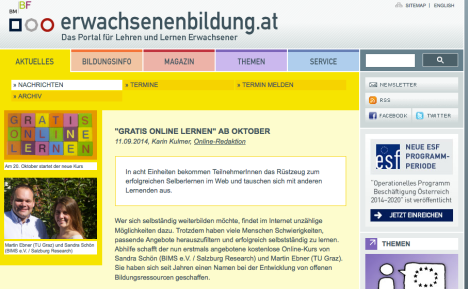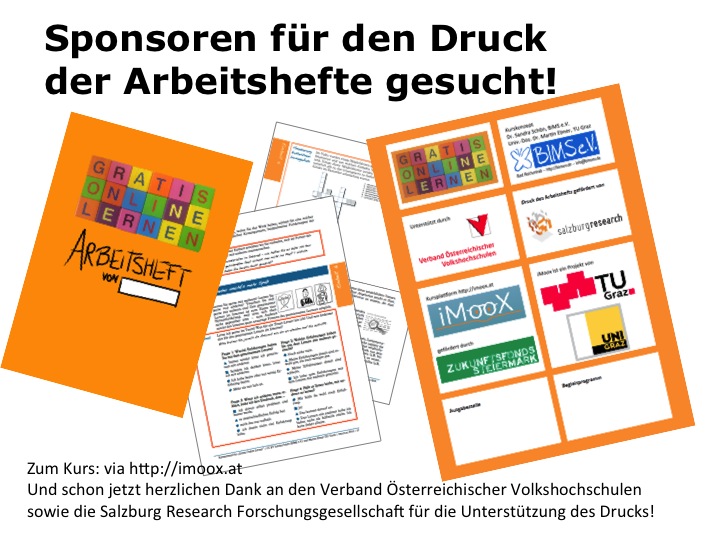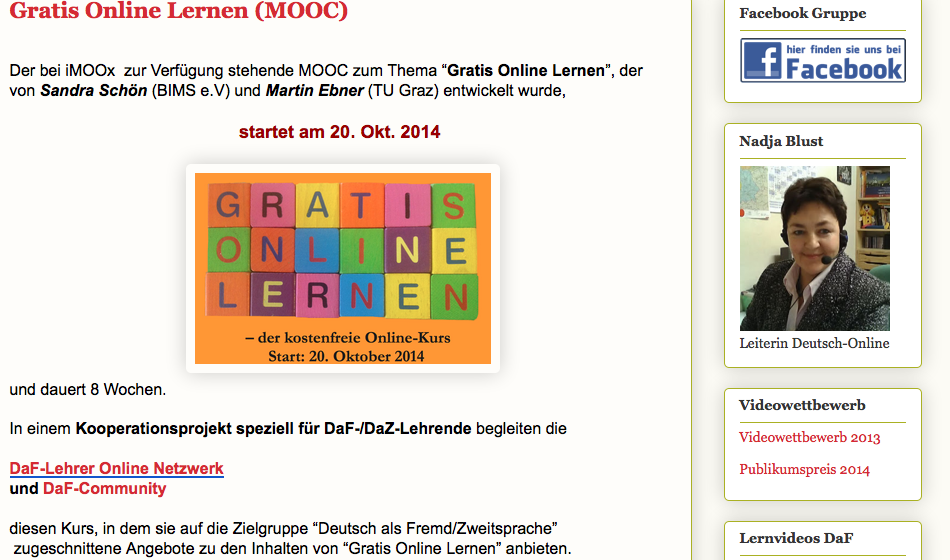
[GOL14] Unser MOOC „Gratis Online Lernen“ braucht eure Unterstützung :-)

gol14_ankuendigung

So, der Kurs „steht“ zwar noch nicht komplett, aber die Videos sind seit Ostern „im Kasten“ – und wir intensivieren unsere Suche nach Unterstützer/innen …. [zum Google Doc mit allen aktuellen! Informationen]

[publication] Markov Chain and Classification of Difficulty Levels Enhances the Learning Path in One Digit Multiplication

Our second publication at this year HCII conference in Crete, Greece is about „Markov Chain and Classification of Difficulty Levels Enhances the Learning Path in One Digit Multiplication„.
Abstract:

In this work we focus on a specific application named “1×1 trainer” that has been designed to assist children in primary school to learn one digit multiplications. We investigate the database of learners’ answers to the asked questions by applying Markov chain and classification algorithms. The analysis identifies different clusters of one digit multiplication problems in respect to their difficulty for the learners. Next we present and discuss the outcomes of our analysis considering Markov chain of different orders for each question. The results of the analysis influence the learning path for every pupil and offer a personalized recommendation proposal that optimizes the way questions are asked to each pupil individually.

Markov Chain and Classification of Difficulty Levels Enhances the Learning Path in One Digit Multiplication… by Martin

Klicken Sie auf den unteren Button, um den Inhalt von www.scribd.com zu laden.

Inhalt laden

Reference: Taraghi, B., Saranti, A., Ebner, M., Schön, M. (2014) Markov Chain and Classification of Difficulty Levels Enhances the Learning Path in One Digit Multiplication. Learning and Collaboration Technologies. Designing and Developing Novel Learning Experiences. Panayiotis, Z., Ioannou, A. (Ed.), Springer Lecture Notes, pp. 322-322

[publication] Attention Profiling Algorithm for Video-based Lectures

Our first publication at this year HCII conference in Crete, Greece about „Attention Profiling Algorithm for Video-based Lectures“ is now online available as prelimiary version. The slides are already published here.
Abstract:

Due to the fact that students‘ attention is the most crucial resource in a high-quality course it is from high importance to control and analyze it. This could be done by using the interaction and the communication because they are known as valuable influencing factors of the attention. In this publication we introduce a web-based information system which implements an attention-profiling algorithm for learningvideos
as well as live-broadcastings of lectures. For that different methods of interaction are offered and analyzed. The evaluation points out that the attention profiling algorithm delivers realistic values.

Attention Profiling Algorithm for Video-based Lectures by Martin

Klicken Sie auf den unteren Button, um den Inhalt von www.scribd.com zu laden.

Inhalt laden

Reference: Wachtler, J., Ebner, M., Taraghi, B. (2014). Attention Profiling Algorithm for Video-based Lectures. Learning and Collaboration Technologies. Designing and Developing Novel Learning Experiences. Panayiotis, Z., Ioannou, A. (Ed.), Springer Lecture Notes, pp. 358-367

[recording] Big Data – Wie gut kann und sollte ich meine Nutzer kennen?

Die Aufzeichung vom 11.05.2014 aus der heurigen Vorlesung „Gesellschaftliche Aspekte der Informationstechnologie“ sind nun verfügbar. Aus technischen Gründen wurde mein Vortrag zu freien Bildungsressourcen nicht aufgezeichnet, aber dazu gibt es bereits hier einen ähnlichen Vortrag.

  1. Martin Gersch: Big Data: wie gut kann und sollte ich meine Nutzer kennen?
  2. Klicken Sie auf den unteren Button, um den Inhalt von curry.tugraz.at zu laden.

    Inhalt laden

[publication] The Maker Movement. Implications of new digital gadgets, fabrication tools and spaces for creative learning and teaching

Together with Swapna Kurma and Sandra I did an short intrdocution to the increasing maker movement which was published right now: „The Maker Movement. Implications of new digital gadgets, fabrication tools and spaces for creative learning and teaching„.

The “Maker Movement” deals with innovative forms of production and do-it-yourself work. It is not only a way for new business models and developments, e.g. using 3D print or other new digital tools and gizmos, but also influencing education. This paper introduces several diverse terms (from FabLabs to Hackerspaces) and gives insights into background, practice and existing experiences from Maker Movement in educational settings amongst all age groups. As a conclusion, the authors present reasons why practitioners and researcher should consider its educational potential. Besides its creative and technological impacts, learning by making is an important component of problem-solving and relating educational content to the real world. Besides this, digital tools for making are not expensive, for example apps for mobile devices or rents for 3D printer (compared with desktops in 1:1 settings). The Maker Movement is seen as an inspiring and creative way to deal with our world, it is aware of ecological challenges and of course, and it is able to develop technological interest and competences casually.
Finally, the authors give recommendation for reading for all who got interested in making.

Bildschirmfoto 2014-07-04 um 23.16.56
Reference: Schön, Sandra; Ebner, Martin & Kurma, Swapna (2014). The Maker Movement. Implications of new digital gadgets, fabrication tools and spaces for creative learning and teaching. In: eLearning Papers, 39, July 2014, pp.14-25., URL: https://www.openeducationeuropa.eu/en/article/Learning-in-cyber-physical-worlds_In-depth_39_2?paper=145315

[publication] Learning Analytics: From Theory to Practice – Data Support for Learning and Teaching

Our contribution at this year International Computer Assisted Assessment Conference (CAA 2014) about „Learning Analytics: From Theory to Practice – Data Support for Learning and Teaching“ is now online available.
Abstract:

Much has been written lately about the potential of Learning Analyt- ics for improving learning and teaching. Nevertheless, most of the contributions to date are concentrating on the abstract theoretical or algorithmic level, or, deal with academic efficiencies like teachers’ grading habits. This paper wants to fo- cus on the value that Learning Analytics brings to pedagogic interventions and feedback for reflection. We first analyse what Learning Analytics has to offer in this respect, and, then, present a practical use case of applied Learning Analytics for didactic support in primary school Arithmetic.

Learning Analytics: From Theory to Practice – Data Support for Learning and Teaching by Martin

Klicken Sie auf den unteren Button, um den Inhalt von www.scribd.com zu laden.

Inhalt laden

Reference: Greller, W., Ebner, M., Schön, M. (2014) Learning Analytics: From Theory to Practice – Data Support for Learning and Teaching. In: Computer Assisted Assessment. Kalz, Marco, Ras, Eric (Eds.) -Research into E-Assessment, Communications in Computer and Information Science Volume 439, 2014, pp 79-87. Springer, New York

[presentation] Learning Analytics in Math – Why Open Education?

Marieke asked me if I can give a short input for the Open Education Working Group about aspects of Open Education for Learning Analytics. Here you will find the event and this are the slides I will use for the short talk:

Klicken Sie auf den unteren Button, um den Inhalt von www.slideshare.net zu laden.

Inhalt laden

[presentation] Learning Analytics: From Theory to Practice – Data Support for Learning and Teaching

Our presentation (done by Martin) at this year International Computer Assisted Assessment Conference (CAA 2014) about „Learning Analytics: From Theory to Practice – Data Support for Learning and Teaching“ is now online available.

Klicken Sie auf den unteren Button, um den Inhalt von www.slideshare.net zu laden.

Inhalt laden

[presentation] Finding and Exploring Commonalities between Researchers Using the ResXplorer

Our presentation at this year HCII Conference in Crete, Greece about „Finding and Exploring Commonalities between Researchers Using the ResXplorer“ is now online available – enjoy the slides 🙂

Klicken Sie auf den unteren Button, um den Inhalt von www.slideshare.net zu laden.

Inhalt laden

[presentation] Markov Chain and Classification of Difficulty Levels Enhances the Learning Path in One Digit Multiplication

Beni did the presentation about „Markov Chain and Classification of Difficulty Levels Enhances the Learning Path in One Digit Multiplication“ at this HCII conference in Creete, Greece. Here are his slides:

Klicken Sie auf den unteren Button, um den Inhalt von www.slideshare.net zu laden.

Inhalt laden