We gave a presentation at the Game4Change multiplier event in Maribor about „How Learning Analytics, Gamification and beyond can contribute to Online Learning„.
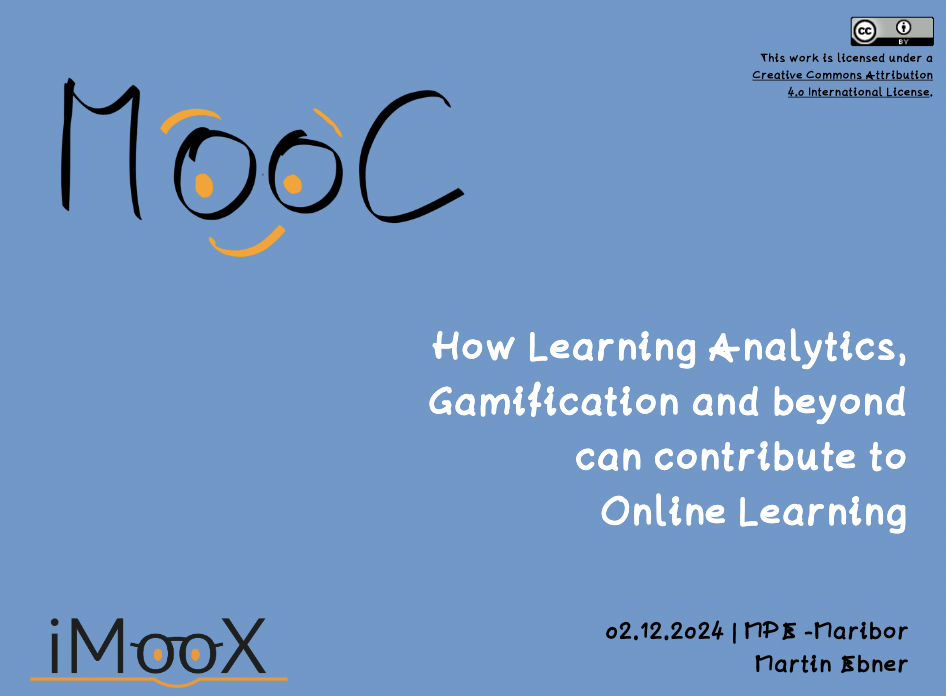
Find here my slides online.

Digitale Lehre an und rund um der Technischen Universität Graz
Veröffentlichungen zu jeweiligen Thema
We gave a presentation at the Game4Change multiplier event in Maribor about „How Learning Analytics, Gamification and beyond can contribute to Online Learning„.
Find here my slides online.
Es freut uns, dass wir ankündigen können, dass die TU Graz nächstes Jahr am 13.5.2025 eine Partnerbühne für das University Future Festival anbieten wird. Wir haben dazu das Thema „KI-Applikationen an der Hochschule“ gewählt und der Call for Participation ist bis 20.1.2025 geöffnet.

Wir freuen uns auf viele Interessierte die sich live vor Ort mit uns austauschen wollen, wir werden versuchen ein tolles Programm zusammenzustellen.
 Issue 19(08) of our journal on emerging technologies for learning got published. Enjoy the readings as usual for free :-).
Table of Contents:
Nevertheless, if you are interested to become a reviewer for the journal, please just contact me 🙂 .
Ich bin gebeten worden einen Gastbeitrag für APA-Science zu machten unter der Überschrift KI in der Bildung und folgenden Gedanken:
Anwendungen, die von KI-unterstützt werden, sind im Alltag angekommen und damit natürlich auch im Lehr- und Lernbetrieb der Hochschulen. Selbstverständlich sind damit neue Herausforderungen verbunden, Risiken, aber auch Chancen und Potenziale.
[Originalbeitrag bei APA-Science]
[.pdf @ ResearchGate]
Zitation: Ebner, M. (2024) Die Vielfalt des Einsatzes von KI im Lehr- und Lernalltag ist (fast) unbegrenzt, aber … , APA-Science, online am 23.10.24, https://science.apa.at/power-search/6531323553575723843
Für die Ausgabe Pädagogik 10/24 wurden wir angefragt für einen kurzen Beitrag zu „Didaktik und Praxis der Maker Education„
Abstract:
Die Maker Education eröffnet neue Lernmöglichkeiten und vielfältige Potenziale. Dabei muss es nicht immer gleich der neu eingerichtete, voll ausgestattete Makerspace sein, in dem die Schüler*innen projektorientiert und fächerverbindend arbeiten.
[Link zum Originalartikel]
[Draft @ ResearchGate]
Zitation: Hannah Bunke-Emden, Kristin Narr, Sandra Schön, Didaktik und Praxis der Maker Education (21.10.2024), Pädagogik 10/24. Beltz Verlagsgruppe, 69 469 Weinheim, ISSN: 0933-422X, 2024 #10, S.12-15
Our publication at this year’s E-Learn conference about „Distance Learning in Times of COVID-19 at Austrian Schools: A Rapid Systematic Literature Review“ is available online.
Abstract:
The COVID-19 pandemic has had a profound impact on the Austrian education system, necessitating an abrupt shift to distance learning and triggering a reassessment of digital education strategies. This rapid literature review examines the challenges faced by students in Austria during this time. The synopsis of 7 selected reports revealed six key themes: communication dynamics between students and teachers, availability of communication tools, adequacy of technical equipment, importance of self-regulated learning (SRL) strategies, barriers to the transition to distance learning, and high workload. Despite challenges, including a notable gender gap in communication skills and a digital divide in technology, students and teachers have adapted to new learning modalities. The findings highlight the essential role of effective communication, strategic integration of digital tools, and the importance of promoting SRL to improve student engagement, learning outcomes, and psychological well-being in distance learning contexts. The transition has not only highlighted the demand for resilience and adaptability from all education stakeholders but has also pointed to future opportunities to refine and enhance digital learning scenarios to ensure a more inclusive, effective, and engaging learning experience for students in Austria and beyond.
Citation: Brünner, B., Ebner, M. & Burgsteiner, H. (2024). Distance Learning in Times of COVID-19 at Austrian Schools: A Rapid Systematic Literature Review. In C. Bonk & G. Marks (Eds.), Proceedings of E-Learn: World Conference on E-Learning in Corporate, Government, Healthcare, and Higher Education (pp. 544-549). Singapore, Singapore: Association for the Advancement of Computing in Education (AACE). Retrieved October 14, 2024 from https://www.learntechlib.org/primary/p/225045/
We are very happy to invite submissions to the special issue “Applications of Digital Technology and AI in Educational Settings” in Applied Sciences (ISSN 2076-3417), part of the “Computing and Artificial Intelligence” section. This special issue explores the innovative uses of digital tools and artificial intelligence in enhancing education.
Submission Deadline: 20 March 2025
For more information and to submit your manuscript, visit the MDPI Special Issue Page.
Issue 19(07) of our journal on emerging technologies for learning got published. Enjoy the readings as usual for free :-).
Table of Contents:
Nevertheless, if you are interested to become a reviewer for the journal, please just contact me 🙂 .
At this years‘ EDEN conference we made a publication titled „Should Universities partner with NGOs? A Case Study of a University of Technology and a Coding School for Refugees„
Abstract:
This paper explores the advantages of a University-NGO Partnership between the Faculty of Informatics at Vienna University of Technology (TU Vienna) and the NGO „refugees{code}-, a coding school for refugees in Vienna, Austria. The goal of this collaboration is twofold: Firstly, to help students apply coding skills practically and enhance their proficiency through teaching experiences with underrepresented groups; and secondly, to provide refugees with meaningful activities that match their profession, education, and personal interests, which might have been interrupted in their home countries. The study evaluates the perspectives of the stakeholders involved. To do so, written surveys and interviews with computer science students, refugees and team members of the NGO were conducted. The results indicate that meaningful educational benefits for computer science students can be created within such partnerships, such as enhanced teaching abilities, dispelled prejudices, insights into the factors affecting refugees‘ educational and career trajectories, as well as improved communication and empathy skills. However, challenges for such partnerships also exist, including giving student teachers more time for meetings and discussions, empowering them to make decisions, providing access to counseling psychologists and interpreters, and offering support in managing participants‘ expectations. The findings shed light on the potential benefits from participating in campus-community partnerships and suggest several measures to improve them, such as providing additional ECTS credits, intensifying promotional activities to encourage greater student participation, providing alumni support, and issuing official certificates.
[article @ proceeding’s homepage]
[article @ ResearchGate]
Citation: Wolf, D. and Ebner, M. (2024) ‘Should Universities partner with NGOs? A Case Study of a University of Technology and a Coding School for Refugees’, Ubiquity Proceedings, 4(1), p. 36. Available at: https://doi.org/10.5334/uproc.158.
We made a contribution about our outcomes of the European alliance titled „Usage of (federated) Learning Management Systems in European University Alliances„
Abstract:
In today’s rapidly evolving educational landscape, European universities are increasingly relying on digital technologies for collaboration and learning. European Universities, as transnational alliances, aim to reshape higher education by fostering academic exchange and innovation across borders. With over 40 alliances in existence, enhancing virtual mobility and exchange through interconnected learning infrastructures has become imperative. This paper provides insights into Learning Management System (LMS) adoption within European alliances, focusing on the Unite! alliance as a case study. While Unite! demonstrates successful implementation of Moodle as its central LMS, challenges persist in achieving uniformity across all partners. A desktop analysis of European alliances reveals that Moodle might be the most often used LMS in February 2023. A description of the LMS implementation within the Unite! analysis shows as well that a majority uses Moodle – at least as a second LMS. So, although the decision for a federated LMS based on Moodle might be the right one, these results as well indicate the need for tailored technical solutions for future developments for some partners and disparities in lecturers‘ and students‘ concerning a Moodle so that pre-emptive measures to ensure equitable participation are important. Despite these challenges, Unite!’s experience underscores the potential of Moodle as a widely adopted platform, prompting further exploration into solutions like LTI integration.
[article @ proceeding’s homepage]
[article @ ResearchGate]
Citation: Ebner, M., Schön, S., Alcober, J., Bertonasco, R., Herczak-Ciara, A., Hoppe, C., Martikainen, J., Muchitsch, M., Petersson, J. and da Silva, F.M. (2024) ‘Usage of (federated) Learning Management Systems in European University Alliances’, Ubiquity Proceedings, 4(1), p. 37. Available at: https://doi.org/10.5334/uproc.159.