[L3T] L3T goes Learntec

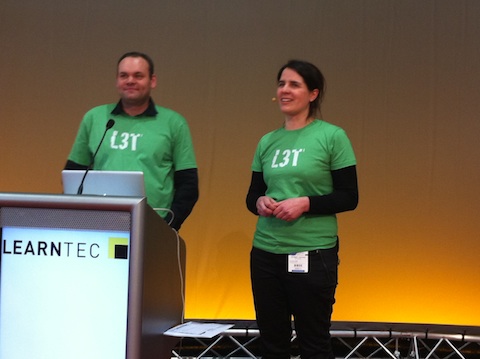
Es freut uns, dass wir etwas ankündigen können: Das Buch wird online am 1.2.2011 freigeschaltet und zwar live auf der großen E-Learning-Messe Learntec in Karlsruhe.
Wir überlegen auch eventuell einen Livestream von dort durchzuführen und hoffen eure Unterstützung auf den Sozialen Netzwerken, damit das Ereignis angemessen über die Bühne gebracht werden kann. Also den 1.2.2011 rot im Kalender vormerken – L3T GOES ONLINE.
Abstract:

Im Rahmen des Vortrags stellen wir das Projekt L3T vor. Mehr als 130 Autoren/innen, 80 Gutachter/innen und weitere Mitarbeiter/innen haben beigetragen, um ein Lehrbuch für Lernen und Lehren mit Technologien zu erstellen und online zur Verfügung zu stellen. Von der Idee, dem Call for Chapter Über die Zusammensetzung der Teams, dem Einreich- und Reviewprozess wird besonders aus dem Blickwinkel von Kollaboration und Kooperation gezeigt, wie sich das Projekt entwickelte und damit stark auf Werkzeuge und Methoden des Web 2.0 setzte. Am Ende der Präsentation werden die Kapitel des Lehrbuchs live online freigeschaltet und damit der Öffentlichkeit zur Verfügung gestellt. Weitere Informationen über das Projekt finden Sie unter https://l3t.tugraz.at

[vortrag] Wie verändern Neue Medien den Unterricht?

Es ist zwar noch einige Zeit hin, aber nachdem es schon eine Ankündigung gibt, will ich auch noch drauf hinweisen. Man hat mich gebeten für die Reihe Vita activa „Wissen schaffen“ einen Vortrag über e-Learning zu halten. Der vorgeschlagene Titel meinerseits lautet: Digitales Lehren und Lernen: Wie verändern Neue Medien den Unterricht? und findet am 4. April 2011 von 19.00 – 21.00 an der Universität Graz im Zentrum für Weiterbildung statt.
Hier gibt es die detaillierte Einladung.

[publication] iPhone/iPad Human Interface Design

Our workshop proposal on „iPhone/iPad Human Interface Design“ held at the 6th Symposium (USAB 2010) of the Workgroup HCI&UE of the Austrian Computer Society in Carinthia (Southern Austria) is now online. The slides are already available here and also a short video summary.

Abstract:

In this tutorial, we will present the Human Interface Guidelines for both iPhone and iPad and offer hands-on experience in designing user interfaces for these devices. We will also discuss how to integrate the guidelines in higher education and give examples from our lecture on iPhone application development. The goal of the tutorial is to provide the participants with a basic understanding of the iPhone Human Interface Guidelines and enable them to review and design iPhone apps according to the standards.

Reference: Ebner, M.; Kolbitsch, J.; Stickel, C. (2010) iPhone / iPad Human Interface Design. – in: Human-Computer Interaction in Work & Learning, Life & Leisure, pp. 489 – 492

[publication] The XAOS Metric – Understanding Visual Complexity as measure of usability

Our publication about „The XAOS Metric – Understanding Visual Complexity as measure of usability“ held at the 6th Symposium (USAB 2010) of the Workgroup HCI&UE of the Austrian Computer Society in Carinthia (Southern Austria). The slides are already available here.

Abstract:

The visual complexity of an interface is a crucial factor for usability, since it influences the cognitive load and forms expectations about the subjacent software or system. In this paper we propose a novel method that uses entropy, structure and functions, to calculate the visual complexity of a website. Our method is evaluated against a well known approach of using the file size of color jpeg images for determining visual complexity. Both methods were applied on a dataset consisting of images of 30 different websites. These websites were also evaluated with a web survey. We found a strong correlation for both methods on subjective ratings of visual complexity and structure. This suggests both methods to be reliable for determination of visual complexity.

Reference:Stickel, C.; Ebner, M.; Holzinger, A. (2010) The XAOS Metric: Understanding Visual Complexity as measure of usability. Springer Lecture Notes in Computer Science LNCS 6389. – in: Human-Computer Interaction in Work & Learning, Life & Leisure, Lecture Notes in Computer Science LNCS 6389., pp. 278 – 290

[sem1p] Präsentation über Präsentation

Beim 6. und letzten Online Meeting des Seminars „eModeration“ haben wir über allgemeine Präsentationsregeln geredet. Die Slides sind nun online.
Damit ist die Online Phase auch beendet und wir freuen uns auf die abschließende Präsenzveranstaltung. Zusammenfassend sei festgehalten, dass es wie immer sehr schwer war in den Online Meetings die technischen Hürden zu meistern, aber wir denken es ist nach einiger Eingewohnung gut gelaufen.

Bisherige Unterlagen: