Das IJAB-Journal hat mich angefragt um einen Kurzbeitrag rund um die Situation des digitale Lernen gerade in der CoVid19-Situation. Herausgekommen ist dieser kurze Artikel.
Gerade in diesen Tagen der COVID-19-Krise erfahren Schüler/-innen und Studierende aber auch Lehrkräfte eine Digitalisierung der Lehre in unvorhersehbarem Ausmaße. Mehr oder weniger über Nacht wurden Bildungseinrichtungen gezwungen die analoge, traditionelle Präsenzlehre einzustellen und auf „digitale Formate“ umzusteigen. Was für die formale Bildung gilt, gilt in diesem Fall auch für die non-formale Bildung sowie für Fort- und Weiterbildungen von Fachkräften der Jugendarbeit. Gelingen kann der digitale Umstieg nur mit einer Herangehensweise, die digitale und analoge Komponenten einbezieht.
We are very happy that our research study on „Higher Education Landscape 2030“ is now online available – published in Springer Briefs in Education via Open Access.
Abstract: This open access Springer Brief provides a systematic analysis of current trends and requirements in the areas of knowledge and competence in the context of the project “(A) Higher Education Digital (AHEAD)—International Horizon Scanning / Trend Analysis on Digital Higher Education.” It examines the latest developments in learning theory, didactics, and digital-education technology in connection with an increasingly digitized higher education landscape. In turn, this analysis forms the basis for envisioning higher education in 2030.Here, four learning pathways are developed to provide a glimpse of higher education in 2030: Tamagotchi, a closed ecosystem that is built around individual students who enter the university soon after secondary education; Jenga, in which universities offer a solid foundation of knowledge to build on in later phases; Lego, where the course of study is not a monolithic unit, but consists of individually combined modules of different sizes; and Transformer, where students have already acquired their own professional identities and life experiences, which they integrate into their studies. In addition, innovative practice cases are presented to illustrate each learning path.
Reference: Orr, D., Luebcke, M., Schmidt, J.P., Ebner, M., Wannemacher, K., Ebner, M., Dohmen, D. (2020) Higher Education Landscape 2030. A Trend Analysis Based on the AHEAD International Horizon Scanning. SpringerBriefs in Education. 978-3-030-44896-7
Abstract: This research is intended to answer the question, how are the students‘ perceptions of internet technology in learning and how is the acceptance of Padlet as a microblogging platform for writing skills in German language level A2-B1 CEFR standards for the student. In summary, 21 students within the range of 19-22 years participated, which consisted of 2 males and 19 females – data obtained through opened and closed questionnaires. The results of data analysis showed that students had positive perceptions using internet technology in learning. However, students cannot accept Padlet as a microbloggingplatform in learning German writing skills due to several factors that influence it. This research has an essential finding: before conducting online learning, lecturers have to consider internet availability and the adequacy of reviews to their smartphones as a learning infrastructure.
Reference: Kharis, Dameria, C. N., Ebner, M. (2020) Perception and Acceptance of Padlet as a Microblogging Platform for Writing Skills. In: International Journal of Interactive Mobile Technologies (iJIM). 14/13. pp. 213-220
We did a short publication about „Bridging the Gap: A Computer Science Pre-MOOC for First Semester Students“ and it was published now in the Electronic Journal of e-Learning.
Abstract: Knowledge in Computer Science (CS) is essential, and companies have increased their demands for CS professionals. Despite this, many jobs remain vacant. Furthermore, computational thinking (CT) skills are required in all contexts of problem solving. A further serious problem arises from the gender disparity in technology related fields. Even if tech companies want to hire women in technology, the number of women who enter these fields is remarkably low. In high schools with no technical focus, most teenagers acquire only low‑level skills in CS. The consequences are misleading preconceptions about the fundamental ideas of CS and stereotype‑based expectations. Consequently, many teenagers exclude computing from their career path. In this paper, two promising concepts to overcome these challenges are presented. In 2018, a voluntary gamified lecture “Design your own app”, held at the University of Graz for students of all degree programs, was introduced. The course attracted over 200 students and received positive evaluations. This led to the second concept. In January 2019, a MOOC (Massive Open Online Course) with the title “Get FIT in Computer Science” was designed and launched in August 2019 on the platform iMooX.at with the goal to provide a basic introduction to different concepts of CS, including programming and the application of game design strategies. The MOOC was accompanied by an offline lecture, following the principles of flipped classroom and inverse blended learning. For evaluation purposes, we collected data at three stages: 1) during the MOOC, 2) during the offline lecture, and 3) two months after the lecture. The results showed that the MOOC framework was a promising approach to support and motivate at least a certain group of first‑semester students, especially those who had no prior knowledge in CS.
Reference: Spieler, B., Grandl, M., Ebner, M., Slany, W. (2020) Bridging the Gap: A Computer Science Pre-MOOC for First Semester Students. In: Electronic Journal of e-Learning. 18 (3). pp. 248-260
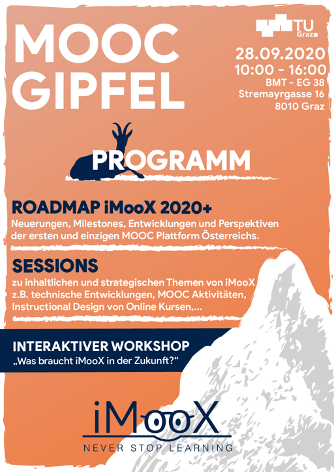
Jährlich findet im iMooX Headquarter in Graz ein Zusammenkommen aller iMooX-Partnerinnen und -Partner sowie MOOC-Erstellerinnen und -Ersteller im Rahmen eines MOOC-Gipfels statt. Bei dieser eintägigen Veranstaltung werden Erfahrungen mit den MOOCs und mit der Plattform iMooX ausgetauscht, eine Gelegenheit geboten andere Teilnehmer*innen kennenzulernen, sich zu vernetzen und mögliche Synergien zu schaffen. Das Gipfeltreffen bietet damit die Möglichkeit, einen aktiven Part in der Weiterentwicklung von iMooX zu spielen und ist einer ausgewählten Gruppe vorbehalten. Wir möchten Euch mit dem Blogeintrag einen Einblick und Rückblick auf den iMooX-MOOC-Gipfel geben und euch nochmals DANKE für die Teilnahme sagen!
Gestartet wurde der Gipfel mit einem exklusiven Preview zum aktuellen Stand der iMooX-Plattform. Im Rahmen dieser Roadmap-Präsentation wurde das neue Design der zukünftigen MOOC-Plattform vorgestellt und über strategische Ausrichtungen der Plattform gesprochen. Das Team hinter iMooX durfte vor den Vorhang treten und sich vorstellen, sodass eine persönliche Zusammenarbeit in Zukunft noch besser funktionieren kann.
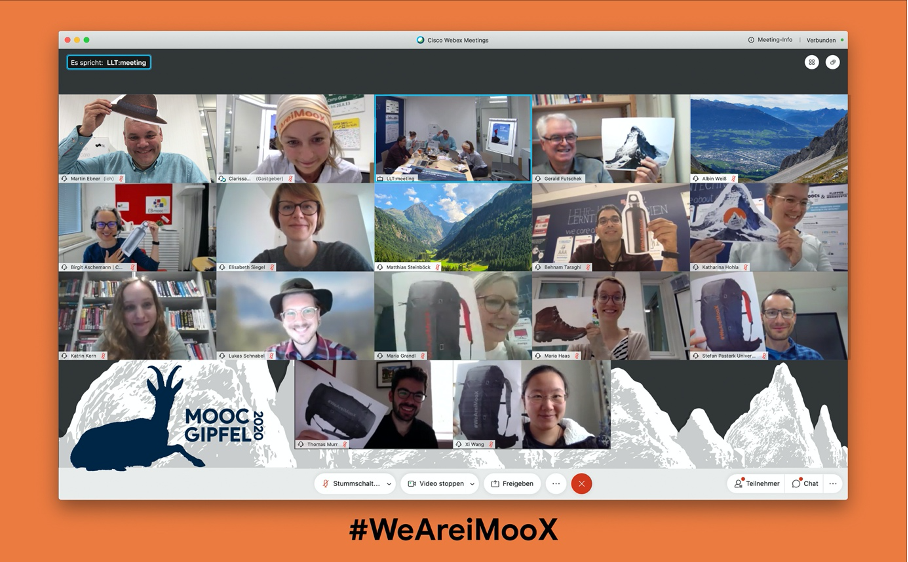
Doch, nicht nur wir sind iMooX, sondern auch IHR seid es – #WeareiMooX lautet daher unser Credo! iMooX Partner*innen mit ins Boot holen, Ideen sammeln und diskutieren, das war für den Gipfel sowie auch die kommende Zusammenarbeit zentral. Daher war der zweite Programmpunkt des Gipfels geknüpft an eine Gruppenaufgabe: Gemeinsam sollten die Teilnehmenden mithilfe des neuen MOOC-Maker-Canvas (ein Blogbeitrag hierzu folgt in den kommenden Tagen) einen Monster-MOOC konzipieren. Der Canvas soll zukünftigen MOOC-Makern helfen, alle wichtigen konzeptionellen Milestones eines MOOC im Blick zu behalten und diese auf einem DinA3 Papier übersichtlich zu sammeln.
Teil drei des Gipfels war eine interaktive Session via gathertown, bei dieser sich die Teilnehmenden über mögliche Wünsche und Innovationspotentiale der MOOC-Plattform austauschen konnten. Gesammelt wurden alle Wünsche online via feedbackr. Die Umsetzbarkeit der Themen wird aktuell geprüft und diskutiert. Über Neuerungen halten wir euch gerne auf dem Laufenden.
Durch die besonderen Gegebenheiten dieses Jahr, mussten wir auch den MOOC-Gipfel in den virtuellen Raum verlegen und konnten unsere neuen iMooX-Goodies leider nicht persönlich übergeben. Die Teilnehmenden konnten sich im Anschluss der Veranstaltung aber über ein Goodie-Packerl freuen. Zu unserer aktuellen Goodie-Serie für Partner*innen gehört ein Multifunktionstuch, ein USB-Stick, ein Bio-Baumwolle-Sackerl und noch viele weitere Goodies.
Our research about „Web Analytics as Extension for a Learning Analytics Dashboard of a Massive Open Online Platform“ got published.
Abstract: Massive open online courses (MOOCs) provide anyone with Internet access the chance to study at university level for free. In such learning environments and due to their ubiquitous nature, learners produce vast amounts of data representing their learning process. Learning Analytics (LA) can help identifying, quantifying, and understanding these data traces. Within the implemented web-based tool, called LA Cockpit, basic metrics to capture the learners’ activity for the Austrian MOOC platform iMooX were defined. Data is aggregated in an approach of behavioral and web analysis as well as paired with state-of-the-art visualization techniques to build a LA dashboard. It should act as suitable tool to bridge the distant nature of learning in MOOCs. Together with the extendible design of the LA Cockpit, it shall act as a future proof framework to be reused and improved over time. Aimed toward administrators and educators, the dashboard contains interactive widgets letting the user explore their datasets themselves rather than presenting categories. This supports the data literacy and improves the understanding of the underlying key figures, thereby helping them generate actionable insights from the data. The web analytical feature of the LA Cockpit captures mouse activity in individual course-wide heatmaps to identify regions of learner’s interest and help separating structure and content. Activity over time is aggregated in a calendar view, making timely reoccurring patterns otherwise not deductible, now visible. Through the additional feedback from the LA Cockpit on the learners’ behavior within the courses, it will become easier to improve the teaching and learning process by tailoring the provided content to the needs of the online learning community.
Reference: Leitner P., Maier K., Ebner M. (2020) Web Analytics as Extension for a Learning Analytics Dashboard of a Massive Open Online Platform. In: Ifenthaler D., Gibson D. (eds) Adoption of Data Analytics in Higher Education Learning and Teaching. Advances in Analytics for Learning and Teaching. Springer, Cham. https://doi.org/10.1007/978-3-030-47392-1_19
Thanks to my colleagues – we did a publication for this year CDMAKE-conference about „Property-Based Testing for Parameter Learning of Probabilistic Graphical Models„.
Abstract: Code quality is a requirement for successful and sustainable software development. The emergence of Artificial Intelligence and data driven Machine Learning in current applications makes customized solutions for both data as well as code quality a requirement. The diversity and the stochastic nature of Machine Learning algorithms require different test methods, each of which is suitable for a particular method. Conventional unit tests in test-automation environments provide the common, well-studied approach to tackle code quality issues, but Machine Learning applications pose new challenges and have different requirements, mostly as far the numerical computations are concerned. In this research work, a concrete use of property-based testing for quality assurance in the parameter learning algorithm of a probabilistic graphical model is described. The necessity and effectiveness of this method in comparison to unit tests is analyzed with concrete code examples for enhanced retraceability and interpretability, thus highly relevant for what is called explainable AI.
Reference: Saranti A., Taraghi B., Ebner M., Holzinger A. (2020) Property-Based Testing for Parameter Learning of Probabilistic Graphical Models. In: Holzinger A., Kieseberg P., Tjoa A., Weippl E. (eds) Machine Learning and Knowledge Extraction. CD-MAKE 2020. Lecture Notes in Computer Science, vol 12279. Springer, Cham. https://doi.org/10.1007/978-3-030-57321-8_28