[publication] Mixed Reality Books: Applying Augmented and Virtual Reality in Mining Engineering Education #AR #VR #research

Our chapter about „Mixed Reality Books: Applying Augmented and Virtual Reality in Mining Engineering Education“ got published in the book „Augmented Reality in Education“.

Abstract:
This chapter deals with the integration of Augmented and Virtual Reality (AR/VR) elements into academic mining education. The focus lies on the didactical approach within the EU-funded MiReBooks (Mixed Reality Books) project. The project aims to develop a series of AR- and VR-based interactive mining manuals as a new digital standard for higher education across European engineering education. By combining AR and VR technologies, it is possible to address current challenges in mining education in an innovative way. These virtual applications should make otherwise impossible and dangerous situations accessible to students. Classical paper-based teaching materials are enriched with AR content and translated into pedagogically and didactically coherent manuals for integrative use in the classroom. The authors explore how AR and VR instruments can be effectively integrated into teaching. The results of a broad evaluation of AR/VR-based lectures are presented and discussed in this chapter. The experiences and findings are summarized in a decision matrix for the use of AR/VR-based technologies in teaching.

Abstract Chapter

[Chapter @ journal’s homepage]
[draft @ ResearchGate]

Reference: Daling, L., Kommetter, C., Abdelrazeq, A., Ebner, M. & Ebner, M. (2020) Mixed Reality Books: Applying Augmented and Virtual Reality in Mining Engineering Education. In: Augmented Reality in Education. Geroimenko, V. (Ed.). pp. 185-195. Springer, DOI: 10.1007/978-3-030-42156-4

[interview] MOOCs zur Förderung der digitalen Kompetenz im Lehramtsstudium: Chancen und Herausforderungen #tugraz #imoox #mooc

Im Rahmen eines Themenspecials rund um „Digitale Medien im Lehramtsstudium“ habe ich das didaktische und organisatorische Konzept der beiden MOOCs „Lehren und Lernen mit digitalen Medien I“ und „Lehren und Lernen mit digitalen Medien II“ vorgestellt. Insbesondere ging es mir darum, zu zeigen, wie gut das Konzept auch für andere Hochschulen nutzbar wäre.

In der österreichischen Lehramtsausbildung arbeiten acht Hochschulen zusammen, um mithilfe von MOOCs und begleitenden Übungen die digitalen Kompetenzen der Studierenden zu fördern. Das Interview mit Dr. Martin Ebner von der Technischen Universität Graz gibt Einblicke in die Herausforderungen und Mehrwerte, die das innovative Lehr- und Lernkonzept bietet.

Webeite eteaching.org

[Interview auf eteaching.org]

[presentation] Chatbots for Brand Representation in Comparison with Traditional Websites #chatbot #master #tugraz

Johannes did his masterthesis about „Chatbots for Brand Representation in Comparison with Traditional Websites„. The slides of his successful defense you can find right here:

Klicken Sie auf den unteren Button, um den Inhalt von www.slideshare.net zu laden.

Inhalt laden

[talk] Digitale Lehre aus Studierendensicht #fnma #online #talk #podium

Ich durfte den letzten Talk des Forums Neue Medien in der Lehre Austria (fnma) moderieren und auch das anschließende Podium. In Zeiten von CoVid-19 bedeutet dies natürlich, dass alles online stattfinden musst. Auch das haben wir gemeistert wie man in der Aufzeichnung sehen kann:

YouTube

Mit dem Laden des Videos akzeptieren Sie die Datenschutzerklärung von YouTube.
Mehr erfahren

Video laden

Technisch haben wir es etwas über drei Ecken realisiert. Es wurde WebEx verwendet, welches dann von einem lokalen Rechner über OBS-Studio auf YouTube live gestreamt wurde. Von dort haben wir dann Fragen und Kommentare genommen. Hat aber gut geklappt 🙂

Vielen Dank auch an Simon Malacek und die österreichischen Studierenden – auch wenn die Datenerhebung noch vor CoVid-19 war, trägt sich dazu bei, dass wir die Services wieder zielgerichteter anbieten können.

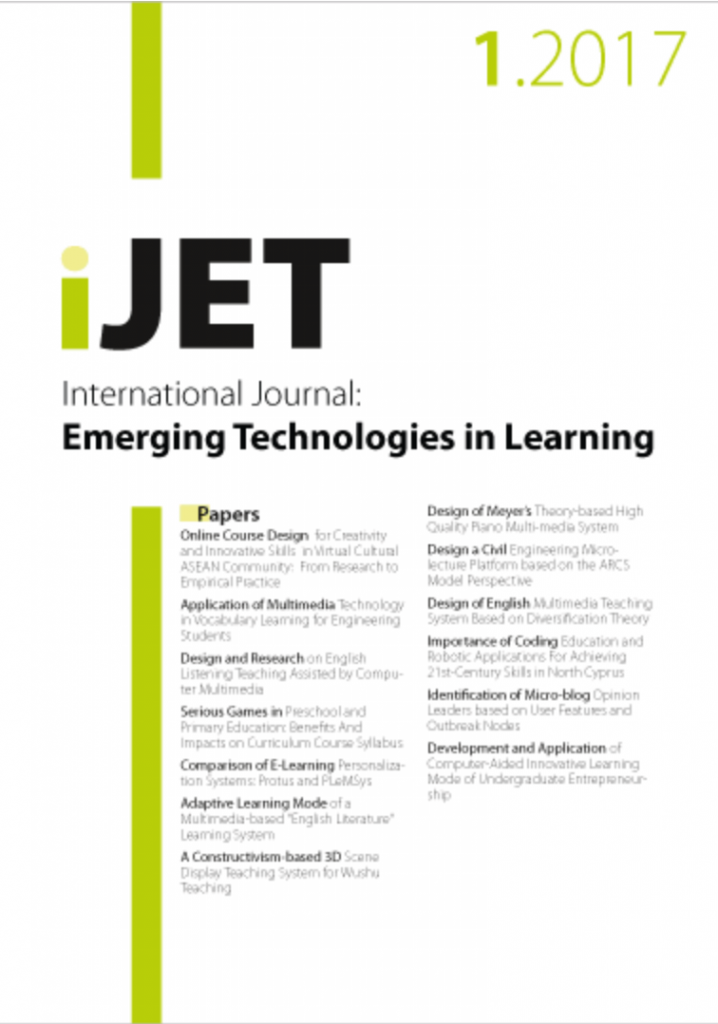
[ijet, journal] Journal of Emerging Technologies in Learning Vol. 15 / No. 10 #ijet #research

Issue 15(10) of our journal on emerging technologies for learning got published. Enjoy the readings as usual for free :-).

Table of Contents:

  • Inquiry-Based Education: Innovation in Participatory Inquiry Paradigm
  • Comparative Analysis for Boosting Classifiers in the Context of Higher Education
  • Teaching Mode of Library Information Literacy Course Based on Hierarchical Embedded Service
  • Energy-Scape Web-Based Application is an Effective Tool to Overcome the Basic Knowledge of Architects Toward Renewable Energy Properties
  • Evaluating the Quality of Social Web Applications Using the LSP Method
  • “Online + Offline” Course Teaching Based on Case Teaching Method: A Case Study of Entrepreneurship Education Course
  • Evaluation of Teaching Quality of College Physical Education Based on Analytic Hierarchy Process
  • Speech Recognition of Oral English Teaching Based on Deep Belief Network
  • An Evaluation of the “PicsAR” Research Project: An Augmented Reality in Physics Learning
  • Application of Virtual Reality Technique in the Construction of Modular Teaching Resources
  • Linked Open Data Framework for Ethnic Groups in Thailand Learning
  • The Impact of Collaborative Group Size on Students’ Achievement and Product Quality in Project-Based Learning Environments
  • The New Face of Digital Books in Genetic Learning: A Preliminary Development Study for Students‘ Critical Thinking
  • An Evaluation and Examination of Quiz Tool within Open-Source Learning Management Systems
  • Personalized Allocation of English Teaching Resources through Weight Calculation Based on Term Frequency-Inverse Document Frequency
  • Using Hawgent Dynamic Mathematic Software in Teaching Trigonometry
  • Prototyping Text Mining and Network Analysis Tools to Support Netnographic Student Projects

[Link to Issue 15/10]

Nevertheless, if you are interested to become a reviewer for the journal, please just contact me :-).

[publication] COVID-19 Epidemic as E-Learning Boost? Chronological Development and Effects at an Austrian University against the Background of the Concept of “E-Learning Readiness” #covid19 #tugraz

Our first research article concerning the situation of COVID-19 titled „COVID-19 Epidemic as E-Learning Boost? Chronological Development and Effects at an Austrian University against the Background of the Concept of “E-Learning Readiness” is published right now.

Abstract:
The COVID-19 crisis influenced universities worldwide in early 2020. In Austria, all universities were closed in March 2020 as a preventive measure, and meetings with over 100 people were banned and a curfew was imposed. This development also had a massive impact on teaching, which in Austria takes place largely face-to-face. In this paper we would like to describe the situation of an Austrian university regarding e-learning before and during the first three weeks of the changeover of the teaching system, using the example of Graz University of Technology (TU Graz). The authors provide insights into the internal procedures, processes and decisions of their university and present figures on the changed usage behaviour of their students and teachers. As a theoretical reference, the article uses the e-learning readiness assessment according to Alshaher (2013), which provides a framework for describing the status of the situation regarding e-learning before the crisis. The paper concludes with a description of enablers, barriers and bottlenecks from the perspective of the members of the Educational Technology department.

Website Future Internet

[full article @ ResearchGate]
[full article @ journal’s homepage]

Reference: Ebner, M.; Schön, S.; Braun, C.; Ebner, M.; Grigoriadis, Y.; Haas, M.; Leitner, P.; Taraghi, B. COVID-19 Epidemic as E-Learning Boost? Chronological Development and Effects at an Austrian University against the Background of the Concept of “E-Learning Readiness”. Future Internet 2020, 12, 94.

[article] A Voice-Enabled Game Based Learning Application using Amazon’s Echo with Alexa Voice Service: A Game Regarding Geographic Facts About Austria and Europe #research #TEL #Alexa

Our first resarch using Amazon’s Alexa for Learning are now published, named „A Voice-Enabled Game Based Learning Application using Amazon’s Echo with Alexa Voice Service: A Game Regarding Geographic Facts About Austria and Europe“ in the International Journal of Interactive Mobile Technologies (iJIM) .

Abstract:
An educational, interactive Amazon Alexa Skill called “Österreich und Europa Spiel / Austria and Europe Game” was developed at Graz University of Technology for a German as well as English speaking audience. This Skills intent is to assist learning geographic facts about Austria as well as Europe by interaction via voice controls with the device. The main research question was if an educational, interactive speech assistant application could be made in a way such that both under-age and full age subjects would be able to use it, enjoy the Game Based Learning experience overall and be assisted learning about the Geography of Austria and Europe. The Amazon Alexa Skill was tested for the first time in a class with 16 students at lower secondary school level. Two further tests were done with a total of five adult participants. After the tests the participants opinion was determined via a questionnaire. The evaluation of the tests suggests that the game indeed gives an additional motivational factor in learning Geography.

Journal’s Homepage

[Link to full article @ ResearchGate]
[Link to full article @ Journal’s Homepage]

Reference: Bilic, L., Ebner, Markus, Ebner, Martin (2020) A Voice-Enabled Game Based Learning Application using Amazon’s Echo with Alexa Voice Service: A Game Regarding Geographic Facts About Austria and Europe, International Journal of Interactive Mobile Technologies (iJIM), 14 (3), pp. 226 – 23

[presentation] Digitalisierung der Lehre – was lernen wir aus der Corona-Krise? #covid19 #tugraz

Im Rahmen der Institutskonferenz an der PH Steiermark bin ich zu einem Vortrag eingeladen worden und habe mich entschieden, dass ich einmal die letzten beiden Monate aufarbeite. Hier sind die Slides, die man durchaus als Zusammenfassung der bisherigen covid19-Zeit sehen kann:

Klicken Sie auf den unteren Button, um den Inhalt von www.slideshare.net zu laden.

Inhalt laden

[publication] Was macht ein gutes Erklärvideo aus? #video #tel #research

Für das Buch „Lehren und Lernen mit Tutorials und Erklärvideos“ durften wir einen Kurzbeitrag zu „Was macht ein gutes Erklärvideo aus?“ schreiben.

Zusammenfassung:
Basierend auf der Analyse und der Gestaltungspraxis von Erklärvideos in der Hochschulbildung stellen Dr. Schön und Dr. Ebner die wichtigsten medialen und didaktischen Gestaltungskriterien für großartige Erklärvideos vor.Basierend auf der Analyse und der Gestaltungspraxis von Erklärvideos in der Hochschulbildung stellen Dr. Schön und Dr. Ebner die wichtigsten medialen und didaktischen Gestaltungskriterien für großartige Erklärvideos vor.

Teaser des Beitrags

[Entwurf bei ResearchGate]

Zitation: Schön, S. & Ebner, M. (2020) Was macht ein gutes Erklärvideo aus? In: Lehren und Lernen mit Tutorials und Erklärvideos. Dorgerloh, S. & Wolf, K. (Hrsg.). Beltz. ISBN 978-3-407-63126-8. S. 75-80

[publication] Digital gestütztes Lehren mittels innovativem MOOC-Konzept #mooc #imoox

Wir haben unsere Erfahrungen mit dem Inverse-Blended-Learning-Konzept im Rahmen der Lehrer/innenbildung festgehalten. Der MOOC „Lehren und Lernen mit digitalen Medien“ dient dabei zur Steigerung der digitalen Kompetenzen für alle Lehramtsstudierenden. Der Beitrag ist nun erschienen im journal für lehrerinnenbildung.

Abstract:
Die Integration digitaler Medien in den Unterricht ist eine Herausforderung unserer Zeit. Daher scheint es naheliegend, dass Lehrpersonen entsprechende Bildungsmaßnahmen erfahren und insbesondere, dass dies auch in die Curricula für Lehramtsstudierende Einzug findet. Der Entwicklungsverbund Süd-Ost in Österreich hat sich dieser Herausforderung gestellt, ein Konzept zur Integration digitaler Medien entwickelt und mit Sommersemester 2019 erstmalig erfolgreich umgesetzt. Dabei wurde nach dem didaktischen Konzept Inverse-Blended-Learning ein Massive Open Online Course (MOOC) in Kombination mit Übungen an den beteiligten Standorten entwickelt. Die statistischen Eckdaten und das Feedback der Studierenden zeigen, dass das Konzept als sehr positiv und zeitgemäß wahrgenommen wird und es daher auch weiterverfolgt werden sollte.

Zusammenfassung

[full article @ journal’s homepage]
[full article @ researchgate]

Zitation: Ebner, M., Adams, S., Bollin, A., Kopp, M., Teufel, M. (2020) Digital gestütztes Lehren mittels innovativem MOOC-Konzept. journal für lehrerinnenbildung. 20(1). S. 68-77