
Postgenerativ.at – let us discuss #ArtificialIntelligence

+++ English version below +++
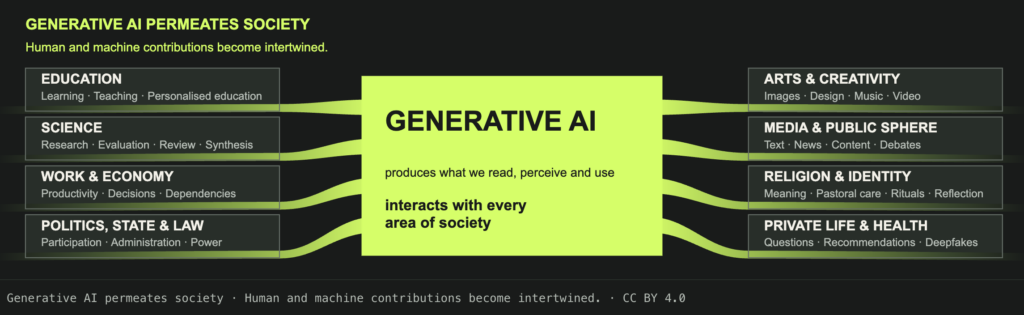
Postgenerativ.at – wir starten eine Webseite. Nein es ist keine Webseite, es soll eine Diskussionsbasis werden zu einem Thema welches uns sehr am Herzen liegt. Dabei gehen wir von einer zentralen Frage aus: „Wie schaut eine Welt aus, die von generativer KI komplett durchdrungen ist?
Dazu haben wir auch versucht „Postgenerativ“ zu definieren:

„PostGenerativ bezeichnet einen gesellschaftlichen Zustand, in dem generative künstliche Intelligenz das alltägliche Leben durchdringt. Sie prägt, wie Menschen arbeiten, lernen, kommunizieren, gestalten und Wissen hervorbringen. Ihre Erzeugnisse fließen in Informationen, Werkzeuge und Umgebungen unseres Alltags ein und wirken so auch auf Menschen, die KI nicht bewusst nutzen. [1] Menschliche und maschinelle Beiträge verschränken sich und sind immer schwerer zu unterscheiden. KI-Ergebnisse werden zunehmend ungeprüft übernommen oder weitergereicht. Umfang und Geschwindigkeit der Generierung können die menschliche Kontrolle überfordern. Zugleich entstehen neue Abhängigkeiten: Wer KI-Systeme kontrolliert, beeinflusst den Zugang zu Wissen und Teilhabe. In Anlehnung an das Postdigitale [2] beschreibt das PostGenerative eine von generativer KI bereits veränderte Lebenswelt, deren Möglichkeiten, Erwartungen und Konflikte sie mitprägt.“

Ziel ist, dass wir eine Möglichkeit geben um über Wirkungen, Folgen von generativer KI nachzudenken um vielleicht die notwendigen Handlungen der nahen Zukunft besser einordnen zu können. Wie auch immer wir freuen uns wenn man uns weitere Indizien schickt, Wortmeldungen schreibt, Kommentare hinterlässt oder einfach auch nur die Webseite verbreitet: KI geht uns alle an – davon bin ich felsenfest überzeugt.

+++

Postgenerative.at – we’re launching a website. No, it’s not just a website; it’s intended to be a forum for discussion on a topic that’s very close to our hearts. We’re starting with one central question: ‘What would a world look like that is completely permeated by generative AI?’
To this end, we’ve also tried to define ‘Postgenerativ’:

„Post-generative describes a societal condition in which generative artificial intelligence permeates everyday life. It shapes how people work, learn, communicate, design and produce knowledge. Its outputs enter the information, tools and environments we encounter every day, affecting even those who do not consciously use it. [1] Human and machine contributions become intertwined and increasingly difficult to distinguish. AI outputs are increasingly adopted or passed on without people reviewing them individually. The volume and speed of generation can overwhelm human oversight. At the same time, new dependencies emerge: whoever controls AI systems shapes access to knowledge and participation. Drawing on the idea of the post-digital [2], the post-generative describes a world already transformed by generative AI, whose possibilities, expectations and conflicts it helps to shape.“

The aim is to provide an opportunity to reflect on the effects and consequences of generative AI, so that we might be better able to contextualise the necessary actions in the near future. In any case, we’d be delighted if you could send us further evidence, write a personal note, leave comments or simply share the website: AI concerns us all – of that I am absolutely convinced.

This is an impactful contributions, and exceptional novelty in the research field of AI in education and beyond

[publication] Does Gamification in MOOC Discussion Forums Work? #imoox #research #mooc

Our this year’s contribution to the eMOOCs conference is about „Does Gamification in MOOC Discussion Forums Work?„. The chapter is dealing with the idea to enhance a discussion forum with different gamification elements.

Abstract:

Massive Open Online Courses (MOOCs) are a new form of learning environment aimed towards accessibility and openness using contemporary technologies. One of the MOOC’s key features is the social interaction which usually takes place in discussion forums. This article focuses on reworking and analyzing the existing iMooX forum by enriching the new design with gamification elements. The intended objectives aim at refreshing the current style and improving its handling and usability. This article provides our experience of this implementation as well as examining whether or not the gamification ele-ments can help increase the participation rate and the teacher-to-student and student-to-student communication exchange. Results of the new design showed a good user satisfaction and a slight positive impact.

[Publication @ Springer]

[Draft verstion @ ResearchGate]

Reference: Reischer M., Khalil M., Ebner M. (2017) Does Gamification in MOOC Discussion Forums Work?. In: Delgado Kloos C., Jermann P., Pérez-Sanagustín M., Seaton D., White S. (eds) Digital Education: Out to the World and Back to the Campus. EMOOCs 2017. Lecture Notes in Computer Science, vol 10254. Springer, Cham, pp. 95-101. doi: 10.1007/978-3-319-59044-8_11

[onlinediscussion] #MMC13 Warum sind MOOCs offen?

Im Rahmen des gerade statt findenden MOOC „Der deutschsprachige MOOC Maker Course„, kurz MMC13, wurde ich eingeladen in einer kleinen Diskussionsgruppe zu Openess allgemein und auch Open Educational Resources zu reden.
Wie schon öfters hier im Blog hab ich versucht darauf hinzuweisen, dass OER ein wesentliches Thema für das digitale Klassenzimmer von morgen ist und dass es vor allem darauf ankommt eine Bewusstseinsbildung zu betrieben.
Hier einmal die gesamte Diskussion auf YouTube:

Weitere interessante Dinge zu OER:

Online-Podium bei e-teaching.org

Ich bin eingeladen worden am 26.10.2009 um 17.00 Uhr zusammen mit Mi­chael Gerth (Uni Leipzig) und Dr. Matthias Rohs (Uni Zü­rich) eingeladen rund um das Thema „Befragungen Studierender zum Thema E-Learning„. Ich werde dort ein wenig zu unseren Umfragen Stellung nehmen.

Inzwischen haben verschiedene Studien die Vorstellung widerlegt, dass die mit Computer und Internet aufgewachsenen heutigen Studierenden diese Technologien problemlos und sinnvoll auch im Studium nutzen können. Welche digitalen Kompetenzen haben die Studierenden wirklich – und welche benötigen sie? Wie beurteilen sie das Thema E-Learning?

Hier die Einladung im Detail auf e-teaching.org.

New Education Wave (N-Ed Wave)?

After my talk at the Online Round Table about „EduPunk„ a really interesting debate started online. Fascinating how many people agreed and some other disagreed. I am quite happy with such a situation due to the fact the scientific discussions help to improve future education.
However I would like to list all the statements on the Web:

  • Stephen mentioned „Martin is seeking to open up the VLE and apply the ideas of edupunk in an institutional context [and not as] as subversive or a challenge to the establishment but rather as a way of enhancing the teaching and learning environment,“ I want to call it N-Ed Wave or some such thing. [Link]
  • Graham disagreed „I am not convinced about the movement from punk to New Wave. But as I said in my original article, we need to establish edupunk as having a meaning in its own right. The music analogy is getting stretched and has limited further purchase.“ [Link]
  • Frances pointed out „Having checked out these and previous responses on Edupunk, I realise that I have missed a dimension that Chris Sessums captures in his response to a blog post on a previous Edupunk sessions“[Link]
  • And of course also Steve shares his opinion „No, Edupunk promises to do for education what Punk did for music. Punk gave the British music industry a much need shot in the arm and saved it from stagnation. I also said that sometimes you need to be destructive in order to be creative“ [Link]
  • Gemma summarized my ideas as „While Ebner isn’t as revolutionary as he tries to find a way to open VLE to free contents and tools.“ [Link]

I like to thank again for discussing this important topic and I am sure that we are all on the right way to enhance our education. If anyone likes to more know about all the stuff we are doing right now there is also a publication online available.