[publication] Learning Activities in Personal Learning Environment

Our publication at this year ED-Media Conference in Victoria, Canada about „Learning Activities in Personal Learning Environment“ is now online available.
Abstract:

Nowadays Learning Management Systems are an integrated part of educational institutions. Teachers as well as learners profit from the so-called Web 2.0 applications in their daily learning process. Communication and collaboration between students have been enhanced using mashups of Web 2.0 technologies. Smart mobile phones and the increased availability of free wireless network access points make the integration of all these tools in our personal daily life and personal learning process much easier than before. This publication focuses on the Personal Learning Environment (PLE) that was launched at Graz University of Technology (TU Graz) in 2010. It illustrates how the PLE at TU Graz has been extended to move towards mobile PLE. Furthermore the learning activities of about more than 4000 learners in the last two years are revealed based on the tracked user behavior. The activities and usage traces are modeled using domain specific semantic ontologies. The models are used as the input for our Analytics Dashboard to visualize statistics and get a quick overview of learning habits and overall reflection usages and activity dynamics in the PLE.

Learning Activities in Personal Learning Environment by Martin

Klicken Sie auf den unteren Button, um den Inhalt von www.scribd.com zu laden.

Inhalt laden

Reference:Taraghi, B., Softic, S., Ebner, M. & De Vocht, L. (2013). Learning Activities in Personal Learning Environment. In Proceedings of World Conference on Educational Multimedia, Hypermedia and Telecommunications 2013 (pp. 2466-2475). Chesapeake, VA: AACE.

[masterthesis] Relevant Information and Information Visualization for Lecturers in Web-Based Audience Response Systems

Karin did her masterthesis about Realfeedback and made a worthful contribution to the visualisation possibilities for ARS-Systems. Find here her presentation of the masterthesis:

Klicken Sie auf den unteren Button, um den Inhalt von de.slideshare.net zu laden.

Inhalt laden

If you like to try the application then do it here for free.

[presentation] Teachers Little Helper: Multi-Math-Coach

Yesterday Martin did this presentation about our math-multi-trainer at the IADIS Conference in Prague. Find here the slides:

Klicken Sie auf den unteren Button, um den Inhalt von www.slideshare.net zu laden.

Inhalt laden

[masterthesis] Quantitative Digital Backchannel: Developing a Web-Based Audience Response System for Measuring Audience Perception in Large Lectures

Christian did his masterthesis about a quantitative backchannel for mass-interaction in large lecture halls. Find here his presentation of the masterthesis:

Klicken Sie auf den unteren Button, um den Inhalt von de.slideshare.net zu laden.

Inhalt laden

[presentation] Ist der Touchscreen der Füller von morgen?

Im Rahmen eines Vortrages am BIFEB in Strobl habe ich über die Zukunft des digitalen Lehrens und Lernens geredet. Meine Folien sind hier online:

Klicken Sie auf den unteren Button, um den Inhalt von www.slideshare.net zu laden.

Inhalt laden

s

[iphone, #COER13] OER-Remix Game

iPhone App OER Remix Game
Quasi ein Nachtrag zum COER13: Wir haben im Rahmen unserer Vorlesung „Mobile Applications 2013“ die App OER-Remix Game umgesetzt. Ziel ist es dabei auf spielerischem Wege die Komplexität der Kombination verschiedenster Lizensierungen verstehen zu lernen. Ehrlich auch mir fällt das auch nicht wirklich immer leicht, ist manchmal ordentlich zum Nachdenken und dann kommt noch der Zeitstress dazu.

Do you ever wanted to explore the depths of license combining or even wanted to proof your knowledge in this craft? Then the OER remix game may be an interesting way to do so!
The Game is structured in two parts. The first and also main part of the game consists of a deck of cards, which is used to explore the challenge of open content license compability issues and, in this context, how you are able to combine open educational ressources. After you found a valid oer remix, you have to choose the end license in the second part of the game , under which your project has to be published.

  • Start in relax mode to explore the game
  • Study the game winning rules and train to be faster
  • Choose a harder difficulty and proof your knowledge and swiftness
  • Gain Achievements to be an oer remix game professional

If you discover any problems, suggestions for improvement or even new features for the game, please send us an email and we will help you as far as possibile!

[Link zur App]

[publication] Why Learning Analytics for Primary Education Matters!

Our publication about „Why Learning Analytics for Primary Education Matters!“ in the Bulletin of the Technical Committee on Learning Technology is now online availabe.
Abstract:

The ubiquitous availability of applications enables us to offer students opportunities to test and train competences in almost every situation. At Graz University of Technolgy two apps for testing competences in multiplication are developed. They estimate the competence level of every user and adapt to their individual development in this domain. They collect a lot of data during a longer period, which could be used on further research. In the foreground they give feedback in a compact and clearly arranged way to the single student and the teachers of classes. But furthermore the analysis of the data during a longer term showed us, that the process of testing and giving feedback has also an positive effect on learning. We emphasize that this quality in supporting the students could not be achieved by human teachers. Information Technology and Learning Analytics gives them a wider radius to perceive specific behavior and establishes their capacity for storing and processing all the relevant data

Here you can find the whole publication as Open Acess [Link]
Reference: Ebner, M., Schön, M. (2013) Why Learning Analytics in Primary Education Matters!,Bulletin of the Technical Committee on Learning Technology, Karagiannidis, C. & Graf, S (Ed.), Volume 15, Issue 2, April 2013, p. 14-17

[ITuG, book, #COER13] Social Media an Hochschulen

Band 3 / Serie ITuG
Band 3 / Serie ITuG
Es freut uns den dritten Band der ITuG-Serie (Internet-Technologie und Gesellschaft) ankündigen zu können. Die Autorin Jennifer-Carmen Frey beschäftigt sich dabei mit dem Thema Social Media an Hochschulen, insbesondere wurde ein Wirksamkeitsanalyse durchgeführt und Handlungsempfehlungen für einen sinnvollen und nachhaltigen universitären Social-Media-Auftritt erarbeitet:

Wie schafft man in sozialen Netzwerken ein Gemeinschaftsgefühl, das tausende von Fans aktiviert? Welche Inhalte erhalten auf Hochschulseiten im Social Web Likes, Shares und Comments? Wie sollten Universitäten Social Media nutzen?
Im internationalen Wettbewerb müssen Universitäten als Stätten des Fortschritts ihre Außenwirkung zunehmend bewusst gestalten. In der Realität präsentiert sich dies jedoch schwierig – Hochschulen zeigen sich in ihrer Öffentlichkeitsarbeit eher wenig fortschrittlich und zählen auf konservative, althergebrachte und vor allem „sichere“ Medien. Doch liegt gerade hier ein großes Potential, denn durch neue Medien können nicht nur schnell und unkompliziert große Massen von Menschen global erreicht werden, sondern auch ein zukunftsorientiertes, modernes Image aufgebaut werden, dass sich – im Falle der sozialen Medien – auch als gemeinschaftsbildendes Element (Instrument) darstellt.
Doch wie präsentiert man sich als Hochschule im Social Web? Welche Rolle spielen Fans und Follower, Likes und Retweets? Was sind Shitstorms, gutes Kritikmanagement, und wie gestaltet man einen sinnvollen Post?
Dieses Buch zeigt, was eine Hochschule tun kann, um im Social Web wahrgenommen zu werden und wie sie am besten ihre Community aktiviert.

Das Buch kann entweder hier bei Amazon bestellt werden oder steht auf der Webseite unter einer CC-BY-NC-ND-Lizenz zum Ausdrucken bereit.

[lecture] Technology Enhanced Learning – Teil 6

In der sechsten und (leider) letzten Einheit meines Seminars „Technology Enhanced Learning“ war Mobile Learning das zentrale Thema. Nach dem gewohnten Input versuchten wir mit Hilfe eines Plakates über mobile Lernszenarien nachzudenken. Hier einmal dazu die Folien:

Klicken Sie auf den unteren Button, um den Inhalt von de.slideshare.net zu laden.

Inhalt laden

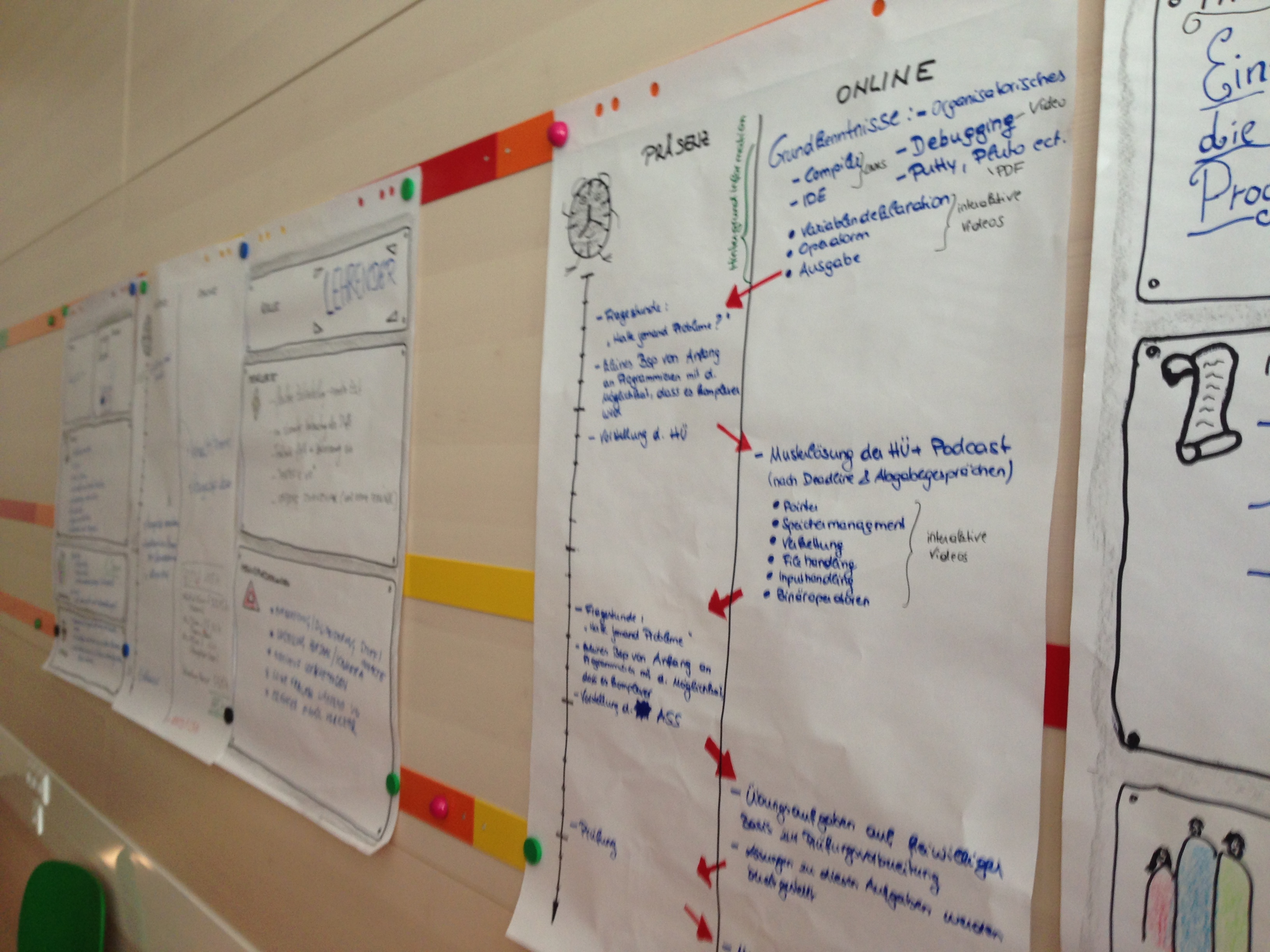
Hier noch ein Bild der erstellten Plakate:
Technology Enhanced Learning / Teil 6