[publication] First steps towards an integration of a Personal Learning Environment at university level

Our publication on „First steps towards an integration of a Personal Learning Environment at university level“ for this year ICT 2011 conference is now online available as draft version. The slides have been already published here.
Abstract:

Personalization is seen as the key approach to handle the plethora of information in today’s knowledge-based society. It is expected that personalized teaching and learning will efficiently address learner needs. The education of the future will change as a result of the influence of Web 2.0 content typified by a steadily increasing supply of data. This means that the students of tomorrow will regularly have to deal with sharing and merging content from different sources. Therefore, mashup technology will become a very important lens by which to focus on individual learning needs and enable personalized access to particular information. The following paper describes the challenges of Personal Learning Environments at higher education institutions. In the first section, the concept of Personal Learning Environments is presented, while the second section discusses the new challenges that arise for learning with the help of Personal Learning Environments. The third section describes the technical background of Personal Learning Environments and the widget standard in general. In section four, a first prototype of a personal learning environment will be presented, which is integrated into the learning culture at the Technical University of Graz. A detailed description of the available widgets for the prototype, along with a first expert evaluation, is provided. Finally, the conclusion of the article consolidates the main points of the paper and present plans for future research together with the prospective developments.

First steps towards an integrated Personal Learning Environment at the university level

Klicken Sie auf den unteren Button, um den Inhalt von www.scribd.com zu laden.

Inhalt laden


Reference: Ebner, M., Schön, S., Taraghi, B., Drachsler, H., Tsang, P. (2011). First steps towards an integration of a Personal Learning Environment at university level. R. Kwan et al. (Eds.): ICT 2011, CCIS 177, pp. 22–36, 2011, Springer-Verlag Berlin Heidelberg 2011

[presentation] First steps towards an integration of a Personal Learning Environment at university level

Our presentation for this year ICT 2011 conference on „First steps towards an integration of a Personal Learning Environment at university level“ is now online available:

First steps towards an integration of a Personal Learning Environment at university level

Klicken Sie auf den unteren Button, um den Inhalt von www.slideshare.net zu laden.

Inhalt laden

View more presentations from Martin Ebner

[presentation] The World of Widgets – An Important Step Towards a Personalized Learning Environment

For this year PLE-Conference we did a Presentation about „The World of Widgets – An Important Step Towards a Personalized Learning Environment for the workshop „Challenges of Designing and Evaluating Usability and User Experience for PLEs (U2X-4-PLE)„. Here are the slides:

[publication] Game Based Learning in Secondary Education: Geographical Knowledge of Austria

Our publication on „Game Based Learning in Secondary Education: Geographical Knowledge of Austria“ at this year ED-Media Conference in Lisbon is now online available. The slides have been already published here.
Abstract:

An educational, interactive flash game, iGeo, was developed at Graz University of Technology (TU Graz) with the intent to assist secondary school students with studying Geography. Objective: Our main research question was to find out whether challenging online games can motivate students to learn and achieve reach better results as a non-assisted group. Experimental Setting: The application was tested for the first time in a class with seventeen pupils at lower secondary school level. Methods: Pretest/posttest experimental control group design with questionnaires. Results: The group learning with iGeo reached significantly better results than the control group in the final examination. Additionally, it can be mentioned that learning by playing a game is more “enjoyable” for the participants. Conclusion: According to the results and the general impression of the students, Game Based Learning (GBL) has definitely a positive impact on the field of secondary education, in this case Geography.

Game Based Learning in Secondary Education: Geographical Knowledge of Austria

Klicken Sie auf den unteren Button, um den Inhalt von www.scribd.com zu laden.

Inhalt laden

Reference: Ebner, M., Böckle, M., Schön, M. (2011). Game Based Learning in Secondary Education: Geographical Knowledge of Austria. In Proceedings of World Conference on Educational Multimedia, Hypermedia and Telecommunications 2011 (pp. 1510-1515). Chesapeake, VA: AACE.

[publication] The Facebook Generation Boon or Bane for E-Learning at Universities?

Our publication on „The Facebook Generation Boon or Bane for E-Learning at Universities?“ at this year ED-Media Conference in Lisbon is now online available. The slides have been already published here.
Abstract:

No other social community has been that booming ever than Facebook. A query among freshmen at Graz University of Technology (TU Graz) displays this strongly ongoing trend too. Compared to the freshmen-studies of the last three years we can demonstrate the way Facebook already influences the communication behavior of today ́s students. Does the use of Facebook lead to a more competent understanding and intensive practice of Web2.0 applications in general? Does Facebook pave the way for Web2.0 or absorbs it by implementing and enabling Web2.0 functionalities on the platform? And what does this mean for teaching and learning aspects so far? Using a couple of statistical analysis methods for complex investigations (hierarchical cluster analysis, the principle component analysis and the varimax rotation) we tried to answer these questions and found out that the usage of Facebook already leaves it ́s marks on the communicational behavior of students. An influence on the usage of other Web2.0 applications cannot be stated with significance so far but it seems that Facebook has a repressive factor rather than a promotive one; it serves as a substitute for them.

The Facebook Generation Boon or Bane for E-Learning at Universities?

Klicken Sie auf den unteren Button, um den Inhalt von www.scribd.com zu laden.

Inhalt laden

Reference: Ebner, M., Nagler, W., Schön, M. (2011). The Facebook Generation – Boon or Bane for E- Learning at Universities?. In Proceedings of World Conference on Educational Multimedia, Hypermedia and Telecommunications 2011 (pp. 3549-3557). Chesapeake, VA: AACE.

L3T Crowdfunding Projekt erfolgreich

Wir möchten uns ganz herzlich bedanken – unser erstes L3T-Crowdfunding Projekt ist erfolgreich verlaufen und wir werden uns nun an die Erstellung der Literaturliste machen :-). Danke an alle die gespendet haben, ihr werdet bald die Liste bekommen und danke, dass wir die Erfahrung sammeln konnten. Diese werden sicherlich in die nächsten Projekte einfließen.
Hier noch die Bestätigung, dass es erfolgreich war 🙂 :

[publication] Reading and Learning with Any Device University Content for E-Books and E-Readers

Our publication on „Reading and Learning with Any Device University Content for E-Books and E-Readers“ at this year ED-Media Conference in Lisbon is now online available. The slides have been already published here.
Abstract:

Due to the fact that e-readers and e-books in general are booming stronger than ever their applicability for teaching and learning aspects absolutely need to be focused. Besides important didactical aspects there are a number of product related challenges that had to be taken first when integrating e-books to the university ́s workaday life. This paper presents a way to turn teaching content into e-reader readable formats. On base of different raw materials according to their formats a couple of e-book output versions (for HTML, PDF, iPad, EPUB and Mobi usage) are compiled automatically. This development of adequate learning content by the meaning of e- book generation for multiple devices is described detailed as well as its user-friendly implementation into the Learning Management System of Graz University of Technology. Current technological limitations of that process and future aspects are discussed too.

Reading and Learning with Any Device University Content for E-Books and E-Readers

Klicken Sie auf den unteren Button, um den Inhalt von www.scribd.com zu laden.

Inhalt laden

Reference: Nagler, W., Ebner, M., Scerbakov, N. (2011). Reading and Learning with Any Device – University Content for E-Books and E-Readers. In Proceedings of World Conference on Educational Multimedia, Hypermedia and Telecommunications 2011 (pp. 1775-1782). Chesapeake, VA: AACE.

Social Media Stream at ED-Media Conference

Last week this year ED-Media Conference took place in Lisbon, Portugal. I as member of the Steering Committee was elected beforehand to coordinate the Social Media Team. Our task was to handle the Twitter stream (#edmedia11) as well as engage people to interact online.
The result is quite amazing – 4 days of Twitter use leads to more than 3700 tweets (see here a statistic) and a lot of further online material.

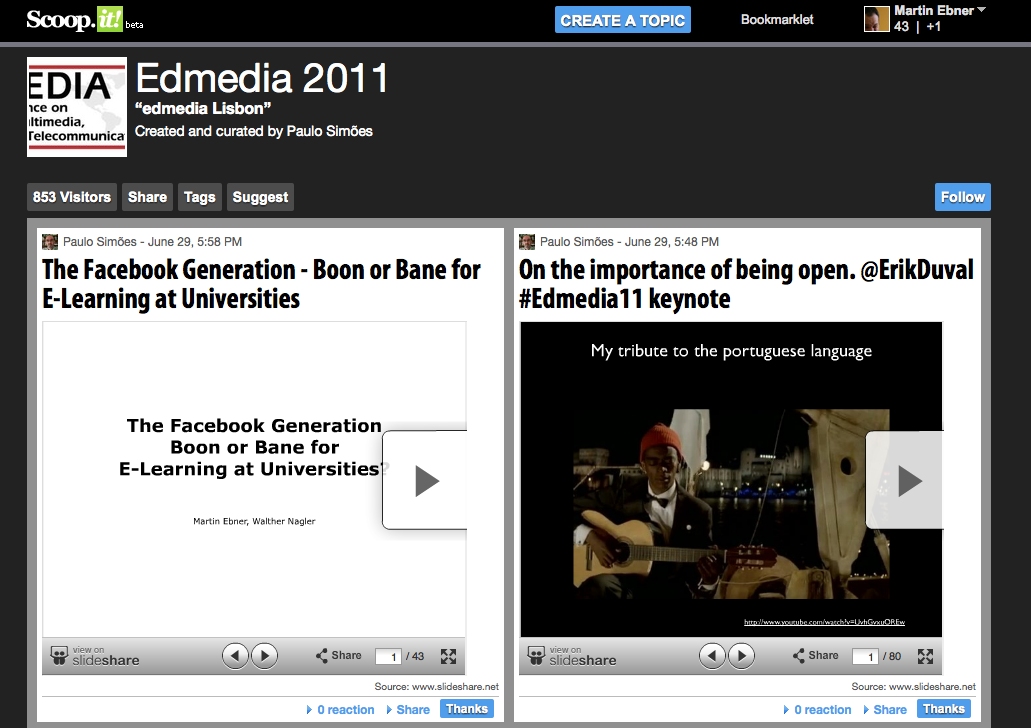
Paulo colleted also all URLs of the stream in our own ED-Media Scoop.it Page – take a look on this, I think we did a good work.

Finally thanks a lot to my team for working with you for just 4 days (and it’s worth to follow them on Twitter): @pgsimoes, @_joanasilva_, @etutoria, @AMargaridaMaia, @GCruzMatos, @jjmpleal

[presentation] Web 2.0 in Higher Education

My last presentation at this year ED-Media Conference was about „Web 2.0 in Higher Education“ – it is a rather „traditional“ one, which I did every year for the graduate student stream (ok, some slides were changed a little bit):

Web 2.0 in Higher Education

Klicken Sie auf den unteren Button, um den Inhalt von www.slideshare.net zu laden.

Inhalt laden

View more presentations from Martin Ebner