
The slides of our presentation about „Geo-Tagging in Archaeology: Practical Experiences with the TUGeoWiki“ at International Congress on “Cultural Heritage and New Technologies” (Workshop “Archäologie & Computer”) are now online available:
[podcast] Web 2.0, Kommunikation, Vernetzung
Der Podcast meines Vortrages im Rahmen der österreichweiten Demonstrationsbewegung #unsereuni an der TU Graz rund um das Thema Web 2.0 und die Auswirkung auf die Gesellschaft ist nun auch verfügbar.
Folien, Livestreams und Fotos habe ich bereits hier veröffentlicht.
Gastvotrag: Digitale Lernumgebungen an Universitäten – wo ist das Ende?
Ich bin eingeladen worden vom Medienzentrum der TU Dresden am nächsten Montag (23.11.2009) einen Gastvortrag zum Thema „Digitale Lernumgebungen an Universitäten – wo ist das Ende?“ zu halten und dabei ein wenig unsere Erfahrungen im Einsatz von Web 2.0 Technologien in Zusammenhang mit traditionellen Lernmanagementsystemen zu schildern.
Abstract meines Votrages:
Der Lernende von heute besitzt einen PC, einen Laptop, ein Mobiltelefon, einen MP3-Player, Breitband- und einen mobilen Internetanschluss. Zumindest zeigen dies die aktuellen Untersuchungen an Erstsemestrigen an der TU Graz. Nun kann die berechtigte Frage gestellt werden, welche Auswirkungen diese zunehmende Digitalisierung auf eine Bildungsinstitution hat. In welcher Weise können die vorhandenen technischen Möglichkeiten genutzt werden um das Lehr- und Lernangebot zu optimieren.
Im Vortrag wird das Konzept der TU Graz näher vorgestellt bzw. das Zusammenspiel von vielen Systemen aufgezeigt und näher diskutiert. Warum der Ansatz einer heterogenen Landschaft durchaus Vorteile bietet, vor allem in Bezug auf die Umsetzung adäquater Lehr- und Lernszenarien, soll beantwortet werden, sowie auch die Frage nach einer zukünftigen Lösung.
Hier gibt es nähere Informationen – freue mich auf die Diskussion.
Call for Papers: Social Software Engineering 2010
I am happy to announce the 3rd International Workshop on Social Software Engineering (SSE2010) that is co-located with the Software Engineering 2010 conference in Paderborn, Germany (February, 22-26 2010). The workshop will take place on February, 24 2010.
„Social Software Engineering“ (SSE) focusses on the development of systems in highly uncertain domains, with evolving goals, frequent changes and much user involvement. SSE systems can often (but not exclusively) be found on the web. Related technical concepts are user feedback, mashups, perpetual beta. However, beneath technical expertise developing social software systems requires competency from other disciplines as diverse as psychology, organizational science or economics. Besides the advent of social software applications, software engeering research recognized in recent years that effective collaboration and knowledge sharing are essential in order to guarantee successful software development and maintenance. Methods and tools that support development teams must be based on interdisciplinary research efforts that investigate technologies, tools, processes and human factors in a holistic manner.
While both directions – engineering social software and dealing with social aspects in the software engineering process – receive considerable attention, we think that ultimately, both might confluence into a new software engineering paradigm. This workshop provides a forum for discussing high quality research on the social aspects of software engineering and the engineering aspects of social software, as well as a meeting place for the community that is currently distributed over several research domains (software engineering, knowledge management, web 2.0, human computer interaction).
Here the detailed call as well as the related Homepage:
[presentation] Web 2.0, Kommunikation, Vernetzung
Im Rahmen der österreichweiten Demonstrationsbewegung #unsereuni bin ich gebeten worden an der TU Graz einem Plenumsvortrag rund um das Thema Web 2.0 und die Auswirkung auf die Gesellschaft zu halten. Ich habe dabei versucht aufzuzeigen, welche Auswirkungen das Web 2.0 bereits hat und mittels Beispielen auch greifbar zu machen. Hier einmal meine Folien:
Vernetzung, Kommunikation, Web 2.0
View more documents from Martin Ebner.
Und hier der Livestream auf UStream:
Hier gibt es noch weitere Fotos des Events.
[publication] Seeing the System through the End Users’ Eyes: Shadow Expert Technique for Evaluating the Consistency of a Learning Management System
Our publication at this year USAB Conference “Usability & HCI Learning from the Extreme” about “Seeing the System through the End Users’ Eyes: Shadow Expert Technique for Evaluating the Conistency of a Learning Management System” is now online available.
Abstract:
Interface consistency is an important basic concept in web design and has an effect on performance and satisfaction of end users. Consistency also has significant effects on the learning performance of both expert and novice end users. Consequently, the evaluation of consistency within a e-learning system and the ensuing eradication of irritating discrepancies in the user interface redesign is a big issue. In this paper, we report of our experiences with the Shadow Expert Technique (SET) during the evaluation of the consistency of the user interface of a large university learning management system. The main objective of this new usability evaluation method is to understand the interaction processes of end users with a specific system interface. Two teams of usability experts worked independently from each other in order to maximize the objectivity of the results. The outcome of this SET method is a list of recommended changes to improve the user interaction processes, hence to facilitate high consistency.
Reference: Holzinger, A.; Stickel, C.; Fassold, M.; Ebner, M.: Seeing the System through the End Users’ Eyes: Shadow Expert Technique for Evaluating the Consistency of a Learning Management System. – in: HCI and Usability for eInclusion. 5th Symposium of of the Austrian Computer Society, USAB 2009, Lecture Notes in Computer Science LNCS 5889. (2009), S. 178 – 192
[presentation] Seeing the System through the End Users’ Eyes: Shadow Expert Technique for Evaluating the Conistency of a Learning Management System
Our presentation at this year USAB Conference „Usability & HCI Learning from the Extreme“ is now online available. The title is „Seeing the System through the End Users’ Eyes: Shadow Expert Technique for Evaluating the Conistency of a Learning Management System“ and we are showing our Usability investigations concerning consistency.
Klicken Sie auf den unteren Button, um den Inhalt von prezi.com zu laden.
[publication] Higher Education m-Learning and e-Learning Scenarios for a Geospatial Wiki
Our publication about „Higher Education m-Learning and e-Learning Scenarios for a Geospatial Wiki“ at this year E-Learn Conference is now online available. We are very proud to announce that we also won the Best Paper Award.
Abstract:
Several fields of higher education, like geology, architecture, or civil engineering, rely on visual information in the context of learning, a considerable part of it moreover location-based. Geotagging, a phenomenon recently spreading through he online and mobile world, offers innovative possibilities to support teachers and learners in such fields. One such approach is the composition of geotagged information with a collaborative environment – a so-called geowiki. A prototype for an educational geowiki, TUGeoWiki, has been developed at Graz University of Technology. This publications outlines possible application scenarios for TUGeoWiki in higher education, taking into account e-Learning as well as m-Learning scenarios.
Reference: Safran, C.; Ebner, M.; Garcia-Barrios, V. M.; Kappe, F. (2009) Higher Education M-Learning and E-Learning Scenarios for a Geospatial Wiki. – in: E-Learn – World Conference on E-Learning in Corporate, Government, Healthcare, & Higher Education ; 2009 (2009)
1. Tag des EduCamp
Moblog vom Nokia N95:
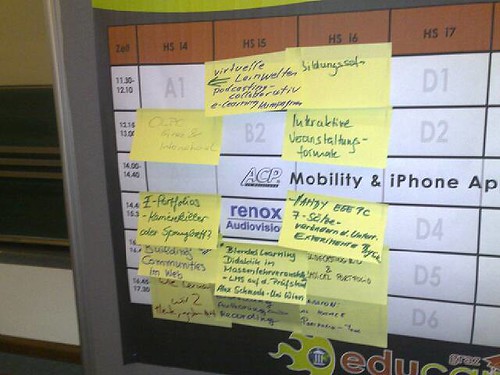
1. Tag des EduCamp
1. Tag des EduCamp
Fr 06.11.2009 11:25 061120091353
Sessionplan des ersten Tages
Originally uploaded by Martin Semriach
Mobility in Education at EduCamp Graz
 We are very proud to be able to announce the topic of our keynote „Mobility in Education“ at this year EduCamp here in Graz.
Detailed Information
Abstract:
Educational content creation, distribution and access is key to 21st century learning. At the same time mobility is a fact of modern life style and therefore a requirement for technologies around e-learning. We are going to present the value on Mobility in Education.
Venue Details:
Topic: Mobility in Education
Date: Friday 06, 2009 / 14.00 (CEST) / HS i7 / Inffeldgasse 25 / TU Graz
Moderation: Martin Ebner
Link to Venue and Registration: Time Table of EduCamp Graz
Registration: Link
Details:: EduCamp Graz