[ijet, journal] Journal of Emerging Technologies in Learning Vol. 15 / No. 4 #ijet #research

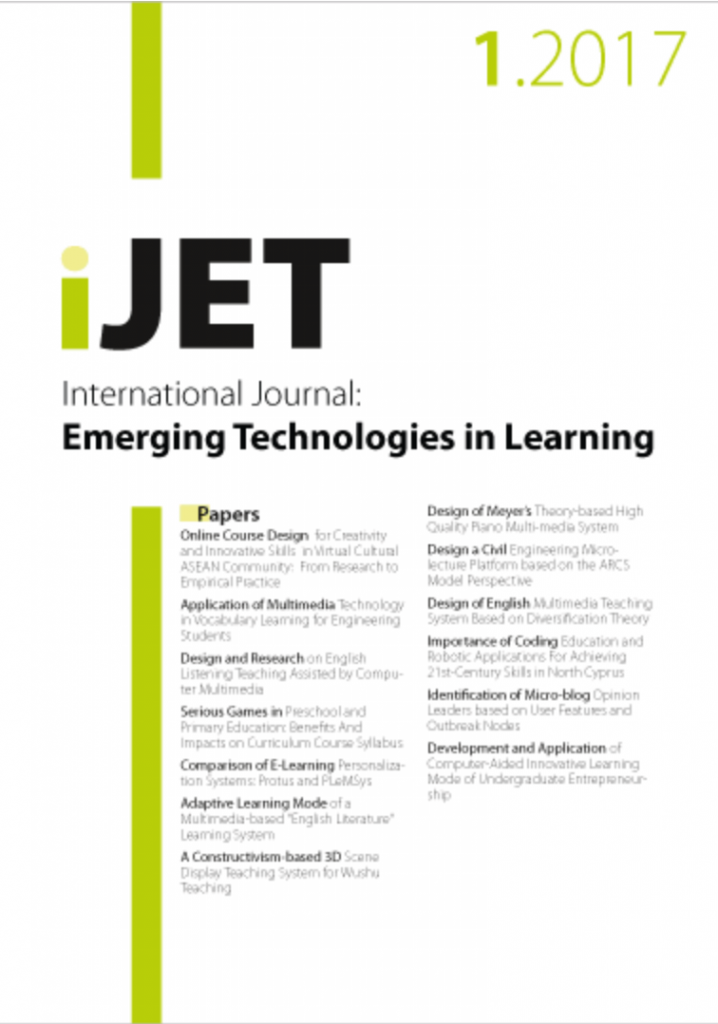
Issue 15(4) of our journal on emerging technologies for learning got published. Enjoy the readings as usual for free :-).

Table of Contents:

  • Adaptive MOOCs Based on Intended Learning Outcomes Using Naïve Bayesian Technique
  • A Modified Evaluation Approach for Direct Assessment of Program Outcomes: Medical Equipment Technology Program as Case Study
  • An Empirical Evaluation of E-Portfolio Critical Success Factors
  • Development and Integration of E-learning Services Using REST APIs
  • In-Game Instructions: The Extent of Their Usefulness in Enhancing the Vocabulary Acquisition of ESL Learners
  • An Advanced Authentication Scheme for E-evaluation Using Students Behaviors Over E-learning Platform
  • Design of STEM Activities: Experiences and Perceptions of Prospective Secondary School Teachers
  • Research on the Spatial Distribution Difference of Compulsory Education between China and Australia
  • Integration of Case Study and Digital Technologies in Physics Teaching Through the Medium of a Foreign Language
  • An Empirical Investigation on Students’ Acceptance of (SM) Use for Teaching and Learning
  • Investigating Generation Z’ Intention to Use Learners’ Generated Content for Learning Activity: A Theory of Planned Behavior Approach
  • Improving Student Capabilities through Research-Based Learning Innovation on E-Learning System
  • Virtual Situated Learning of Spoken English Based on Computer Simulation Technology
  • An Evaluation of Online and Automated English Writing Assistants: Collocations and Idioms Checkers
  • The Architecture of Project-Based Learning in the Supplementary Vocational Education System in a Higher Education
  • Extract Tacit Knowledge in the Learner Model of the Smart Tutoring System

[Link to Issue 15/04]

Nevertheless, if you are interested to become a reviewer for the journal, please just contact me :-).

[eLecture] MOOCs zur Steigerung der digitalen Kompetenzen #imoox #digiPH3

Logo digiPH
cc-by Lene Kieberl/Virtuelle PH

Im Rahmen der 3. Online-Tagung Hochschule digital.innovativ hab ich mich auch für einen Vortrag beworben und zwar zu „MOOCs zur Steigerung der digitalen Kompetenzen„. Ich werde am 30.3.2020 um 19.00 Uhr ein wenig zu den Aktivitäten berichten die wir im Entwicklungsverbund Süd-Ost für Lehramtsstudierende machen und freu mich natürlich auf viele Zuhörerinnen und Zuhörer die sich dann auch noch aktiv in die Diskussion einbringen 🙂 .

[Gesamtes Programm als .pdf]

[publication] The Use of Gamification in Gastronomic Questionnaires

We did a short publication about „The Use of Gamification in Gastronomic Questionnaires“ for the International Journal of Interactive Mobile Technologies (iJIM).

Abstract:
Obtaining customer opinions and customer wishes is increasingly becoming an important part of any entrepreneurial activity for determining customer satisfaction and, subsequently, optimizing products and services as well as strengthen customer loyalty. In catering, there are several ways to capture the guest’s satisfaction or dissatisfaction, as well as customer preferences and customer needs across different channels. One way to obtain a customer’s opinion is to provide a digital online questionnaire. Unfortunately, the participation of guests in such surveys is usually low. In addition, many online questionnaires are aborted prematurely, and questions which require an individual text answer are often left unanswered. Gamification is a process to use game ele-ments, game techniques and game mechanics from games in a different context in order to motivate and force people to do certain activities. This paper discusses whether the use of game elements in an existing gastronomical online questionnaire enhances the engagement of users and whether customer satisfac-tion remains the same. Based on an existing gastronomical online questionnaire from the company ITELL.SOLUTIONS GmbH a gamified questionnaire vari-ant has been developed. Game elements such as points, badges, avatar, story, progress bar and instant feedback have been included. The investigation showed that the use of gamification in questionnaires on open questions did not worsen the involvement of users. The customer satisfac-tion remained unchanged by the embedding of game elements too. Users of the expanded game questionnaire tended to give more precise and longer answers. The completion time also slightly increased for the gamified questionnaire. A direct comparison between the two variants of the questionnaire, showed that users preferred the design of the gamified questionnaire.

Homepage iJIM

[article @ journal’s homepage]
[article @ researchgate]

Reference: Prott, D., & Ebner, M. (2020). The Use of Gamification in Gastronomic Questionnaires. International Journal Of Interactive Mobile Technologies (IJIM), 14(02), pp. 101-118. doi:http://dx.doi.org/10.3991/ijim.v14i02.11695

[mooc] MOOC zu „Lehren und Lernen mit digitalen Medien I“ startet wieder #lul20

Auch heuer wird der MOOC zu „Lehren und Lernen mit digitalen Medien I“ gestartet. Parallel zur Lehrveranstaltung für alle Lehramtsstudierenden des Entwicklungsverbund Süd-Ost werden wir in 6 Wochen in die Grundbegriffe des technologiegestützten Lehrens und Lernens einführen:

Dieser MOOC beschäftigt sich, wie der Titel bereits voraussagt, mit dem Einsatz von digitalen Medien sowohl beim Lehren als auch beim Lernen. Es geht dabei vorranging um eine erste Einführung in den großen Themenkomplex und soll helfen, entsprechende Medienkompetenzen für den eigenen Unterricht zu erwerben.
Dabei werden neben Definitionen und Erklärungen auch Praxisbeispiele gezeigt sowie Tipps und Tricks für den Unterrichtsalltag gegeben, sodass im Anschluss ein erster eigener Einsatz möglich sein soll. Die Inhalte richten sich vorerst speziell an Studierende des Lehramts aller Unterrichtsfächer, aber natürlich auch an im Beruf stehende Lehrerinnen und Lehrer sowie an alle interessierten Personen, die mehr über die Einsatzmöglichkeiten digitaler Medien erfahren wollen.

Beschreibung auf iMooX.at

Selbstverständlich ist der MOOC offen für alle und man kann sich kostenlos dafür einschreiben:

[Kostenlose Anmeldung zum MOOC „Lehren und Lernen mit digitalen Medien I“]

[ijet, journal] Journal of Emerging Technologies in Learning Vol. 15 / No. 3 #ijet #research

Issue 15(3) of our journal on emerging technologies for learning got published. Enjoy the readings as usual for free :-).

Table of Contents:

  • Pedagogical Approaches in the Knowledge Society: The Flipped Classroom Method for the Development of Creativity and Dialogical Learning
  • Features of a Good Story for Non-Technical Adults to Learn Emerging Technologies
  • Forming the Basic Mathematical Knowledge among Technical Students
  • Impact of Agricultural Education on Students’ Career Choice: A Survey
  • A Case Study of Using Edmodo to Enhance Computer Science Learning for Engineering Students
  • M-WebQuest Development: Reading Comprehension of Senior High School Students in Indonesia
  • Restructuring Educational Institutions for Growth in the Fourth Industrial Revolution (4IR): A Systematic Review
  • Peer Learning, Self-Regulated Learning and Academic Achievement in Blended Learning Courses: A Structural Equation Modeling Approach
  • Does Technological Pedagogical Content Knowledge Impact on the Use of ICT In Pedagogy?
  • Guideline to Develop an Instructional Design Model Using Video Conference in Open Learning
  • Enhancing Students’ Higher-Order Thinking Skills (HOTS) Through an Inductive Reasoning Strategy Using Geogebra
  • Computer-Mediated Communication Portal Implementation Framework: A Higher Education Institutional Perspective
  • Mobile Game-Based Language Assessment
  • The Design of a Learning Process for Promoting Teamwork using Project-Based Learning and the Concept of Agile Software Development
  • A Probe into Spoken English Recognition in English Education Based on Computer-Aided Comprehensive Analysis
  • Virtual Mathematics Kits (VMK): Connecting Digital Media to Mathematical Literacy
  • Experiment of the Prototype of Online Learning Resources on Massive Open Online Course (MOOC) to Develop Life Skills in Using Technology Media for Hearing Impaired Students
  • Impact of WhatsApp Interaction on Improving L2 Speaking Skills

[Link to Issue 15/03]

Nevertheless, if you are interested to become a reviewer for the journal, please just contact me :-).

[workshop] Offene Bildungsressourcen in (Hoch-)Schulen

Ich darf heute wieder einen Workshop um das Thema Open Educational Resources halten. Hier einmal der Foliensatz:

Klicken Sie auf den unteren Button, um den Inhalt von www.slideshare.net zu laden.

Inhalt laden

Weiters besprechen wir auch den OER-Canvas für OER-Projekte, welchen ich bereits hier einmal veröffentlicht habe.

[publication] Potential of Bots for Encyclopedia #tugraz #research #bot

We are very pleased that our short chapter about „Potential of Bots for Encyclopedia“ for the special issue on „Digital Heritage and Related Tools„ got pusblished.

Abstract:
The wide range of applications and the capability to process and understand natural languages made chatbots very popular. Besides that, many applications chatbots are also used as information retrieval tools. Chatbots are changing the way users search for information. This document focuses on a chatbot that is used as an information retrieval tool. The chatbot enables information search in natural language in a geography domain. In case of a large number of search results, the chatbot engages users with clarification questions. It also provides support to users when uploading multimedia content to the website.

[full article @ journal’s homepage]
[full article @ researchgate]

Reference: Saracevic, M., Ebner, M. & Ebner, M. (2020) Potential of Bots for Encyclopedia. In: Special issue – „Digital Heritage and Related Tools“, Maurer, H. (ed.). IPSI BgD Transactions. 16(1). pp. 54-60

Österreichischer Preis für Freies Wissen

Die Wikimedia Österreich hatte einen Preis ausgeschrieben und schrieb auf ihrer Webseite:

Um das vielfältige Engagement für Freies Wissen zu würdigen, vergibt Wikimedia Österreich den Österreichischen Preis für Freies Wissen. Ausgezeichnet werden in zwei Preiskategorien zivilgesellschaftliche Einzelinitiativen sowie besonders engagierte Organisationen, die sich um Freies Wissen verdient gemacht haben.

Webseite

Es freut uns sehr, dass wir, als Abteilung Lehr- und Lerntechnologien, ebenfalls unter den nomierten Institutionen aufschienen. Das bestärkt uns natürlich noch mehr am Thema OER weiterzuarbeiten.

Noch mehr freut es mich aber, dass einer meiner Doktorväter, Prof. Hermann Maurer, einen Sonderpreis für sein Lebenswerk (Austria Forum) erhielt und ich ihn bei der Verleihung durch Fr. Bundesministerin Gewessler vertreten durfte.

Verleihung Hermann Maurer durch BMin Gewessler (Foto: Wikimedia Österreich)

[ijet, journal] Journal of Emerging Technologies in Learning Vol. 15 / No. 2 #ijet #research

Issue 15(2) of our journal on emerging technologies for learning got published. Enjoy the readings as usual for free :-).

Table of Contents:

  • Confronting the Challenges of MALL: Distraction, Cheating, and Teacher Readiness
  • Reference Model of E-learning and Quality to Establish Interoperability in Higher Education Systems
  • Digital Competence and Computational Thinking of Student Teachers
  • Towards a New Platform Based on Learning Outcomes Analysis For Mobile Serious Games
  • A Labyrinth Game for Blind Children Using Problem Solving Learning Model
  • Using Blended Learning Approach (BLA) in Inclusive Education Course: A Study Investigating Teacher Students’ Perception
  • Methodology of Forming the Readiness of Miners for Work in Extreme Situations Using a Training Complex
  • An Empirical Study of Application of Multimodal Approach to Teaching Reading in EFL in Senior High School
  • Can the Game-Based Learning Come? Virtual Classroom in Higher Education of 21st Century
  • Analyzing Student Performance in Programming Education Using Classification Techniques
  • Integrating Educational Technologies to Augment Learners‘ Academic Achievements
  • Motivating Medical Students Using Virtual Reality Based Education
  • Visual Education of Music Course for College Students Based on Human-Computer Interaction
  • Student Performance on an E-Learning Platform: Mixed Method Approach
  • Formation of Design and Research Competencies in Future Teachers in the Framework of STEAM Education
  • Competency Based Approach: Modeling and Implementation
  • Moodle-Based Learning: Motivating and Demotivating Factors

[Link to Issue 15/02]

Nevertheless, if you are interested to become a reviewer for the journal, please just contact me :-).

[publication] Microblogging with Padlet: Students’ New Writing Experience on A2–B1 Common European Framework of Reference for Languages (CEFR) #microblogging #research

I did together with my colleagues from Indonesia a small piece of research about „Microblogging with Padlet: Students’ New Writing Experience on A2–B1 Common European Framework of Reference for Languages (CEFR)„.

Abstract:
This research work aims to answer the question, compared to conventional media, whether the use of Padlet as a microblogging platform can improve students‘ German writing skills for A2 – B1 level CEFR standard. Students in the class A wrote with conventional paper sheet. Meanwhile, students in the class B wrote essay writing assignment through the Padlet platform. The study took place in Malang, Indonesia and lasted for one semester. In summary 45 students participated. The pre-test data indicated that there is no difference in the results of the pre-test in the control class and experiment class. The post test scores were obtained from two writing assessments in both classes. The test results indicated the data value sig 0.326 in the ANOVA table, which means that there are no differences in the post-test results in the two classes. Thus, it was concluded that the use of Padlet in microblogging activities in writing did not affect the results of student writing scores. Nevertheless, the use of Padlet has not any disadvantages, whereas students get additonal digital skills and respond additionally positively to the use of Padlet.

Abstract of the publication

[Full article @ journal’s homepage]
[Full article @ researchgate]

Reference: Kharis, S., Ebner, M., Wijayati, P, Hidayat, E., Afifah, L. (2020) Microblogging with Padlet: Students’ New Writing Experience on A2–B1 Common European Framework of Reference for Languages (CEFR). International Journal of Emerging Technologies in Learning (i-JET), 15(1), pp. 176-187