[publication] Experiences with a MOOC-platform — Who are our learners and what do they think about MOOCs? #research #MOOC #emoocs #imoox

Our contribution about „Experiences with a MOOC-platform — Who are our learners and what do they think about MOOCs?“ to this year eMOOCs conference in Naples got published now:

iMooX, the first and currently only Austrian MOOC platform, has been hosting xMOOCs since 2014. Directly after the start a survey of the first three MOOCs was conducted and published in 2015. In the meantime, the MOOC platform contains more than 45 courses and serves many thousands of learners. Therefore, we are investigating, if there is a change towards the learners themselves, their expectations and experiences regarding learning with MOOCs as well as with the platform. Using the exact same survey as years before it can be shown that there are little changes in the right directions or maybe it can be concluded that learning with MOOCs became more common to a broader public, at least in the academic world.

[Full article @ ResearchGate]

[Conference Proceeding eMOOCs 2019]

Reference: Leitner, P., Ebner, M. (2019) Experiences with a MOOC-platform — Who are our learners and what do they think about MOOCs?. Proceedings of Work in Progress Papers of the Research, Experience and Business Tracks at EMOOCs 2019co-located with the (European MOOCs Stakeholders Submmit 2019) Conference. pp 163-168. Naples, Italy

[publication] Influential factors for technology-enhanced learning: professionals’ views #tugraz #research

Our publication about „Influential factors for technology-enhanced learning: professionals’ views“ got published in the Journal of Research in Innovative Teaching &Learning.

Abstract:

Purpose
The literature includes several studies that define different critical success factors (CSF) which have to be considered to support the implementation of technology-enhanced learning (TEL) approaches. An analysis of such studies revealed that (1) regional differences seem to determine the CSF for TEL approaches, (2) certain CSF are relevant for TEL approaches in general, and (3) professionals in higher education determine which influential factors they consider when implementing TEL approaches. Thus, the question arises: in general, which influential factors do professionals in Austrian and German institutions of higher education actually consider when implementing TEL approaches?

Design/methodology/approach
The study is a quantitative research approach based on survey data.

Findings
The results show that certain influential factors seem to be generally important, such as the factors of respecting learning success or motivation. However, the outcome of the study also indicated that different moderating variables like experiences and personal relevance affect the professionals’ choices.

Originality/value
The originality and value are in the approach to identify generally important influential factors for the implementation of TEL approaches in Austrian and German institutions of higher education.

[Article @ Journal’s Homepage]

[Article @ ResearchGate]

Reference: Schweighofer, P., Weitlaner, D., Ebner, M., Rothe, H. (2019) Influential factors fortechnology-enhanced learning: professionals’ views. Journal of Research in Innovative Teaching &Learning, https://doi.org/10.1108/JRIT-09-2017-0023

[study] AHEAD – Internationales Horizon-Scanning: Trendanalyse zu einer Hochschullandschaft in 2030 #tugraz

Es freut uns, dass die Studie zu „AHEAD – Internationales Horizon-Scanning: Trendanalyse zu einer Hochschullandschaft in 2030“ nun öffentlich zugänglich ist. Wir haben über ein Jahr mit dem internationalen Konsortiuum arbeiten dürfen (AHEAD-Webseite) und freuen uns über das Ergebnis:

Das Projekt „(A) Higher Education Digital (AHEAD) – Internationales Horizon-Scanning / Trendanaly- se zur digitalen Hochschulbildung“ hat von Februar 2018 bis Januar 2019 eine systematische Ana- lyse der aktuellen Trends und Anforderungen in den Bereichen Wissens- und Kompetenzanforde- rungen unternommen und die neuesten Entwicklungen in der Lerntheorie, Didaktik sowie in der digitalen Bildungstechnologie vor dem Hintergrund einer (zunehmend) digitalisierten Hochschulbil- dung untersucht. Die Analyse bildete die Grundlage für ein Horizon-Scanning für die Hochschulbil- dung im Jahr 2030, das Zukunftsszenarien entwickelt, die sich soziale und digitale Innovationen zunutze machen, um künftige Anforderungen an das Hochschulwesen erfüllen zu können. Die Studie wurde im Auftrag des Bundesministeriums für Bildung und Forschung (BMBF) vom FiBS Forschungsinstitut für Bildungs- und Sozialökonomie zusammen mit dem Institut für Hochschul- entwicklung (HIS-HE) durchgeführt.

[Studie beim Hochschulforum Digitalisierung]

[Studie @ ResearchGate]

Zitation:
Orr, D., Lübcke, M., Schmidt, P. Ebner, M., Wannemacher, K., Ebner, M., Dohmen, D. (2019). AHEAD – Internationales Horizon-Scanning: Trendanalyse zu einer Hochschullandschaft in 2030 – Hauptbericht der AHEAD-Studie. Arbeitspapier Nr. 42. Berlin: Hochschulforum Digitalisierung. DOI: 10.5281/zenodo.2677655

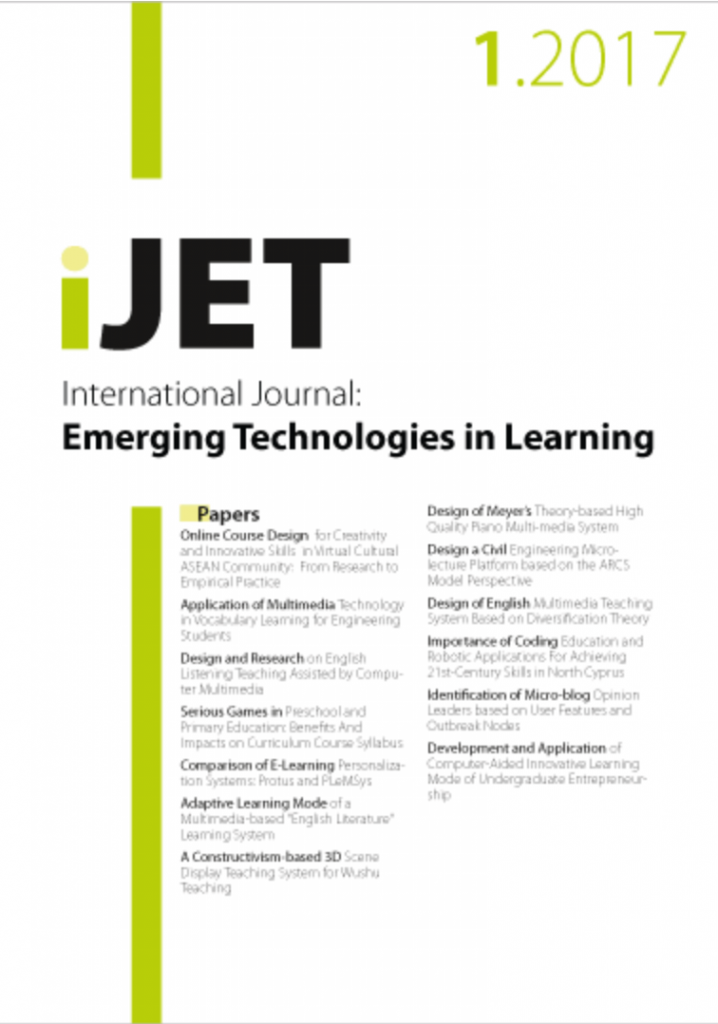
[ijet, journal] Journal of Emerging Technologies in Learning Vol. 14 / No. 10 #ijet #research

Issue 14(10) of our journal on emerging technologies for learning got published. Enjoy the readings as usual for free :-).

Table of Contents:

  • A Mind Map Teaching Mode for Sports Anatomy based on 3DBody
  • Structural Equation Model of Acceptance Cloud Learning for Sustainability Usage in Higher Education Institutes
  • Hybrid Learning by Using Brilian Applications as One of the Learning Alternatives to Improve Learning Outcomes in College
  • Learning Style Preferred by English and Computer Students in Indonesia Context
  • Factors Influencing ICT Adoption in Some Selected Secondary Schools in Ogun State, Nigeria
  • Redesigning and Implementing Traditional Musical Instrument in Integrated Technology Classroom
  • Family Volunteers as Alternative Future Resources: School Leaders’ Beliefs and Practices
  • The Classroom as a Makerspace: Use of Tablets and Cutting Plotter to Create Pop-Up Cards in Educational Environments
  • The Development Model of Semar Counselling to Improve the Self-Esteem of Vocational Students with Psychological Distress
  • Optimizing E-Learning Cognitive Ergonomics Based on Structural Analysis of Dynamic Responses
  • Scaffolded Block-based Instructional Tool for Linear Data Structures: A Constructivist Design to Ease Data Structures’ Understanding
  • Learning Analytics: Issues on the Pupil-Teacher Ratio in Public Primary Schools in Nigeria
  • Internet Utilization by the Students with Visual Impairment Disabilities
  • Design of Programming Experiment Course Platform Based on MOOCs

[Link to Issue 14/10]

Nevertheless, if you are interested to become a reviewer for the journal, please just contact me :-).

[publication] Learning Analytics Cockpit for MOOC Platforms #imoox #LearningAnalytics

Our article about an important extension for iMooX titled „Learning Analytics Cockpit for MOOC Platforms“ got publishes now. Enjoy reading 🙂
Abstract:

Within the sector of education, Learning Analytics (LA) has become an interdisciplinary field aiming to support learners and teachers in their learning process. Most standard tools available for Learning Analytics in Massive Open Online Courses (MOOCs) do not cater to the individual’s conception of where Learning Analytics should provide them with insights and important key figures. We propose a prototype of a highly configurable and customizable Learning Analytics Cockpit for MOOC-platforms. The ultimate goal of the cockpit is to support administrators, researchers, and especially teachers in evaluating the engagement of course participants within a MOOC. Furthermore, comparing learner’s individual activity to course wide average scores should enhance the self-assessment of students, motivate their participation, and boost completion rates. Therefore, several metrics were defined which represent and aggregate learner’s activity. From this predefined list, stakeholders can customize the cockpit by choosing from multiple visualization widgets. Although, the current prototype focuses only on a minimal group of stakeholders, namely administrators and researchers. Therefore, it is designed in a modular, highly configurable and customizable way to ensure future extensibility. It can be strongly carried out that customization is integral to deepen the understanding of Learning Analytic tools and represented metrics, to enhance the student’s learning progress.

[Article @ Book’s Homepage]

[Draft @ ResearchGate]

Reference: Maier, K., Leitner, P., & Ebner, M. (2019). „Learning Analytics Cockpit for MOOC Platforms“. In Emerging Trends in Learning Analytics. Leiden, Niederlande: Brill | Sense. doi: https://doi.org/10.1163/9789004399273_014

[publication] Why Will Technology Enhanced Language Learning be Essential for Pupils? #LearningAnalytics

Our publication about „Why Will Technology Enhanced Language Learning be Essential for Pupils?“ got published in the Bulletin of the Technical Committee on Learning Technology.
Abstract:

The availability of personal digital devices in schools and at home are offering new ways of engaging students in the area of language learning. In this publication, we present a new approach on writing and blogging for children aged 8 to 12 years, which is especially helpful for those who struggle with the acquisition of German orthography. On a web-based platform the pupils can write essays and blog them later on. Combined with learning analytics methods we offer individualized feedback during the process of writing and a training database with appropriate exercises to support the students‘ autonomous learning.

[Article @ Journal’s Homepage]

[Article @ ResearchGate]

Reference: Ebner, M., Ebner, M., Edtstadler, K. (2019) Why Will Technology Enhanced Language Learning be Essential for Pupils?. Bulletin of the Technical Committee on Learning Technology. 2019/1. pp. 14-17

[aufzeichung] Open Educational Resources #OER #tugraz

Im Rahmen einer Fortbildungsveranstaltung an der FH Joanneum wurde mein Kurzinput zu „Open Educational Resources“ aufgezeichnet und steht zum Nachhören zur Verfügung:

YouTube

Mit dem Laden des Videos akzeptieren Sie die Datenschutzerklärung von YouTube.
Mehr erfahren

Video laden

[publication] Bildungskonzil: Denkraum „Strategie – Wissenschaft“ #tugraz

Im Nachgang des Bildungskonzils ist nun wieder eine Zusammenfassung erschienen, wo ich den Beitrag für den Denkraum „Strategie – Wissenschaft“ beisteuren durfte.

Der Denkraum „Strategie – Wissenschaft“ hatte zum Ziel sich mit den Auswirkungen der Künstlichen Intelligenz auf die Bildung zu beschäftigen. Insbesondere sollte dabei der wissenschaftliche Sektor im Zentrum sein.

[Beitrag bei ResearchGate]

Zitation: Ebner, M. (2019) Zusammenfassung Bildungskonzil – Denkraum „Strategie – Wissenschaft“, Braucht Künstliche Intelligenz Bildung? Ergebnisse und Forderungen zur Bildungsdebatte in Österreich, WKO Niederösterreich, S. 38-41

[ijet, journal] Journal of Emerging Technologies in Learning Vol. 14 / No. 9 #ijet #research

Issue 14(9) of our journal on emerging technologies for learning got published. Enjoy the readings as usual for free :-).

Table of Contents:

  • The Impact of Using Drama in Education on Life Skills and Reflective Thinking
  • User Identification in the Process of Web Usage Data Preprocessing
  • Perception and Attitude Toward Self-Regulated Learning of Thailand’s Students in Educational Data Mining Perspective
  • Identification of Authors’ Profiles in Wiki Using Quiz Game Based on Clusters Analysis Techniques
  • Enhancing Learners’ Writing Performance through Blog-Assisted Language Learning
  • Smartphone Applications as a Teaching Technique for Enhancing Tertiary Learners‘ Speaking Skills: Perceptions and Practices
  • A Systematic Review of Personalized Learning: Comparison between E-Learning and Learning by Coursework Program in Oman
  • Using Multimedia-Assisted LINCS for Learning English Pronunciation
  • The Development of E-PAS Based on Massive Open Online Courses (MOOC) on Local History Materials
  • Implementation of Flipped Classroom Model and Its Effectiveness on English Speaking Performance
  • E-learning within the Field of Andragogy
  • YouTube Usage in the University Classroom: An Argument for its Pedagogical Benefits

[Link to Issue 14/9]

Nevertheless, if you are interested to become a reviewer for the journal, please just contact me :-).

[blogpost] Inverse Blended Learning – How to Deal with MOOCs More Successfully #tugraz #research #InverseBlendedLearning #MOOC

Sandra and I did a short blogpost for our colleagues in Philadelphia about our didactical approach of „Inverse Blended Learning„, based on our MOOC-research

We guess that all innovative educators especially in the field of educational technology love to work with MOOCs. We simply get the possibility to teach a broad audience and are working with learners really interested in the stuff. In recent years, the number of those courses have increased while impressive educational institutions report successful experiences.

[Link to the blogpost]