Im Rahmen der ICM 2019 in Marburg darf ich heute über „Bildungsinformatik als Motor zur digitalen Mündigkeit?“ reden. Hier gibt es dazu meine Folien:
Klicken Sie auf den unteren Button, um den Inhalt von www.slideshare.net zu laden.
Digitale Lehre an und rund um der Technischen Universität Graz
Veröffentlichungen zu jeweiligen Thema
Im Rahmen der ICM 2019 in Marburg darf ich heute über „Bildungsinformatik als Motor zur digitalen Mündigkeit?“ reden. Hier gibt es dazu meine Folien:
Klicken Sie auf den unteren Button, um den Inhalt von www.slideshare.net zu laden.
Ich durfte in der Zeitschrift „Bildung und Beruf“ eine kurze Einführung zu Learning Analytics geben – hier der Beitrag.
Zusammenfassung:
Learning Analytics ist ein sehr junges Forschungsgebiet aus dem Bereich der Bildungsinformatik und versucht durch das Sammeln und Gegenüberstellen von Daten Unterstützung im Lernprozess zu geben. Dieser Beitrag gibt eine Einführung und stellt die wesentlichen Aspekte, kritischen Punkte, Ziele und Methoden vor. Weiters soll dabei ein Bezug zur berufsbildenden Schulpraxis geschaffen werden.
Zitation: Ebner, M. (2019) Learning Analytics – eine Einführung. Bildung und Beruf. Ausgabe Februar 2019. S. 46-49. ISSN 2511-1353
At the DOIT Expert Meeting in Vienna I got the oppertunity to talk about „Maker education in curricula and beyond – current state and approaches in Austria“. Find here my slides:
Klicken Sie auf den unteren Button, um den Inhalt von www.slideshare.net zu laden.
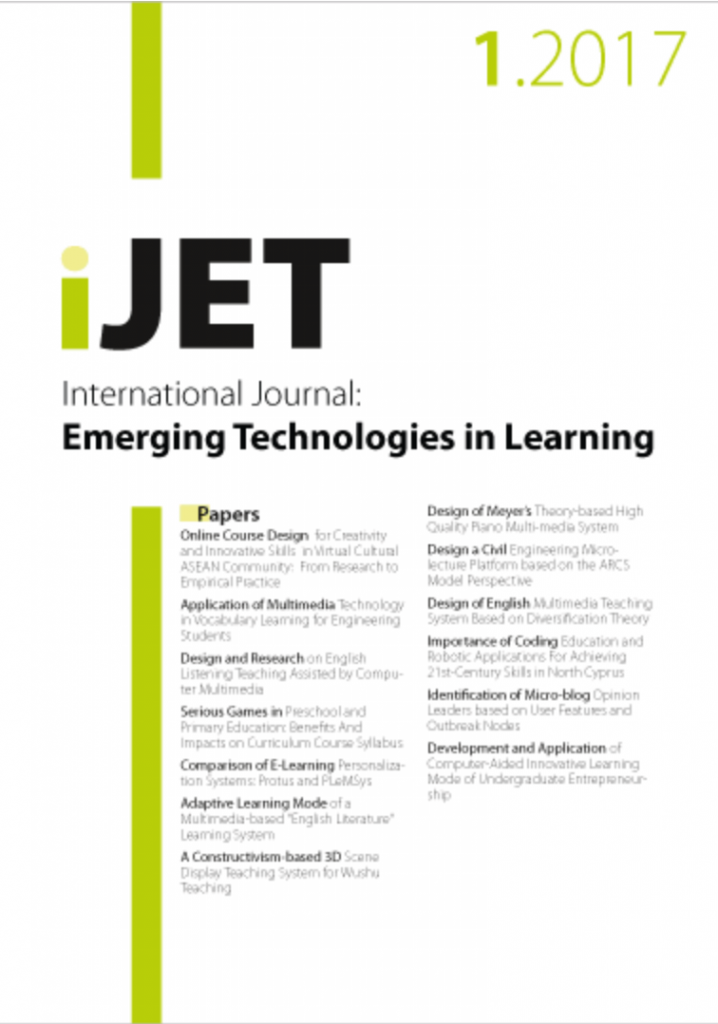 Issue 14(3) of our journal on emerging technologies for learning got published. Enjoy the readings as usual for free :-).
Table of Contents:
Nevertheless, if you are interested to become a reviewer for the journal, please just contact me :-).
Der heutige Workshop an der Universität Passau steht ganz im Zeichen von meinem mir wichtigstem Anliegen – Open Educational Resources. Hier gibt es den Foliensatz dazu:
Klicken Sie auf den unteren Button, um den Inhalt von www.slideshare.net zu laden.
Hinweis für Nicht-TeilnehmerInnen: Es handelt sich um einen Ganztages-Workshop.
Our chapter on „Learning Analytics Challenges to Overcome in Higher Education Institutions“ got published in the book „Utilizing Learning Analytics to Support Study Success“
Abstract:
While a large number of scientific publications explain the development of prototypes or the implementation of case studies in detail, descriptions of the challenges and proper solutions when implementing learning analytics initiatives are rare. In this chapter, we provide a practical tool that can be used to identify risks and challenges that arise when implementing learning analytics (LA) initiatives and discuss how to approach these to find acceptable solutions. In this way, implementers are given the opportunity to handle challenges early on and avoid being surprised at a critical moment in the project, which will save time, resources, and effort. We are aware that all aspects needed to successfully carry out learning analytics initiatives are co-dependent. Nonetheless, we identified and categorized the criteria necessary for implementing successful learning analytics initiatives. We conclude this chapter with an overview of the challenges faced and possible approaches that can be taken to facilitate the successful implementation of learning analytics.
Reference: Leitner P., Ebner M., Ebner M. (2019) Learning Analytics Challenges to Overcome in Higher Education Institutions. In: Ifenthaler D., Mah DK., Yau JK. (eds) Utilizing Learning Analytics to Support Study Success. Springer, Cham
Issue 14(2) of our journal on emerging technologies for learning got published. Enjoy the readings as usual for free :-).
Table of Contents:
Nevertheless, if you are interested to become a reviewer for the journal, please just contact me :-).
Im neuen Magazin erwachsenenbildung.at zum Thema „Lern- und Bildungsräume“ haben wir einen Beitrag zu „Makerspaces als Kreativ- und Lernräume“ geschrieben.
Zusammenfassung:
Makerspaces haben in den letzten Jahren auch in der Erwachsenenbildung verstärkt Aufmerksamkeit erlangt. Es handelt sich dabei um Werkstätten, die digitale Werkzeuge und auch traditionelle Werkzeuge anbieten (Fablabs, Hackerspace, Repaircafé, Offene Werkstätten etc.). Makerspaces sind vielerorts aber auch Räume, in denen sich Menschen unabhängig von der Arbeit oder dem Zuhause für das gute Gespräch und Miteinander treffen können – was auch als „Herz des Gemeinwesens“ und „Wurzel der Demokratie“ betrachtet werden kann. Der Maker-Bewegung inhärent ist das Primat des selbstorganisierten Lernens, d.h., die Aktiven im Makerspace fühlen sich selbst für ihre Projekte und Lernfortschritte verantwortlich und organisieren sich Informationen und Unterstützung. Gleichzeitig ist der Makerspace damit auch ein informeller Lernraum: Das „Learning by doing“, also das Lernen während der Arbeit und des Gestaltens, gehört zur Charakteristik der Arbeit in Makerspaces. In diesem Beitrag werden diese neuen Lernräume aus Perspektive der Erwachsenenbildung vorgestellt und diskutiert. (Red.)
[Artikel auf der Webseite des Magazin]
Zitation: Schön, Sandra/Ebner, Martin/Grandl, Maria (2019): Makerspaces als Kreativ- und Lernräume. Werkstätten mit digitalen Werkzeugen aus Perspektive der Erwachsenenbildung. In: Magazin erwachsenenbildung.at. Das Fachmedium für Forschung, Praxis und Diskurs. Ausgabe 35/36, 2019. Wien. Online im Internet: http://www.erwachsenenbildung.at/magazin/19-35u36/meb19-35u36.pdf. Druck-Version: Books on Demand GmbH: Norderstedt.
Issue 14(1) of our journal on emerging technologies for learning got published. Enjoy the readings as usual for free :-).
Table of Contents:
Nevertheless, if you are interested to become a reviewer for the journal, please just contact me :-).
Zusammen mit Sandra Schön hab ich einen weiteren Beitrag zu Open Educational Resources geschrieben und zwar die Zusammenfassung des Vortrages im Rahmen der 1. Online-Tagung der VPH 2018.
Kurzfassung:
In diesem Kurzbeitrag wird dargestellt, warum freie Bildungsressourcen für die Hochschule von morgen eine Notwendigkeit darstellen. Nach einer Begriffsdefinition werden Argumente für die Stärkung von OER vorgestellt. Darüberhinaus kann gezeigt werden, dass bereits auf viele existierende Ressourcen zugegriffen werden kann bzw. wie diese selbst genutzt werden können.
Zitation: Martin Ebner, Sandra Schön (2018). Open Educational Resources – eine Notwendigkeit für die digital gestützte Hochschullehre. In: Miglbauer, M., Kieberl, L., & Schmid, S. (Hrsg.). Hochschule digital.innovativ | #digiPH. Tagungsband zur 1. Online-Tagung, Graz: FNMA, S. 183-194. ISBN: 9783748120056