[podcast] Innovative Lehre in Embedded Systems und IoT #tugraz

Es freut uns, dass wir nun den 25. Teil unserer Podcast-Serie „Lehren – Lernen – Lauschen“ auf der TELucation-Webseite zur Verfügung stellen können. Diesesmal spricht Carlo Alberto Boano zu „Innovative Lehre in Embedded Systems und IoT„:

In dieser englischsprachigen Folge des Podcasts begrüßen wir Carlo Alberto Boano vom Institut für Technische Informatik (wo er die LENS-Gruppe leitet), der für seine Lehrveranstaltung „Embedded Internet“ mit dem Preis für exzellente Lehre ausgezeichnet wurde. In diesem Gespräch erzählt er von seinem internationalen Werdegang von Italien über Schweden und Deutschland bis nach Graz, wo er heute im Bereich Embedded Systems und Internet of Things tätig ist. Er spricht über seine Forschung an winzigen, batterielosen IoT-Geräten, die nachhaltige Smart-City-Anwendungen ermöglichen, und über seine Begeisterung für die Lehre. Außerdem erklärt er, wie er Studierende vom Bachelor- bis zum PhD-Level mit interaktiven Methoden und praxisnahen Projekten motiviert, warum Nachhaltigkeit für ihn zentral ist und wie er mit innovativen Ansätzen wie Feedback-Tools und offenen Laborformaten Lernfreude und Eigenständigkeit fördert.

[#25 – Carlo Alberto Boano: Innovative Lehre in Embedded Systems und IoT]

Und nicht übersehen – der Podcast ist auch in allen gängigen Portalen verfügbar:

[publication] aicast: Combining AI-Generated and Instructor-Defined Content in Educational Podcasts #research #tugraz

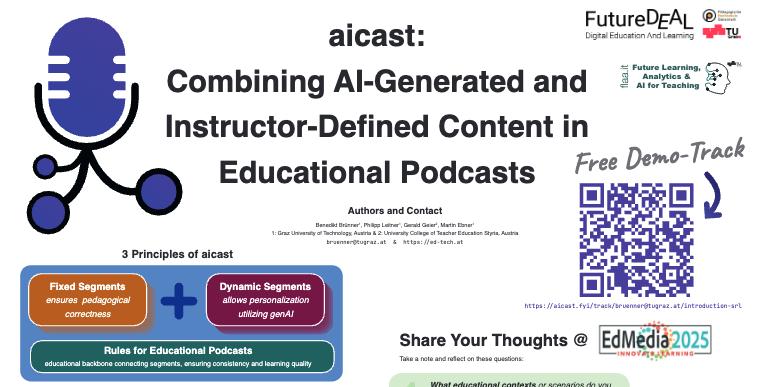
At this year’s ED-Media conference, we introduced a new AI-based concept for educational podcasts: „aicast: Combining AI-Generated and Instructor-Defined Content in Educational Podcasts„.

Abstract:
Generative AI is transforming educational content. In this poster, we present aicast.fyi, an open-source platform for producing personalized educational podcasts that combine AI-generated and instructor-defined content. Each track contains dynamic and fixed segments. Instructors define guiding questions during track design, ensuring alignment with learning objectives. This hybrid approach addresses concerns about maintaining instructional integrity with automation and personalization. The poster provides an architectural overview and demonstrates how the system integrates text generation and voice synthesis to produce audio-based learning experiences. Instructional designers must play an active role in shaping AI-assisted educational tools. This poster invites educators, designers, and researchers to engage with aicast and collaborate on developing high-quality, responsible, and learner-centered audio content. By allowing learners to control content sequences and personalize segments based on their own inputs, aicast.fyi also supports self-regulated learning (SRL), empowering users to take ownership of their educational journey.

[draft @ ResearchGate]
[full article @ conference website]

Reference: Brünner, B., Leitner, P., Geier, G. & Ebner, M. (2025). aicast: Combining AI-Generated and Instructor-Defined Content in Educational Podcasts. In T. Bastiaens (Ed.), Proceedings of EdMedia + Innovate Learning (pp. 148-152). Barcelona, Spain: Association for the Advancement of Computing in Education (AACE). Retrieved June 4, 2025 from https://www.learntechlib.org/primary/p/226139/

[publication] Workshop for Special Interest Group Emerging Technologies for Learning and Teaching: Exploring Educational Podcasts with AI #tugraz #research

We also did workshops at this year’s ED-Media conference. One of them was titled „Workshop for Special Interest Group Emerging Technologies for Learning and Teaching: Exploring Educational Podcasts with AI“ and followed the idea of open discussions.

Abstract:
How can educators unleash the power of AI without losing control over core educational strategies? In this workshop, we introduced aicast, an open-source platform for educational podcasts that combines the best of both worlds: AI-generated elements for personalization and flexibility, and fixed elements, with instructor-defined content to ensure pedagogical accuracy. This hybrid approach reduces the risks associated with AI-generated materials like hallucinations. Attendees experienced how the platform utilizes LLMs like ChatGPT for personalized content authoring and ElevenLabs for high-quality voice synthesis, enabling real-time creation of educational audio content. After a short demo and hands-on session, participants engaged in a guided discussion: What is the core of an educational podcast? Most importantly from the perspective of an instructional designer, how must an educational podcast be? This session was part of the Special Interest Group on Emerging Technologies for Learning and Teaching at the ED-Media 2025 conference.

[draft @ ResearchGate]
[full article @ conference website]

Reference: Ebner, M. & Brünner, B. (2025). Workshop for Special Interest Group Emerging Technologies for Learning and Teaching: Exploring Educational Podcasts with AI. In T. Bastiaens (Ed.), Proceedings of EdMedia + Innovate Learning (pp. 1375-1376). Barcelona, Spain: Association for the Advancement of Computing in Education (AACE). Retrieved June 4, 2025 from https://www.learntechlib.org/primary/p/226347/.

[workshop] Exploring Educational Podcasts with AI #edmedia25

We are delighted that we can offer another workshop for our „SIG“ at this year’s EDMedia conference in Barcelona titled „Exploring Educational Podcasts with AI

Abstract:
How can educators unleash the power of AI without losing control over core educational strategies? In this workshop, we will introduce aicast, an open source platform for educational podcasts that combines the best of both worlds: AI-generated elements for personalization and flexibility, and fixed elements, with instructor-defined content to ensure pedagogical accuracy. This hybrid approach reduces the risks associated with AI-generated materials like hallucinations. Attendees will learn how the platform utilizes LLMs like ChatGPT for personalized content authoring and ElevenLabs for high-quality voice synthesis, enabling real-time creation of educational audio content. After a short demo and hands-on session, participants will engage in a guided discussion: What is the core of an educational podcast? How do structure, tone, and repetition affect learning? Most importantly from the perspective of an instructional designer, how must an educational podcast be? This session is part of the Special Interest Group on Emerging Technologies for Learning and Teaching and invites participants to think critically about the role of AI in educational podcasting. Even more we invite instructional designer to collaborate with us to bring educational podcast to a next level
.

We would love to meet you in Barcelona, even more, if you can join our workshop – cu there 🙂

[Link to conference’s website]

[podcast] Praxisnahe Lehre in der Geodäsie #tugraz #telucation

Es freut uns, dass wir nun den 24. Teil unserer Podcast-Serie „Lehren – Lernen – Lauschen“ auf der TELucation-Webseite zur Verfügung stellen können. Diesesmal spricht Werner Lienhart zu „Praxisnahe Lehre in der Geodäsie“:

Werner Lienhart vom Institut für Ingenieurgeodäsie und Messsysteme spricht in diesem Podcast über die vielfältigen Aspekte der Lehre in der Geodäsie. Er erzählt, wie Studierende an der TU Graz durch praxisnahe Lehrmethoden auf die Herausforderungen ihres Fachgebiets vorbereitet werden – von realen Messungen an Brücken und Tunnelbaustellen bis hin zur Arbeit mit digitalen Zwillingen und Sensorik. Dabei betont er die Bedeutung des Zusammenspiels von Theorie und Praxis, die Rolle von Aha-Momenten im Lernprozess und den Einfluss der Ingenieurgeodäsie auf Nachhaltigkeit und Infrastrukturüberwachung. Ein Einblick in eine faszinierende Disziplin, die weit mehr umfasst, als man auf den ersten Blick vermutet.

[#24 – Werner Lienhart: Praxisnahe Lehre in der Geodäsie]

Und nicht übersehen – der Podcast ist auch in allen gängigen Portalen verfügbar:

[podcast] Praxisnahe Laborlehre im Fokus #tugraz #telucation

Es freut uns, dass wir nun den 23. Teil unserer Podcast-Serie „Lehren – Lernen – Lauschen“ auf der TELucation-Webseite zur Verfügung stellen können. Diesesmal spricht Tanja Wrodnigg zu „Praxisnahe Laborlehre im Fokus“:

In dieser Folge spricht Tanja Wrodnigg vom Institut für Chemie und Technologie biobasierter Systeme über ihre vielfältigen Tätigkeiten – von Grundlagenforschung im Bereich Kohlenhydratchemie über ihre Arbeit als Studiendekanin bis hin zur intensiven Laborarbeit mit Studierenden. Ihr Schwerpunkt liegt auf der praxisnahen Ausbildung im Chemiestudium, die international für ihre hohe Qualität bekannt ist. Tanja Wrodnigg erläutert, warum die Laborlehre nicht nur fachlich, sondern auch zwischenmenschlich bereichernd ist und wie sie Studierende durch persönliche Betreuung fördert. Außerdem teilt sie ihre Erfahrungen als Studiendekanin und Mentorin. Sie betont die Bedeutung von Kommunikation, Teamarbeit und Diversität – sowohl in der Lehre als auch in der Wissenschaft.

[#23 – Tanja Wrodnigg: Praxisnahe Laborlehre im Fokus“]

Und nicht übersehen – der Podcast ist auch in allen gängigen Portalen verfügbar:

[podcast] Bildung für nachhaltige Entwicklung #tugraz #telucation

Es freut uns, dass wir nun den 22. Teil unserer Podcast-Serie „Lehren – Lernen – Lauschen“ auf der TELucation-Webseite zur Verfügung stellen können. Diesesmal spricht Dominik Ruffeis zu „Bildung für nachhaltige Entwicklung“:

Dominik Ruffeis (Sprachen, Schlüsselkompetenzen und Interne Weiterbildung bzw. Teaching Academy) spricht in diesem Podcast über Bildung für nachhaltige Entwicklung. Er erklärt, warum BNE in die eigene Hochschullehre integriert werden sollte und gibt praktische Methodentipps zur Umsetzung, wie z. B. die Toolbox zur Transformation der Hochschullehre

[#22 – Dominik Ruffeis „Bildung für nachhaltige Entwicklung“]

Und nicht übersehen – der Podcast ist auch in allen gängigen Portalen verfügbar:

[podcast] Rechtliche Aspekte von KI in der Lehre #tugraz #telucation

Es freut uns, dass wir nun den 22. Teil unserer Podcast-Serie „Lehren – Lernen – Lauschen“ auf der TELucation-Webseite zur Verfügung stellen können. Diesesmal spricht Viktoria Moser zu „Rechtliche Aspekte von KI in der Lehre“:

Viktoria Moser (Juristin bei der Organisationseinheit Lehr- und Studienentwicklung des Vizerektorats Lehre) spricht in dieser Folge über rechtliche Grundlagen, die die universitäre Lehre regeln. Insbesondere geht sie dabei auf den aktuellen Stand und offene rechtliche Fragen in Bezug auf den Einsatz von KI in Lehrveranstaltungen, Abschlussarbeiten und Prüfungen ein.

[#21 – Viktoria Moser „Rechtliche Aspekte von KI in der Lehre“]

Und nicht übersehen – der Podcast ist auch in allen gängigen Portalen verfügbar:

[podcast] KI in der Hochschuldidaktik #tugraz #telucation

Es freut uns, dass wir nun den 20. Teil unserer Podcast-Serie „Lehren – Lernen – Lauschen“ auf der TELucation-Webseite zur Verfügung stellen können. Diesesmal spricht Verena Schwägerl-Melchior zu KI in der Hochschullehre:

Verena Schwägerl-Melchior (Sprachen, Schlüsselkompetenzen und Interne Weiterbildung bzw. Teaching Academy der TU Graz) spricht in diesem Podcast über die Entwicklung und die Angebote der Teaching Academy sowie über die Auswirkungen von KI auf die Hochschullehre und Hochschuldidaktik. Sie erzählt, was KI in der Vorbereitung und Durchführung von Lehre, im wissenschaftlichen Schreiben und in der Leistungsfeststellung bieten kann, aber auch, wo Vorsicht geboten ist oder alternative Methoden gefunden werden müssen, um die Qualität der Lehre aufrechtzuerhalten.

[#20 – Verena Schwägerl-Melchior: KI in der Hochschullehre]

Und nicht übersehen – der Podcast ist auch in allen gängigen Portalen verfügbar: