[publication] “How Satisfied Are You With Your MOOC?”- A Research Study About Interaction in Huge Online Courses #mooc

Our reworked publication about „“How Satisfied Are You With Your MOOC?”—A Research Study About Interaction in Huge Online Courses“ got published in the journal of Journalism and Mass Communication and is free available :-).
Abstract:

This research work investigates the importance and satisfaction on the level of interaction in MOOCs (Massive Open Online Courses) as perceived by learners and instructors. The study is based on data from online students and instructors of MOOCs. Two web-based surveys were used to collect data. The theoretical bases of the two surveys is the five-step model for interactivity developed by Salmon (2001). Salmon’s model proposed effective e-moderating in five discrete steps (Access and Motivation, Online Socialization, Information Exchange, Knowledge Construction and Development). Findings of the survey revealed that students rated the importance of interactions in MOOCs as highly important. However, they reported negatively the availability of many criteria suggested by Salmon. On the other hand, Instructors rated nearly half of Salmon criteria as less important, and consequently did not offer them in their MOOCs. In addition, the study revealed that students and instructors rated a high level of satisfaction in MOOCs. In contrast, some students expressed their less satisfaction of interaction in MOOCs. They revealed their dissatisfaction to that lack of instructor interaction. Instructors suggested that it is impossible for instructor to interact with this huge number of students in MOOCs. As a result, some strategies were suggested to enhance instructor interaction with students of MOOCs

[Full article @ ResearchGate]

[Full article @ Journal Homepage]

Reference: Khalil, H., Ebner, M. (2015) „How Satisfied Are You With Your MOOC?“ —A Research Study About Interaction in Huge Online Courses, Journalism and Mass Communication 5 (12), pp. 629 – 639
Schummelzettel Nr. 2 #imoox #OER

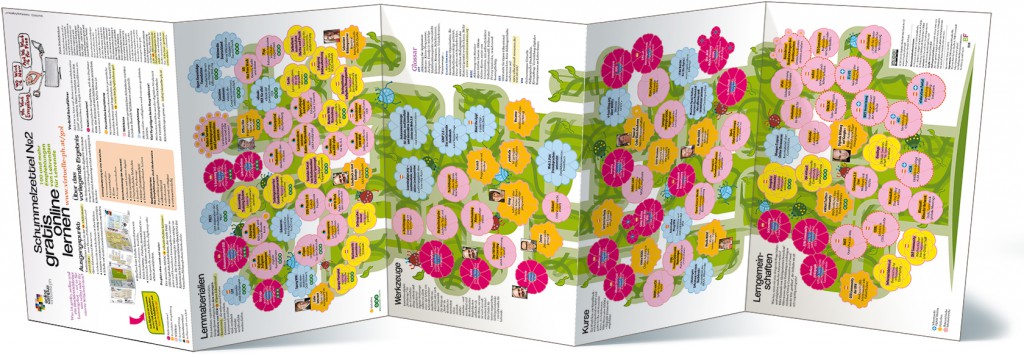
SchummelzettelDas Schönste an Open Educational Resources ist, wenn tatsächlich etwas mit den zur Verfügung gestellten Inhalten gemacht wird. So geschehen bei der Virtuellen PH in Zusammenarbeit mit engagierten Lernenden beim Gratis Online Lernen MOOC bei iMooX. Entstanden ist der Schummelzettel Nr. 2, der sämtliche Links des MOOCs übersichtlich darstellt:

Der Schummelzettel No2: Gratis Online Lernen – 100 und mehr Empfehlungen von Lehrenden für Lehrende ist das Ergebnis einer weiteren digitalen Werkstatt, die sich im Rahmen des Open Air #2 zusammen gefunden hat. Mehr zum Open Air #2 – Gratis Online Lernen finden Sie weiter unten.

[Link zum Schummelzettel]

[publication] Google Glass in Face-to-face Lectures – Prototype and First Experiences #AR #research

Our paper about „Google Glass in Face-to-face Lectures – Prototype and First Experiences“ got published in the International Journal of Interactive Mobile Technologies.
Abstract:

Graz University of Technology has a long tradition in doing technology-enhanced courses. Following the latest trends, as mentioned in the NMC Horizon Report [32], we reviewed the possibility to use a wearable technology, in our case the Google GlassTM, in courses to improve the interaction between the lecturer and the audience with a special focus on huge classes. The lack of interaction in traditional face-to-face lectures is a well-known problem with a long research history [4], [12]. New technologies in Audience Response Systems (ARS) offer new ways to improve the interaction between teacher and student by enabling to ask questions to the audience [5] to get instant feedback during a lecture. Currently many types of web-based ARSs are available on the market [15]. Our research focused on finding an ARS suitable for the visualization in the Google Glass display. Further we developed a prototype and described first practical experiences.

[Full Text @ ResearchGate]

Reference: Ebner, M., Mühlburger, H., Ebner, M. (2016) Google Glass in Face-to-face Lectures – Prototype and First Experiences. International Journal of Interactive Mobile Technologies (iJIM). 10(1). pp. 27-34

Erstaunen in UK: … ein Staatspreis für Erwachsenebildung mit einem MOOC? #gol15 #gol14 #imoox

John Field, der britische „Learning Professor“ hat erstaunt zur Kennnis genommen, welch hohe Wertschätzung „Gratis Online Lernen“ mit der Verleihung des Österreichischen Staatspreis für Erwachsenenbildung erhält.

Er schreibt in seinem Blog dazu:

In the field of adult learning, there is every possibility that MOOCs will thrive while organised face-to-face provision nose-dives. It doesn’t take much imagination to conceive of a policy maker or two who asks why the state is funding courses in adult education centres when tens of thousands can follow a MOOC much more cheaply.

But MOOCs and publicly funded adult education can rub along quite nicely. That’s the message I take, at any rate, from hearing that this year’s National Adult Education Prize in Austria was awarded to a MOOC called ‘Gratis Online Lernen’ (‘Learning Online for Free’).Its aim was to offer an introduction to online learning for people who have only mastered the basics of using the internet.

Taken by 1,500 people the first time it was offered, the MOOC was developed jointly by researchers in e-learning and worker education working in collaboration with the Austrian Adult Education Association and over 40 different providers.

The prize was duly handed over by Gabriele Heinisch-Hosek, a Minister in the current government. That’s nice. Our ministers, sadly, are more likely to sneer at adults who need an introduction to using the internet. But we do have plenty of experience of celebrating adult learners and providers, and we should be happy to welcome the creators of MOOCs to our ranks.

Bildschirmfoto 2015-12-07 um 14.15.11

[presentation, emoocs] How to integrate and automatically issue Open Badges in MOOC platforms #emoocs2016 #imoox #tugraz

EMOOCs 2016Today the EMOOCs conference is starting – for sure it will be a great event. If you did not find time to visit us, you can follow the twitter stream with the hashtag #emoocs2016. The whole conference proceeding is already available on ResearchGate.
Futhermore I will also give a presentation today about our Open Badges implemention for the iMooX platform. Here you can pick up the slides:

Klicken Sie auf den unteren Button, um den Inhalt von www.slideshare.net zu laden.

Inhalt laden

[publication] Design für eine Plattform zum Schreibenlernen im Grundschulalter #LearningAnalytics

IDeR BlogIm Rahmen der heurigen DeLFI-Tagung hab ich kurz unser kürzliches begonnenes EU-Projekt, den IDeR-Blog, vorstellen können. Hier gibt es nun noch auch die zugehörige Publikation.
Zusammenfassung:

Viele Jugendliche haben mit Lese- und Schreib- oder Rechtschreibproblemen zu kämpfen. Werden diese nicht erkannt und gefördert, wirkt sich das im Erwachsenenalter negativ aus [SMH08]. In diesem Beitrag beschreiben wir ein Informationssystem für den deutschsprachigen Raum, das sich derzeit im Aufbau befindet und mit Hilfe von Learning Analytics versucht personalisiertes Lernen zu fördern. Die Zielgruppe des Forschungsprojekts sind Kinder im Alter zwischen 8 und 12 Jahren. Schülerinnen und Schüler können Texte in Form von Blogeinträgen verfassen, welche automatisiert auf orthografische Fehler ausgewertet werden. Die qualitative Analyse wird mit Hilfe eines eigens dafür entwickelten Wörterbuches umgesetzt und den Lehrkräften zur Verfügung gestellt.

[Link zum Beitrag]

Zitation: Ebner, M., Taraghi, B., Ebner, M., Aspalter, C., Biermeier, S., Edtstadler, K., Gabriel, S., Goor, G., Gros, M., Huppertz, A., Martich, S., Steinhauer, N., Ullmann, M., Ziegler, K. (2015) Design für eine Plattform zum Schreibenlernen im Grundschulalter. In: Proceedings of DeLFI Workshops 2015 co-located with 13th e-Learning Conference of the German Computer Society (DeLFI 2015)München, Germany, September 1, 2015, S. 118-122.

[publication] Making mit Kindern. Mit digitalem Do-it-yourself den Alltag von morgen gestalten #LAMultimedia

Zusammen mit Sandra Schön habe ich in der aktuellen LA Multimedia über die „Maker Days for Kids“ sowie den aktuellen Online-Kurs „Making mit Kindern“ berichtet.

Zusammenfassung:

Die Maker-Bewegung versucht durch Einsatz von unterschiedlichen traditionellen und digitalen Hilfsmitteln neue Produkte zu kreieren. Bei den Making-Aktivitäten mit Kindern und Jugendlichen steht daher die Förderung der Kreativität und Kompetenz im Mittelpunkt, um in die Welt von morgen gestalten.

[Link zur Draftversion]

Zitation: Schön, Sandra und Ebner, Martin (2015). Making mit Kindern. Mit digitalem Do-it-yourself den Alltag von morgen gestalten. In: LA Multimedia, Ausgabe Heft 4 (November 2015), Beitrag gebührenpflichtig zugänglich unter URL: https://www.lamultimedia.de/heft/57150400/Ausgabe-November-Heft-4-2015-Gesundheit-foerdern

[publication] Mobile Learning and STEM – First Experiences in a Public Secondary High School in Ghana #mlearning

Our contribution to the book „Mobile Learning and STEM: Case Studies in Practice“ titled „Mobile Learning and STEM – First Experiences in a Public Secondary High School in Ghana“ got published.
Abstract:

The publication provides preliminary findings of an interdisciplinary project, where working in teacher-student teams was experienced as a solution to exploit the capacity of mobile devices for learning in combination with launching STEM (Science, Technology, Engineering, and Mathematics) interventions in order to enrich activities in learning and teaching. In three workshops it was investigated how mobile devices can trigger creativity and initiate shifts in education-practice at a Secondary High School in Ghana. Teacher-student collaboration was identified as stimulation for content development and tackling cross-disciplinary learning activities.

[Draft version at ResearchGate]

Reference: Grimus, M., Ebner, M. (2016) Mobile Learning and STEM – First Experiences in a Senior High School in Ghana. In: Mobile Learning and STEM: Case Studies in Practice. Crompton, H, Traxler, J. (ed.) Routledge. pp. 1-16