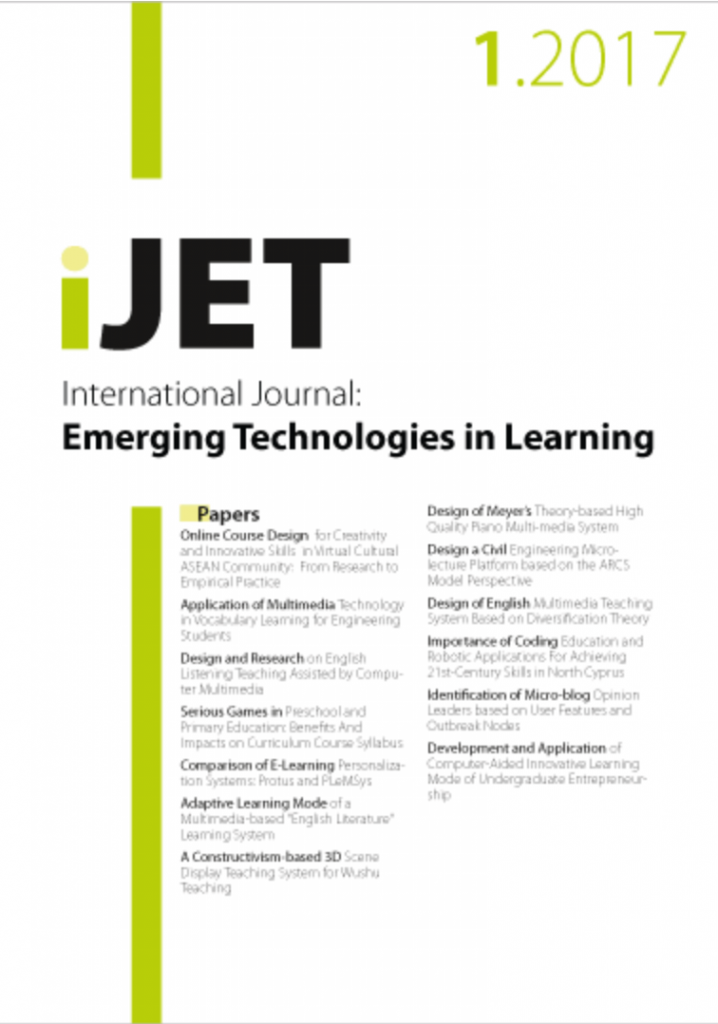
[ijet, journal] Journal of Emerging Technologies in Learning Vol. 16 / No. 21 #ijet #research

Issue 16(21) of our journal on emerging technologies for learning got published. Enjoy the readings as usual for free :-).

Table of Contents:

  • A Proposed Architecture of an Intelligent System for Assessing the Student’s UML Class Diagram
  • From the Music Learning Process to its Effective Design
  • Object-Based Trace Model for Automatic Indicator Computation in the Human Learning Environments
  • Automatic Recommendation System of College English Teaching Videos Based on Students’ Personalized Demands
  • Students’ Perceptions of Online Lecture Delivery Modes: Higher Education During Covid-19 Pandemic and Beyond
  • An Empirical Study on the Effect and Quality of Situational English Teaching
  • Evaluation Criteria for Quality Education of Physical Education Lessons Based on Logical Analysis
  • The Student-centered STEM Learning Model Based on Artificial Intelligence Project: A Case Study on Intelligent Car
  • Remote Academic Platforms in Times of a Pandemic
  • Digital Technologies for Heritage Teaching: Trend Analysis in New Realities
  • Application of Project-Driven Teaching in College English Class
  • Development Strategies for Higher Education Institutions Based on the Cultivation of Core Competitiveness
  • E-Learning Recommendation System for Big Data Based on Cloud Computing
  • Online Education and Engineering Students‘ Perception of Pedagogical Quality, in Learning the Process Control Course with MATLAB
  • Ideals and Virtual Realities
  • Development of a Set of Requirements for the Hardware and Software of LMS Services of the University
  • Modification of the Role of a Teacher Under the Conditions of Distance Learning

[Link to Issue 16/21]

Nevertheless, if you are interested to become a reviewer for the journal, please just contact me :-).

[ijet, journal] Journal of Emerging Technologies in Learning Vol. 16 / No. 20 #ijet #research

Issue 16(20) of our journal on emerging technologies for learning got published. Enjoy the readings as usual for free :-).

Table of Contents:

  • The Effects of Online Learning on Students’ Performance: A Comparison Between UK and Jordanian Universities
  • Evaluation of Innovation and Entrepreneurship Ability of Computer Majors Based on Neural Network Optimized by Particle Swarm Optimization
  • Cognitive Development, Learning Strategies and Academic Performance in The First Stage of University Education
  • Effect of Entrepreneurship Education for College Students in the Context of a Mobile Internet Environment
  • Use of Digital Media in Higher Education across Country Contexts: A Comparison between Germany and Thailand
  • Problem-oriented Teaching Mode based on Data Mining Technology in the Sports Psychology Classroom
  • Analysis of Peculiarities of Using Digital Technologies in the University Professional Training Content
  • Use of Technological Equipment for E-learning in Peruvian University Students in Times of Covid-19
  • Influence of Music Intervention on Emotional Control and Mental Health Management Self-efficacy of College Students
  • Diversified Education Strategies and Objectives for Advanced Tourism Talents
  • Adapt Learning Path by Recommending Problems to Struggling Learners
  • Students’ Acceptance of Discord as an Alternative Online Learning Media
  • Investigating the Effect of Virtual Laboratory Simulation in Chemistry on Learning Achievement, Self-Efficacy, and Learning Experience
  • Psychological and Pedagogical Problems of Computer-aided Teaching of Natural Sciences
  • Teachers’ Views on The Use of Chatbots to Support English Language Teaching in a Mobile Environment
  • A Proposed Ethics Code for Online Learning During Crisis
  • Distance Education and Student Satisfaction Regarding the Pedagogical Support Services Provided in Virtual Teaching-learning Environments
  • Smart Tutoring System: A Predictive Personalized Feedback in a Pedagogical Sequence

[Link to Issue 16/20]

Nevertheless, if you are interested to become a reviewer for the journal, please just contact me :-).

[publication] Change of IT equipment and communication applications used by first-semester students from 2011 to 2020 and possible effects of the COVID-19 pandemic: Analysis of a long-term #tugraz #research #edil21

Our contribuation to this year ED-Media 2021 conference about „Change of IT equipment and communication applications used by first-semester students from 2011 to 2020 and possible effects of the COVID-19 pandemic: Analysis of a long-term“ got published. The slides are already here online.

Abstract:
The technical equipment of first-year students and their preferred communication applications are changing. This paper presents the two latest, unpublished surveys of first-year students at Graz University of Technology (TU Graz) from 2019 (N=824) and 2020 (N=955) and compares the results concerning devices and applications with the results of the surveys conducted since 2011. The analysis shows that laptops, desktop computers and smartphones are among the most important and widespread multifunctional devices, while the MP3 player in particular or the social media application Facebook have lost most of their former importance. The increasing importance of photo-based social media applications, first and foremost Instagram, is striking. If comparing the data from 2019 to those from 2020, the first academic year start that took place within the COVID-19 pandemic, the same applies to the use of Facebook and Facebook Messenger, which now only have the same minor significance as Telegram, Signal, Skype, or others. Concerning effects of the COVID-19 pandemic on the equipment and communication tools used, the authors see a major impact on the prevalence of portable powerpacks.

[article @ learntechlib]
[preprint @ ResearchGate]

Reference: Nagler, W., Mair, B., Ebner, M., Edelsbrunner, S. & Schön, S. (2021). Change of IT equipment and communication applications used by first-semester students from 2011 to 2020 and possible effects of the COVID-19 pandemic: Analysis of a long-term survey. In T. Bastiaens (Ed.), Proceedings of EdMedia + Innovate Learning (pp. 107-114). United States: Association for the Advancement of Computing in Education (AACE). Retrieved August 15, 2021 from https://www.learntechlib.org/primary/p/219645/.

[publication] Effects of Remote Learning on Practitioner Integration #tugraz #research #edil21

Our contribuation to this year ED-Media 2021 conference about „Effects of Remote Learning on Practitioner Integration“ got published. The slides are already here online.

Abstract:
The widespread inclusion of experts and practitioners in educational settings to teach and collaboratively learn can help alleviate a multitude of systemic problems. A new, inclusive path to teach youth the skills needed to utilise the problem solving approach named computational thinking is explored in this case study. During 2020 remote learning became ubiquitous and after a successful face to face workshop the consequences of a virtual environment were evaluated. This publication answers three questions based on an action research approach: What effect has remote learning on practitioner integration? What learning outcomes does a flipped classroom approach lead to? What lessons can be learned for a post-social-distancing world? Data was gathered during an expert driven virtual workshop, in an Austrian technical school with predominantly male students aged 17 to 18 (K-12). Analysis revealed the benefits of remote expert integration as relatively little overhead can establish practical knowledge and differentiated perspectives in an almost uninterrupted virtual workflow. The integration of practitioners should be made possible within virtual environments to minimise distraction and overhead if applicable. Despite its clear benefits a blended environment with additional face to face settings led to more interaction and excitement from the learners. Easy access to experts and practitioners is key to offer young people the tools necessary to face the challenges of the future.

[draft @ ResearchGate]
[final publication @ learntechlib]

Reference: Pollak, M., Sagbauer, N.N. & Ebner, M. (2021). Effects of Remote Learning on Practitioner Integration. In T. Bastiaens (Ed.), Proceedings of EdMedia + Innovate Learning (pp. 389-400). United States: Association for the Advancement of Computing in Education (AACE). Retrieved July 28, 2021 from https://www.learntechlib.org/primary/p/219684/

[publication] Speech-based Learning with Amazon Alexa #tugraz #research #edil21

Our contribuation to this year ED-Media 2021 conference about „Speech-based Learning with Amazon Alexa“ got published. The slides are already here online.

Abstract:
Almost every child and adult today have access to the Internet and different technologies like smartphones, tablets and co. Scientists recognized this very quickly and started to create a whole new way of learning. Therefore, learning applications have been developed to increase student and adult interest in studying and training. This paper describes the development of a speech-based Alexa Skill for educational purposes. The main goal is to help students as well as adults to learn and train mathematical basic calculation types. The skill was designed in a way that young students as well as adults can interact with Alexa in their own words. Therefore, the skill „Mathe Rätsel“ (Eng.: „Math riddle“) offers two difficulties to meet the needs of young and old users.

[draft @ ResearchGate]
[article @ proceeding’s homepage]

Reference: Weiss, M., Ebner, M. & Ebner, M. (2021). Speech-based Learning with Amazon Alexa. In T. Bastiaens (Ed.), Proceedings of EdMedia + Innovate Learning (pp. 156-163). United States: Association for the Advancement of Computing in Education (AACE). Retrieved July 27, 2021 from https://www.learntechlib.org/primary/p/219651/.

[publication] School Start Screening Tool #edil21 #research #app

Our contribuation to this year ED-Media 2021 conference about „School Start Screening Tool“ got published. The slides are already here online.

Abstract:
This paper concentrates on the implementation of a new screening method in Austrian schools to assess children and find out if they have any special educational needs in educational areas like phonology, counting, knowledge of letters and numbers and others. The underlying structure of the assignments was developed by developmental psychologists from the University of Graz and the University of Vienna and then implemented as a mobile application for Android tablets. For testing and evaluation purposes, the app’s prototype was first used voluntary by multiple Austrian schools. Furthermore, the mobile application had to be fully functional when offline as well as a central web application had to be developed to give the developmental psychologists access to the screening results. However, the main goal was to develop the application in a way that especially children without sufficient skills in reading and writing are able to understand the assignment’s tasks and to perform input.

[Draft @ ResearchGate]
[article @ LearnTechLib]

Reference: Krassnig, P., Ebner, M. & Ebner, M. (2021). School Start Screening Tool. In T. Bastiaens (Ed.), Proceedings of EdMedia + Innovate Learning (pp. 213-226). United States: Association for the Advancement of Computing in Education (AACE). Retrieved July 26, 2021 from https://www.learntechlib.org/primary/p/219660/.

[ijet, journal] Journal of Emerging Technologies in Learning Vol. 16 / No. 18 #ijet #research

Issue 16(18) of our journal on emerging technologies for learning got published. Enjoy the readings as usual for free :-).

Table of Contents:

  • Critical Success Factors in Accepting Technology in the Classroom
  • A First Experience of Using Failure Report as a Reflective Tool in Engineering Education
  • Online Learning in Egyptian Universities Post COVID-19 Pandemic: A Student’s Perspective
  • A Design of Personal Learning Network on Social Networking Tools with Gamification for Professional Experience
  • Conceptual Approaches of Prospective Pedagogy
  • The Challenges of Initial Teacher Training
  • A Research-Based Smart Classroom in An Exercise Physiology Course
  • Design of Computerized Adaptive Testing Module into Our Dynamic Adaptive Hypermedia System
  • Application of Virtual Scenario Teaching in Spoken English Teaching
  • Quantitative Analysis on the Evaluation Indicators of Teaching Abilities of Physical Education Teachers in Colleges and Universities
  • Comprehensive Evaluation for Teaching Quality of College Faculty
  • Design and Implementation of An Intelligent Classroom Teaching System for Music Class Based on Internet of Things
  • An Artificial Neural Network (ANN)-Based Learning Agent for Classifying Learning Styles in Self-Regulated Smart Learning Environment
  • Adoption of Chatbots for Learning among University Students: Role of Perceived Convenience and Enhanced Performance
  • Qualitative Development of Students’ Digital Skills by Integrating a Spreadsheet Software in First Year Introduction to Engineering and Seminar Course
  • The Effect of Computer Software Interaction on Students Cognitive Abilities Enhancement: The Case of Engineering Educators’ Perspective
  • Informal Science Pedagogical Innovation to Promote Understanding of Technology Application in Fluids Mechanics
  • Answer-Aware Question Generation from Tabular and Textual Data using T5
  • Perceptions of Non-English Major College Students on Learning English Vocabulary with Gamified Apps

[Link to Issue 16/18]

Nevertheless, if you are interested to become a reviewer for the journal, please just contact me :-).

[ijet, journal] Journal of Emerging Technologies in Learning Vol. 16 / No. 17 #ijet #research

Issue 16(17) of our journal on emerging technologies for learning got published. Enjoy the readings as usual for free :-).

Table of Contents:

  • Key Issues on Informal Learning in the 21st Century: A Text Mining-based Literature Review
  • Micro-learning Platforms Brand Awareness Using Socialmedia Mlarketing and Customer Brand Engagement
  • Machine Learning Prediction and Recommendation Framework to Support Introductory Programming Course
  • Measuring User Satisfaction of Educational Service Applications using Text Mining and Multicriteria Decision-Making Approach
  • Identification and Learning Styles‘ Variation Factors for a Hybrid and Distance Learning Professional Training ODL-SPOC
  • Design and Construction of a PBL Based Evaluation Index System for Classroom Music Education
  • Current State of Art Design Education in Colleges and a New Hybrid Learning Mode
  • What are the Latent Topics Associated with Experience in Flipped Learning? An Empirical Investigation of University Students‘ Interview Responses
  • Design and Performance Analysis of a Training Mode for Digital Media Majors
  • A New Fuzzy Comprehensive Evaluation Model for Influencing Factors of Physical Education
  • Relevant Influence of Semantic Web Framework on Smart E-Learning Environment
  • Use of Virtual Reality Technology in Animation Course Teaching
  • Changes in Student Autonomy via E-Learning Courses
  • Evaluation of Teaching Effect in Higher Educational Institutions and Identification of Its Influencing Factors
  • The Use of The High-Performance Computing in The Learning Process
  • A Study on the Usage Intention of Japanese Learning Mobile Applications
  • Evidence-based Smartphone Use among Engineering Students in an Academic Writing Course
  • Design and Implementation of A Collaborative Educational Gamification Authoring System

[Link to Issue 16/17]

Nevertheless, if you are interested to become a reviewer for the journal, please just contact me :-).

[whitepaper] Whitepaper Quantifizierung von virtueller Lehre an österreichischen Hochschulen #fnma #austria

Im Rahmen einer FNMA-Arbeitsgruppe haben wir uns mit dem Thema „Quantifizierung von virtueller Lehre an österreichischen Hochschulen“ beschäfitigt und sind glaub ich nach spannenden Diskussionen und intensiver Zusammenarbeit zu einem guten Ergebnis gekommen.

Zusammenfassung:
Die Covid-19-Pandemie hat die Schwierigkeiten der Digitalisierung der Lehre von einem Tag auf den anderen zur Priorität und virtuelle Lehre zur zwischenzeitlichen Norm gemacht. Das begleitende Vokabular zur virtuellen Lehre erweist sich dabei als äußerst divers.
Dieses Whitepaper schafft eine einheitliche Definition der Kernbegriffe, grenzt diese gegeneinander ab und zeigt die Implikationen für die verschiedenen Stake- holder des Bildungssektors in einer postpandemischen Welt auf.
Umsetzungen von virtueller Lehre der unterschiedlichen Hochschultypen, die Ana- lyse der rechtlichen Rahmenbedingungen sowie erste Ansätze für die Mess- und Bewertbarkeit virtueller Lehre geben den Status quo der österreichischen Hoch- schullandschaft wieder.
Darauf aufbauend wurden unter Einbezug der Prinzipien zur Qualitätssicherung von virtueller Lehre 10 Empfehlungen als unterstützende Faktoren für die Quanti- fizierung virtueller Lehre an österreichischen Hochschulen erarbeitet:
[1] Bereitstellung der notwendigen Infrastruktur und Supportstruktur für virtu- elle Lehre
[2] Lehrpersonen mit entsprechenden Angeboten zu (medien-)didaktischen Aus- und Weiterbildungen unterstützen
[3] Virtuelle Lehre mit etablierten Verrechnungsschemata quantifizieren
[4] Asynchrone Lehraufwände in der Lehrplanung sichtbar machen
[5] Gelungene virtuelle Lehre sichtbar machen
[6] Virtuelle und hybride Formate fördern
[7] Freiheit der Lehre gilt auch für virtuelle Lehre
[8] Virtuelle Lehre benötigt rechtliche Grundlagen
[9] Virtuelle Lehre benötigt finanzielle Grundlagen
[10] Virtuelle Lehre benötigt österreichweite Abstimmung

[Whitepaper @ ResearchGate]
[Whitepaper @ Homepage]

Zitation: Fallmann Irmgard, Steinbacher Hans-Peter, Ammenwerth Elske, Burian Renate, Ebner Martin, Ghoneim Andrea, Gegenburger Bianca, Grün Elisabeth, Hauser Werner, Heinrich Monika, Karpf Klaus, Krizek Gerd, Lietze Stefanie, Mantler Herbert, Mair Michael, Niederl Franz, Oberhuemer Petra, Rehatschek Herwig, Rinnhofer Christina, Strasser Thomas, Zitek Andreas (2021). Quantifizierung von virtueller Lehre an österreichischen Hochschulen. Forum Neue Medien in der Lehre Austria.

[ijet, journal] Journal of Emerging Technologies in Learning Vol. 16 / No. 16 #ijet #research

Issue 16(16) of our journal on emerging technologies for learning got published. Enjoy the readings as usual for free :-).

Table of Contents:

  • Evaluating Feasibility and Effectiveness of Digital Game-Based Instructional Technology
  • A Blended Grammar Learning System Featuring Unsupervised Pattern Discovery
  • Simple Technology is an Improved Solution for a Post-Pandemic Informative System: A Reference Model
  • An Intelligent Assessment System of Teaching Competency for Pre-service Teachers Based on AHP-BP Method
  • Influence of Entrepreneurship Education on Employment Quality and Employment Willingness
  • Development of Students‘ Pedagogical Abilities through Socio-Psychological Training
  • Pedagogical Mediation and Complexity. A Perspective on the Training of Economists
  • Comprehensive Application of Spatial and Reasoned Thinking in Physical Education
  • A New Music Teaching Mode Based on Computer Automatic Matching Technology
  • Research in the Classroom: The Teaching of Economics and Gamification
  • Web-Based Learning Under Tacit Mining of Various Data Sources
  • Adopting A New Hybrid Force Model: A Survey During Covid-19 In Indian Higher Education
  • Integrating the Webinar as a Tool to Support Adult Training: A Case Study on the Training for Entrepreneurs of SMEs in Thailand
  • Testing an Immersive Virtual Environment for Decreasing Intergroup Anxiety among University Students: An Interpersonal Perspective
  • The Digital Educational Environment: The Problem of Its Accessibility for Visually Impaired Students
  • Using Serious Games and Video Materials in Clinical Training in Nursing and Midwifery Education
  • Virtualization of Teaching and Learning of Engineering Students and its Impact on Self-Perception of Attitude Acquisition, in the Context of COVID-19
  • Applying Collaborative Learning for Enhancing the Teaching-Learning Process in Online Learning through Social Media

[Link to Issue 16/16]

Nevertheless, if you are interested to become a reviewer for the journal, please just contact me :-).