[blogpost] Inverse Blended Learning – How to Deal with MOOCs More Successfully #tugraz #research #InverseBlendedLearning #MOOC

Sandra and I did a short blogpost for our colleagues in Philadelphia about our didactical approach of „Inverse Blended Learning„, based on our MOOC-research

We guess that all innovative educators especially in the field of educational technology love to work with MOOCs. We simply get the possibility to teach a broad audience and are working with learners really interested in the stuff. In recent years, the number of those courses have increased while impressive educational institutions report successful experiences.


[Link to the blogpost]

[presse] Digitale Lernmedien: Vom Hören zum Sehen #podcast #tugraz

DiePresse.com hat mich kurz interviewt zu einem Beitrag über „Digitale Lernmedien: Vom Hören zum Sehen„. Es gang zwar vorrangig über Podcasts, aber das verschwimmt natürlich heute zunehmends:

Podcasting in der Lehre befindet sich in der Konsolidierungsphase und ist heute nicht mehr wegzudenken. Didaktisches Know-how ist allerdings nach wie vor wichtig.

[Artikel bei DiePresse.com]

[imoox] Woche 3: Wir erstellen OER #coer19 #imoox

Der Kurs zu freien Bildungsressourcen geht bereits in die dritte Woche. Nachdem wir OER definiert und auch erfolgreich gesucht bzw. gefunden haben, wollen wir uns der Lizenzierung widmen. Im Zentrum dieser Woche steht also die Frage, wie komme ich nun zur Lizenz?

Nachdem wir wissen was OER ist, wie es definiert ist und hoffentlich auch nutzbares Material gefunden haben, geht es einen Schritt weiter. Wie kann ich denn nun meine eigenen Lehrunterlagen richtig lizenzieren? Das ist eigentlich einfach, wenn man weiß wie es geht. Dazu also ein Video diese Woche.
Im Anschluss widmen wir uns noch der Fragestellung wie man denn eigentlich bestehende OER-Materialien kombiniert und welche Lizenz das neue Material hat bzw. auch haben muss. Das schaut oft aufs Erste sehr einfach ist, kann aber durchaus kompliziert werden. Leider bleibt es aber niemandem erspart, außer die ganze Welt lizenziert mit CC 0 🙂

Anmeldungen zum MOOC sind noch jederzeit möglich.

[imoox, gadi] Privatssphäre und Copyright #gadi18 #imoox

Peter PurgathoferGADI14 - Wolfgang SchinaglDer MOOC „Gesellschaftliche Aspekte der Informationstechnologie“ auf iMooX geht leider in die letzte und 10te Woche. Zum Abschluss kommen zwei sehr erfahrene Experten zu Wort: Prof. Peter Purgathofer und Dr. Schinagl.
Sie sind seit Anbeginn des Internets dabei und haben die rasante bisherige Entwicklung auch maßgeblich mitgesteuert. Trotzdem rufen sie auf, den kritischen Blick nicht zu verlieren? Warum? Nun dazu muss man beim MOOC vorbeischauen 🙂 .
Also unbedingt noch mitdiskutieren – der Einstieg in den MOOC ist jederzeit noch möglich.
[Link zum Kurs]

[app] Plus-Minus Trainer #tugraz #learninglab

Es gibt wieder eine neue App im LearningLab der TU Graz – einen Plus-Minus-Trainer für Android-Endgeräte.

Plus-Minus Trainer is a learning software enabling children practicing additions and subtractions on a device running Android.
Multiple training modes are provided for this cause:

  • Online mode: Exercise written addition and subtraction. Tasks and Solutions are retrieved and respectively saved from a web server, located at https://schule.learninglab.tugraz.at/plusminus/.
  • Following modes do not need internet access. The difficulty of the randomly generated tasks can be changed in the application’s settings:
    • Plus-Minus mode: Solving of randomly generated written additions or subtractions.
    • Speed mode: Solving of randomly generated calculations within a timebox of 60 seconds including a high score list.
    • Tree mode: Solving of three randomly generated Calculations connected by a calculation tree.
    • Analogy mode: Solving of similar tasks (e.g. 5+2 and 2+5)
    • Symbolic addition: Solving of simple inline additions with auxiliary symbols.
    • Symbolic subtraction: Solving of simple inline subtractions with auxiliary symbols.

[Download app for free in Google play store]

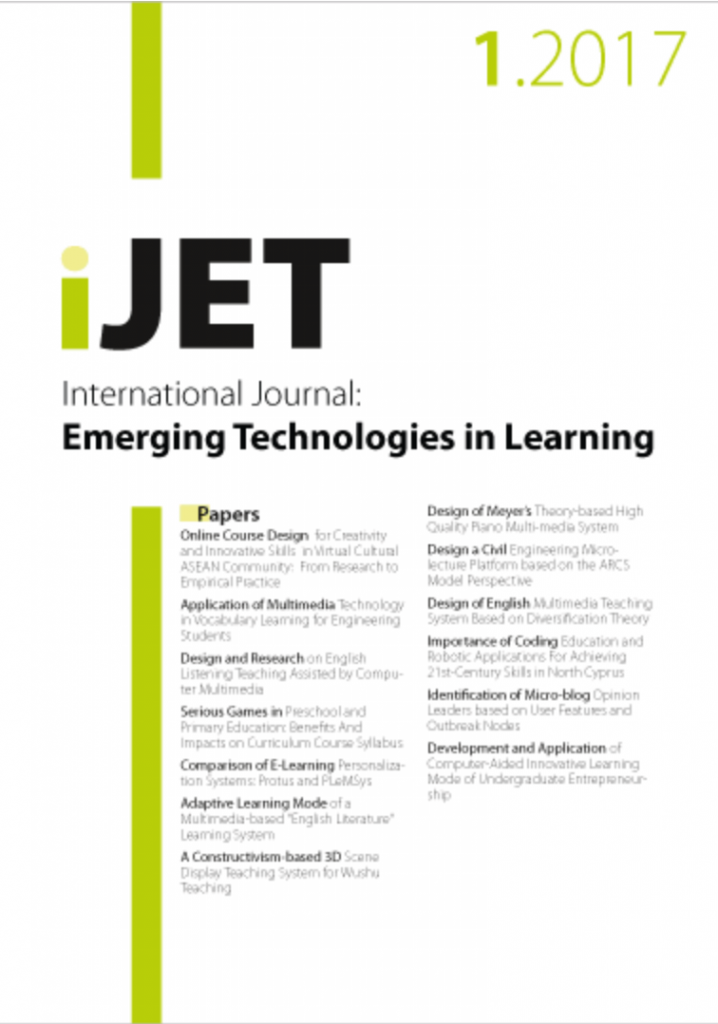
[ijet, journal] Journal of Emerging Technologies in Learning Vol. 14 / No. 8 #ijet #research

Issue 14(8) of our journal on emerging technologies for learning got published. Enjoy the readings as usual for free :-).

Table of Contents:

  • Prediction Model on Student Performance based on Internal Assessment using Deep Learning
  • Analysis the Efficient Energy Prediction for 5G Wireless Communication Technologies
  • Differential Classification Method in Different Teaching Models of Accounting Courses Based on Naive Bayesian Classification Algorithm
  • Design of Database Teaching Model Based on Computational Thinking Training
  • Doc2Vec &Naïve Bayes: Learners’ Cognitive Presence Assessment through Asynchronous Online Discussion TQ Transcripts
  • University-Enterprise Cooperative Education Mode in the Context of Emerging Engineering Disciplines
  • The Influence of Community Structure on the Diffusion of Knowledge—A View Based on Market Segmentation
  • Evaluation on the Effect of Service-Learning in E-Business Professional Curriculum
  • Application Research of an Innovative Online Education Model in Big Data Environment
  • How does Entrepreneurial Education Influence the Entrepreneurial Intention of College Students: The Moderating and Mediating Effects of Entrepreneurial Alertness
  • Difference between Engineering Program Accreditations at Baccalaureate and Master’s Level: Case Study Based on ABET
  • “Ecological Chain” Cultivation Model of Youth Maker in Universities Based on Needs Analysis
  • Research on a Visual Sensing and Tracking System for Distance Education
  • Teaching Mode of Thinking Development Learning Based on Mind Mapping in the Course of Health Fitness Education
  • Geogebra and Grade 9 Learners’ Achievement in Linear Functions
  • Evaluation of Gender Differences Based on Knowledge Adaptation in the Field of Gamification and Computer Science
  • Survey on Sound and Video Analysis Methods for Monitoring Face-to-Face Module Delivery

[Link to Issue 14/8]

Nevertheless, if you are interested to become a reviewer for the journal, please just contact me :-).

[imoox] Woche 2 im COER19: Suchen und finden von OER #imoox #coer19

Der Kurs zu freien Bildungsressourcen geht bereits in die zweite Woche. Nachdem wir OER nun definiert haben, widmen wir uns der Frage wo gibt es denn bereits OER und wie finden wir etwas passendes:

Diese Woche wollen wir uns ansehen, wer denn überhaupt OER bereits zur Verfügung stellt. Und vielleicht überraschend für Sie, es sind bereits erstaunlich viele. Wenn man also weiß wo man schauen kann, findet man sehr schnell wahre Schätze. Sollte das noch nicht ausreichend, dann geben wir im zweiten Video Hinweise wie man ganz gezielt nach OER suchen kann.
Wir wünschen also eine erfolgreiche Schatzsuche 🙂

Anmeldungen zum MOOC sind noch jederzeit möglich.

[imoox, gadi] Artifical Intelligence, Innovation durch IT und Urheberrecht #gadi19 #imoox

Frank KappeDer MOOC „Gesellschaftliche Aspekte der Informationstechnologie“ auf iMooX befindet sich bereits in der vorletzten und neuten Woche. Dennoch ist es immer noch wahnsinnig spannend, sind doch die Themen immer wieder inspirierend. Diesesmal sind die Experten Wolfgang Slany, Frank Kappe und Michael Lanzinger dran. Zuerst beschwert sich Prof. Kappe über die mangelnde Innovationskraft bei unseren Studierenden, da sie seiner Ansicht nach viel zu wenige Unternehmen gründen. Wie ein Konter wirkt dann das Thema von Michael Lanzinger, da das Urheberrecht ja sehr einschränkend ist. Abschließend adressiert Prof. Slany noch ein sehr spannendes Thema und fragt sich wie die Zukunft so ausschauen kann.
Also unbedingt vorbei schauen und mitdiskutieren – der Einstieg in den MOOC ist jederzeit noch möglich.
[Link zum Kurs]

[journal] International Journal of Learning Analytics and Artificial Intelligence for Education (iJAI) #learninganalytics

I am very proud to announce a rather new journal – called „International Journal of Learning Analytics and Artificial Intelligence for Education (iJAI)„. I will assist the Journal as Deputy Editor:

The newly launched International Journal of Learning Analytics and Artificial Intelligence for Education (www.i-jai.org) aims to increase knowledge and understanding of ways in which learning analytics (LA) and artificial intelligence (AI) can support and enhance education. As such the journal aims to connect researchers and other stakeholders that share a common interest in understanding learning and teaching and improving learning and teaching with the support of LA and AI. Thus the journal aims to bridge the gap between pure academic research journals and more practical publications.

We are asking for contributions in following areas:

  • Analysing Learner’s Activity, Engagement, and Motivation
  • Modeling Learning and Teaching in Different Environments (online, blended and physical environments)
  • Evaluation and Development of Teaching Practices and Learning Designs
  • Application of Machine Learning, Educational Data Mining, and Predictive Analytics
  • Social Network Analysis and Network Modelling Tools
  • Supporting and Developing Assessment and Feedback Practices
  • Supporting Personalised and Adaptive Learning
  • Analyzing and Improvement of Learning Organisations based on Data
  • Development of new Methods and Theories
  • AI applications in the educational domain

If you are interested please visit the Journal’s Homepage and send us your latest research 🙂