Wir freuen uns sehr bekannt geben zu können, dass unsere App MatheBingo den Lörnie 2013 in der Kategorie Apps gewonnen hat. Der Preis wird jährlich vom Bundesministerium für Unterricht, Kunst und Kultur für „ausgezeichnetes e-Learning“ vergeben.
Herzliche Gratulation nochmals allen Beteiligten und wir hoffen, dass auch alle Kinder viel Spaß an der App haben.
[lecture] Technology Enhanced Learning – Lecture 3
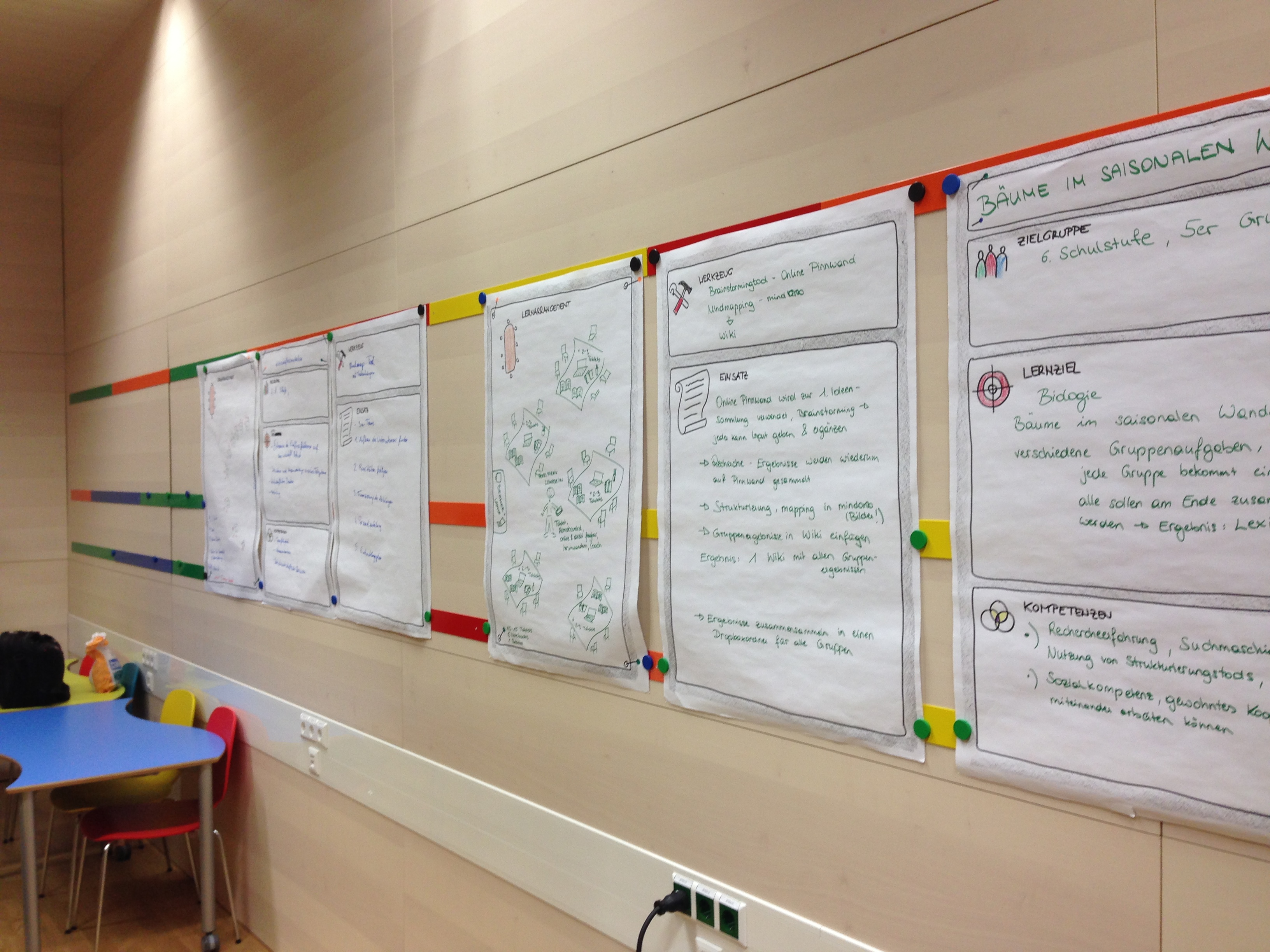
The third lecture of my seminar „Technology Enhanced Learning“ was done by our colleague Hanan Khalil. She introduced the field of Instructional Design and explained her perspectives on learning objectives as an educational technologies. Attached you will find here slides as well as a photo of a poster series of one student group done during the lecture:
Klicken Sie auf den unteren Button, um den Inhalt von de.slideshare.net zu laden.
[presentation] Social Media Learning
Ihm Rahmen des „ExpertInnenforum Hochschuldidaktik“ der Fachhochschule Oberösterreich bin ich gebeten worden, heute einen Vortrag zu Social Media Learning zu halten. Die Folien sind einmal hier erhältlich:
Klicken Sie auf den unteren Button, um den Inhalt von de.slideshare.net zu laden.
[GADI13] Enterprise 2.0 und intellectual property

Ich darf heute, Mittwoch 24.04.2013, wieder zur Vorlesung „Gesellschaftliche Aspekte der Informationstechnologie“ an der TU Graz herzlich begüßen. Der fünfte Termin besteht aus folgendenden Vorträgen:
- Alexander Stocker: „Enterprise 2.0: Einsatz von Social Software im Unternehmensintranet„
- Peter Purgathofer: „intellectual property„
Die Vorträge werden live ab 16.15 Uhr gestreamt – Link zum Streamingserver
Weitere Vorträge/Abstracts findet man hier auf der Vorlesungshomepage.
[publication] Wenn der Lehrraum zum Lernrraum wird
In einem Kurzbeitrag für unser TU Graz internes Magazin TU Graz people habe ich das Ergebnis unseres Projekts zum innovativen Lernraum beschrieben. Nun hoffen wir natürlich dass viele den Raum buchen und nutzen werden.
Abstract:
Wie sollte ein Lehr-, Lernraum gestaltet sein, der andere didaktische Formen als die klassische Frontallehre zulässt? Dieser Frage wurde zusammen mit Studierenden und Lehrenden nachgegangen und konzeptioniert. Das Ergebnis ist bei einem Raum im neuen Produktionstechnikzentrum (PTZ) umgesetzt und steht nun allen Lehrenden und Lernenden zur Verfügung.
Wenn der Lehrraum zum Lernraum wird by Martin
Klicken Sie auf den unteren Button, um den Inhalt von www.scribd.com zu laden.
Zitation: Ebner, M. (2013) Wenn der Lehrraum zum Lernraum wird, TU Graz people, 45 (2013-1), S. 16
[publication] Automated Podcasting System for Universities
The whole podcasting team of our departemt has published our new experiences and developments about our podcasting activities. The publication titled „Automated Podcasting System for Universities“ is now published in the new issue of the International Journal of Emerging Technologies for Learning (iJET). Get here the FULL PAPER (you have to register for open access on the plattform).
Abstract:
This paper presents the results achieved at Graz University of Technology (TU Graz) in the field of automat-
ing the process of recording and publishing university lectures in a very new way. It outlines cornerstones of the
development and integration of an automated recording system such as the lecture hall setup, the recording hard-
ware and software architecture as well as the development of a text-based search for the final product by method of
indexing video podcasts. Furthermore, the paper takes a look at didactical aspects, evaluations done in this context
and future outlook.
Reference: Grigoriadis, Y., Stickel, C., Nagler, W., Ebner, M., Schön, M. (2013) Automated Podcasting System for Universities, International Journal of Emerging Technologies for Learning (iJET), Vol. 8, 1 (2013), p. 24-32 [.pdf]
[lecture] Technology Enhanced Learning – Einheit 2
Die zweite Einheit meines Seminars „Technology Enhanced Learning“ befasste sich mit dem Begriff Blended Learning. Nach einer kurzen Input-Phase beschäftigten wir uns intensiv mit der Idee eine bestehende Vorlesung in eine Lehrveranstaltung zu verwandeln, die sowohl Präsenz- als auch Online-Phasen hat. Die Ergebnisse sind durchaus spannend gewesen und wurden gut durch die Plakate abgebildet.
Klicken Sie auf den unteren Button, um den Inhalt von de.slideshare.net zu laden.
[presentation] Das Lehrbuch als E-Book
Monika König hat Ihre Masterarbeit zum Thema „Das Lehrbuch als E-Book“ erfolgreich verteidigt. Hier nun noch die Folien, über die schriftliche Arbeit hatte ich bereits hier geschrieben:
Klicken Sie auf den unteren Button, um den Inhalt von de.slideshare.net zu laden.
[vodcast] GADI 2013 – mHealth und Open Educational Resources
Die Aufzeichnungen des dritten Einheit aus „Gesellschaftliche Aspekte der Informationstechnologie“ sind nun online verfügbar:
- Günter Schreier: “mHealth – wer hat die Gesundheitsversorgung in der Tasche“
- Martin Ebner: “Freie Bildungsmaterialien – wesentlicher Bestandteil der Gesellschaft von morgen“
Klicken Sie auf den unteren Button, um den Inhalt von curry.tugraz.at zu laden.
[publication] Interaction Possibilities in MOOCs – How Do They Actually Happen?
Toegehter with Hanan Khalil we did a first research work about Massive Open Online Courses (shortly MOOCs). The publication titled „Interaction Possibilities in MOOCs – How Do They Actually Happen?“ and was accepted for presentation at the 3rd International Conference on Higher Education Development „Future Visions for Higher Education Development“ in Mansoura, Egypt. The slides of Hanan’s talk are already here online.
Abstract:
Massive Open Online Courses (MOOCs) are booming. They possibility to study whatever, wherever, and whenever for free is convincing to millions of online learners. A main criterion for the success of learning is interaction and communication as for MOOCs too. But there is little research work to be found according to the ways of MOOC interaction, its usage, and importance so far. This study deals exactly with these topics. The results of this study show that there is a lot of distinct “student to student” interaction using social networks and other Web 2.0 possibilities but very little “student to instructor” interaction. It is a task of the future to strengthen such interaction in order to optimize the learning outcome and community.
Interaction Possibilities in MOOCs – How Do They Actually Happen? by Martin
Klicken Sie auf den unteren Button, um den Inhalt von www.scribd.com zu laden.
Reference: Khalil, H., Ebner, M. (2013) Interaction Possibilities in MOOCs – How Do They Actually Happen?, International Conference on Higher Education Development, p. 1-24, Mansoura University, Egypt