We are happy to announce another MOOC about the topic „Bayesian probability theory„. Find here the trailer of the MOOC and feel motivated to subscribe, as usual for free 🙂
[Free subscribtion for the MOOC]

Digitale Lehre an und rund um der Technischen Universität Graz
We are happy to announce another MOOC about the topic „Bayesian probability theory„. Find here the trailer of the MOOC and feel motivated to subscribe, as usual for free 🙂
[Free subscribtion for the MOOC]
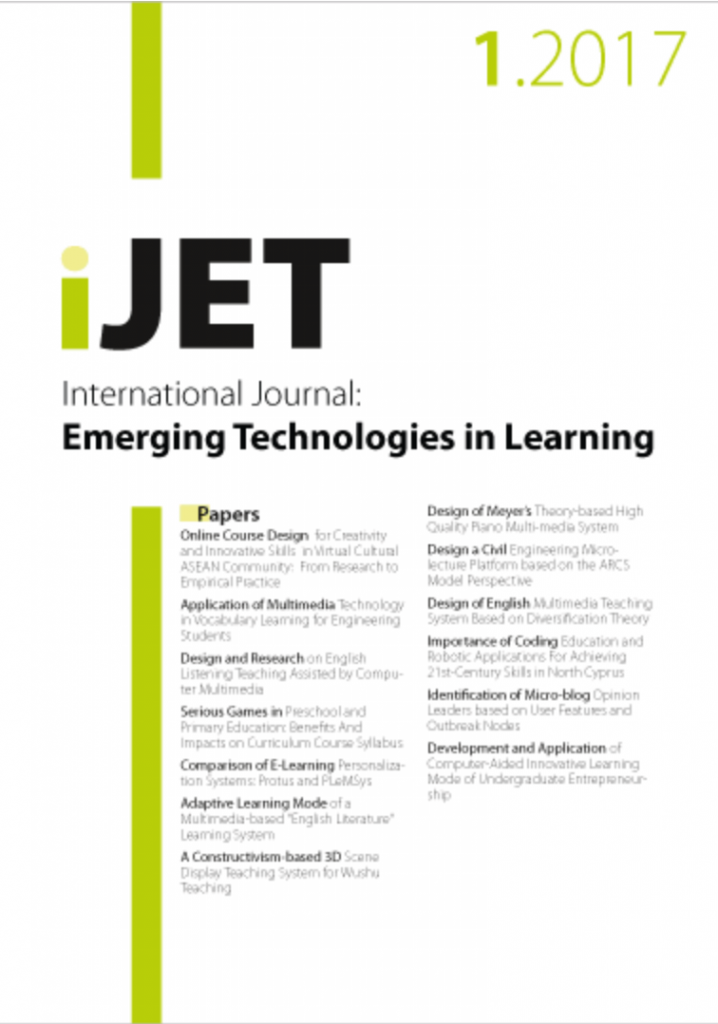
Issue 16(03) of our journal on emerging technologies for learning got published. Enjoy the readings as usual for free :-).
Table of Contents:
Nevertheless, if you are interested to become a reviewer for the journal, please just contact me :-).
Our conference contribution at last year Robotics in Education conference got published now titled „MAKER DAYS for Kids: Learnings from a Pop-up Makerspace„.
Abstract:
Makerspaces exist in different forms with different target groups and goals. Dedicated makerspaces are often organized as communities of practise. They provide space, devices, tools and materials for (digital) (re)production to support (social) innovation and to democratize STEAM education. The potential of makerspaces as authentic learning environments to teach 21st century skills is one reason why pop-up makerspaces are especially designed for children and teenagers, with a great focus on the tools and activities offered. The MAKER DAYS for kids are one example of a temporary makerspace for more than 100 participants with an open approach to encourage (especially female) participants to pursue a career in STEAM domains. Based on the gathered data of the last MAKER DAYS in 2018 and 2019 at Graz University of Technology, this publication focuses on the challenges in the design of maker activities in pop-up makerspaces and comments on the changes and improvements that were/are applied to the last/upcoming event.
[article @ publisher’s homepage]
[draft @ ResearchGate]
Cite this paper as: Grandl M., Ebner M., Schön S., Brünner B. (2021) MAKER DAYS for Kids: Learnings from a Pop-up Makerspace. In: Lepuschitz W., Merdan M., Koppensteiner G., Balogh R., Obdržálek D. (eds) Robotics in Education. RiE 2020. Advances in Intelligent Systems and Computing, vol 1316. Springer, Cham. https://doi.org/10.1007/978-3-030-67411-3_33
Unser Beitrag zu „Entwicklung und Implementierung eines Plug-Ins und von APIs für offene Bildungsressourcen (OER)“ ist nach der erfolgreichen Tagung nun auch als Publikation erschienen.
Zusammenfassung
Um einen breiten Zugang zur Bildung und großzügige Nutzung von Bildungsressourcen zu ermöglichen, setzt auch die Technische Universität Graz (TU Graz) auf offene Bildungsressourcen (Open Educational Resources, kurz OER). Der Beitrag beschreibt die technologischen Entwicklungen und Prozesse, damit Lehrende der TU Graz das eigene Lernmanagementsystem für die Veröffentlichung von OER nutzen können. Es wird im Beitrag nachgezeichnet wie Schnittstellen und Prozesse gestaltet wurden, um Lern-und Lehrressourcen der TU Graz mit entsprechenden Metadaten auszuzeichnen, um sie über das universitätseigene OER-Repositorium und entsprechenden Schnittstellen für das OER-Fachportal der Universität Wien einer breiten Öffentlichkeit recherchierbar anzubieten. Nur entsprechend qualifizierte Lehrende der TU Graz erhalten die Berechtigung für die Nutzung des neuen OER-Plug-In. Der Beitrag schließt mit Empfehlungen für Nachahmer/innen.
[Full article @ Digitale Bibliothek]
[Full article @ ResearchGate]
Referenz: Ladurner, C., Ortner, C., Lach, K., Ebner, M., Haas, M., Ebner, M., Ganguly, R. & Schön, S., (2021). Entwicklung und Implementierung eines Plug-Ins und von APIs für offene Bildungsressourcen (OER). In: Reussner, R. H., Koziolek, A. & Heinrich, R. (Hrsg.), INFORMATIK 2020. Gesellschaft für Informatik, Bonn. (S. 453-465). DOI: doi:10.18420/inf2020_42
Im Rahmen einer kleinen Videoserie wurden drei Videos im Tunnelbaulabor der TU Graz erstellt, welche helfen sollen klassische Materialversuche gut darzustellen. Dabei haben wir eine Hochgeschwindikeitskamera verwendet.
Der dritte Versuch ist der Spaltzugversuch (hier mit dem einachsialen Druckversuch und dem Punktlastversuch vereint):
Clarissa hat einen Beitrag für den Blog des Hochschulforum Digitalisierung zum Thema „Technologiegestützte Lehre vermitteln – TELucation an der TU Graz“ erstellt und dabei unsere TELucation-Sammelmappe beschrieben. Diese Mappe leistet uns gute Dienste an der TU Graz und liegt auf allen Instituten auf. In diesen Zeiten ist sie natürlich ein wesentlicher Bestandteil unserer Beratungs- und Unterstützungstätigkeiten.
Selbstverständlich werden alle Beiträge unter einer offenen Lizenz online gestellt, sodass wir uns freuen wenn auch andere Hochschulen diese verwenden können.
We are happy to announce that the OpenCast Summit 2021 will be take place between 6th and 9th April 2021 completly online and we are part of the organisation of the even.
The websit now is online and the Call for Proposals is open till 22nd of February
Es freut uns sehr, dass der Relaunch von iMooX.at doch großes Medienecho hervorgerufen hat, weil nur so wir die Möglichkeit haben offene und freie Bildung möglichst vielen zugänglich zu machen.
Hier ein paar ausgewählte Reaktionen aus dem Netz:
– iMooX.at – Next Level
– Neue Plattform for digitale Uni-Kurse
– Neue Plattform für kostenlose digitale Uni-Kurse
Ebru did a first publication of her PhD-work titled „Learning Analytics and MOOCs“ for this year HCII conference.
Abstract:
Abstract of the publication
There are new discoveries in the field of educational technologies in the 21st century, which we can also call the age of technology. Learning Analytics (LA) has given itself an important research field in the area of Technology Enhanced Learning. It offers analysis, benchmarking, review and development techniques for example in online learning platforms such as those who host Massive Open Online Course (MOOC). MOOCs are online courses addressing a large learning community. Among these participants, large data is obtained from the group with age, gender, psychology, community and educational level differences. These data are gold mines for Learning Analytics. This paper examines the methods, benefits and challenges of applying Learning Analytics in MOOCs based on a literature review. The methods that can be applied with the literature review and the application of the methods are explained. Challenges and benefits and the place of learning analytics in MOOCs are explained. The useful methods of Learning Analytics in MOOCs are described in this study. With the literature review, it indicates: Data mining, statistics and mathematics, Text Mining, Semantics-Linguistics Analysis, visualization, Social network analysis and Gamification areas are implementing Learning Analytics in MOOCs allied with benefits and challenges.
[full article @ publisher’s webpage]
[draft @ researchgate]
Reference: İnan E., Ebner M. (2020) Learning Analytics and MOOCs. In: Zaphiris P., Ioannou A. (eds) Learning and Collaboration Technologies. Designing, Developing and Deploying Learn- ing Experiences. HCII 2020. Lecture Notes in Computer Science, vol 12205. Springer, Cham. pp. 241-254
Together with my colleagues we published an article about „Experiences Based on a Major Information Server“ in the Journal of Transactions on Internet Research.
Abstract:
In this paper we describe lessons we have learnt from building up a webserver with reliable information over a period of ten years. We show how we have tried to overcome often encountered weaknesses and thus encourage the community to follow our suggestions. We also point out that much research and development work remains to be carried out.
[full article @ ResearchGate]
[full article @ journal’s homepage]
Reference: Delilovic, N., Ebner, M., Maurer, H., Zaka, B. (2020) Experiences Based on a Major Information Server. Transactions on Internet Research 16(1). pp. 75-82