Fachtreffen im Rahmen der Makerdays #makerdays #tugraz

Im Rahmen der Makerdays organisieren wir auch aufgrund der vielen Rückfragen ein Fachtreffen und zwar inmitten der Veranstaltungswoche am 7.8.2019 von 10-16.00 Uhr. Dann kann man sich gleich vor Ort überzeugen (lassen) wie die Workshops aussehen und welche kleinen Projekte wir gerade umsetzen mit den Kindern.

Interessierte Studierende, Lehrende und Personen aus dem Bereich Forschung und Wirtschaft sind herzlich eingeladen, die Bedeutung von Making-Aktivitäten und Makerspaces in der Bildung (von der Primarstufe bis zur Hochschule) im Rahmen des Fachtreffens zu diskutieren.

Dabei sollte natürlich auch das „Making“ nicht zu kurz kommen. Beim Fachtreffen können Sie in die Rolle einer Teilnehmerin/eines Teilnehmers der MAKER DAYS schlüpfen und all das ausprobieren, was Sie bei der Führung durch den Makerspace begeistert hat.

Es erwarten Sie kurze Fachvorträge von Martin Ebner, Kristin Narr, Sandra Schön und Maria Grandl.

Die Veranstaltung ist kostenfrei und wir freuen uns über jede Anmeldung: [Link zum Anmeldefomular]

LLT-Frühstück #tugraz #EducationalTechnology

Es freut mich, dass wir heute bereits zum zweiten Mal das LLT-Frühstück anbieten können für unsere Lehrenden an der TU Graz. Wir wollen hier die Idee eines Kurzinputs mit langem und interaktivem Austausch bei Kaffee wieder umsetzen. Morgen ist das zentrale Thema Open Educational Resources, die OER-Zertifizierung und damit verbunden die technische Umsetzung das „OER-Plugin“ im internen Moodlesystem.

fit4internet listet iMooX-Kurse #tugraz #imoox

Es freut uns sehr, dass die neugegründete Plattform fit4internet auch iMooX-Kurse in ihre Empfehlung mitaufgenommen hat. Das Ziel der Website wird dabei folgendemaßen beschrieben:

fit4internet hat sich dem Anheben der digitalen Kompetenzen verschrieben. Auf dieser Plattform können Sie das österreichische Kompetenzmodell verstehen, Ihren eigenen Kenntnisstand ermitteln, spielerisch Neues erfahren, passende Lernangebote finden – und weiterhin gut informiert bleiben. Als Kursanbieter können Sie Ihre Angebote zuordnen und bewerben. Außerdem erfahren Sie hier, wer als Mitglied oder Partner Aktivitäten zur Steigerung der digitalen Kompetenzen in Österreich unterstützt.

[iMooX-Kurse auf der fit4internet-Plattform]

[mooc] Demokratie MOOC / Teil 3 #imoox

Der iMooX Demokratie-MOOC geht nun in den dritten und letzten Teil. Wir freuen uns, wenn sie gemeinsam mit uns diese spannenden Inhalte erarbeiten, denn besonders in diesen Tagen ist das Demokratieverständnis wichtig:

Der Demokratie-MOOC stellt ein Curriculum für die demokratiepolitische Bildung dar, wobei die vollständigen Lehr- und Lernmaterialien zur Verfügung gestellt werden. So dient der MOOC einerseits der Weiterbildung von allen interessierten Personen, MultipliaktorInnen, KurserstellerInnen, LehrerInnen oder (Sozial-)PädagogInnen. Andererseits stellt der MOOC auch Materialien und Methoden zur Verfügung, damit sich die Teilnehmenden auch motiviert und in der Lage fühlen, Kurse, Unterricht oder Projekte zur Politischen Bildung zu entwickeln und anzubieten.

Die Anmeldung ist wie immer vollkommen kostenfrei: [Link zur Anmeldung]

[publication] Effects of a Mathematical Bridging Course #MOOC #imoox #MatheFit

Our contribution about „Effects of a Mathematical Bridging Course“ to this year eMOOCs conference in Naples got published now:

The secondary to tertiary transition is generally considered as problematic. Thereby, especially mathematics is a significant barrier for students of universities. The reasons are diverse and occur not least because of the changes in the school curriculum caused by the centralised school leaving examination. Subsequently, many universities and academies in the European area provide various approaches to work against the widely spread issue. In 2018, a free accessible online bridging courses for mathematics was designed by Graz University of Technology. The course is provided on the iMooX platform 1 and represents a form of technology-enhanced learning. The aim is to optimise the design of the course considering the needs of freshmen and freshwomen. Following the active course period, course participants take part in evaluations. The outcomes are investigated, which represents the empirical part of the paper. The online course receives positive feedback. As a consequence, it is recommended to continue the course offer within the next few years.

[Full article @ ResearchGate]

[Conference Proceeding eMOOCs 2019]

Reference: Reich, S., Ebner, M., Ebner, M. (2019) Effects of a Mathematical Bridging Course. Proceedings of EMOOCs conference, pp. 197-202, Naples (Italy)

[publication] Conception of a Conversational Interface to Provide a Guided Search of Study Related Data #chatbot

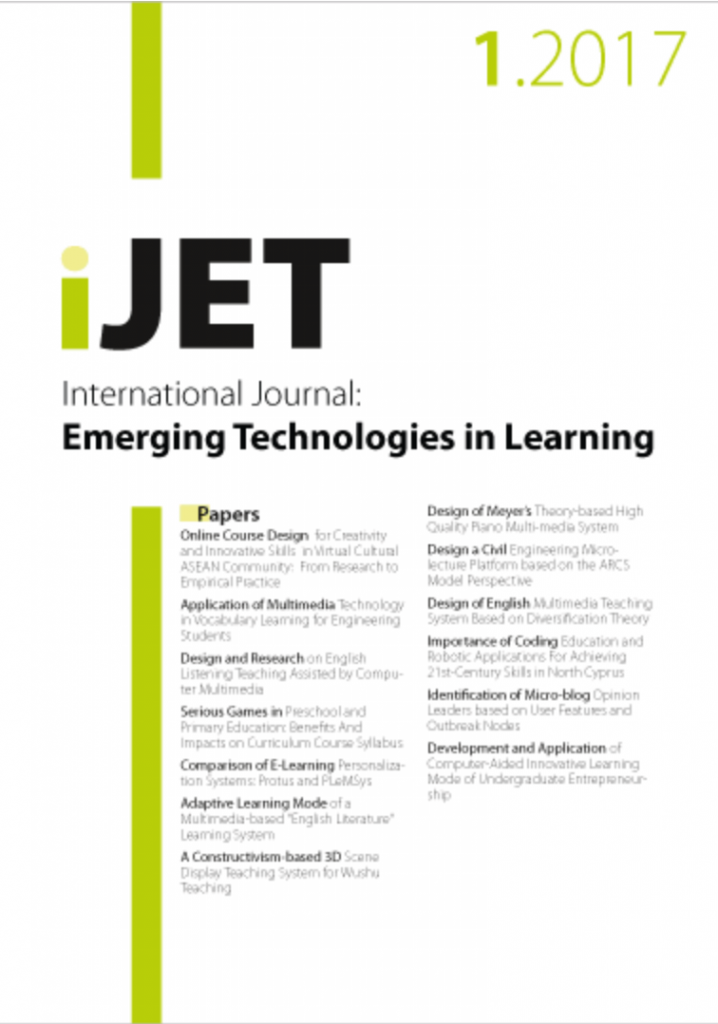
Our research about „Conception of a Conversational Interface to Provide a Guided Search of Study Related Data“ got published in the International Journal of Emerging Technologies.

Abstract:

Since the beginning of software development, solution approaches and technolo-gies have changed massively, including the requirements for a user interface. At the very beginning, it was the desktop application, with a classic Graphical User Interface (GUI), which fulfilled the needs of a user. Nowadays, many applica-tions moved to web respectively mobile and the user behavior changed. A very modern concept to handle the communication between a computer and a user is a chatbot. The range of functions of a chatbot can be very simple up to complex ar-tificial intelligence based solutions. This publication focuses on a chatbot solution for Graz University of Technology (TU Graz), which should support the student by finding study related information via a conversational interface.

[Full Article @ Journal’s Homepage]

[Full Article @ ResearchGate]

Reference: Berger, R., Ebner, M. & Ebner, M. (2019) Conception of a Conversational Interface to Provide a Guided Search of Study Related Data. International Journal of Emerging Technologies (i-JET). 14(7). pp. 37-47

[podcast] Wir bauen eine Stadt #makerdays #tugraz #makereducation

Maria hat in einem kurzen Interview über die Makerdays an der TU Graz berichtet und auch gleichzeitig noch angekündigt, dass es ein paar wenige Restplätze gibt. Die Anmeldung ist hier möglich.

Technik zugänglich und angreifbar zu machen: Das ist das Ziel des Projekts „Maker Days for Kids“. Die TU Graz und der gemeinnützige Verein BIMS e.V. bietet Kindern und Jugendlichen im Sommer die Möglichkeit, in einer offenen Werkstatt kreativ zu arbeiten.

[Link zum Podcast bei Aircampus]

[publication] Experiences with a MOOC-platform — Who are our learners and what do they think about MOOCs? #research #MOOC #emoocs #imoox

Our contribution about „Experiences with a MOOC-platform — Who are our learners and what do they think about MOOCs?“ to this year eMOOCs conference in Naples got published now:

iMooX, the first and currently only Austrian MOOC platform, has been hosting xMOOCs since 2014. Directly after the start a survey of the first three MOOCs was conducted and published in 2015. In the meantime, the MOOC platform contains more than 45 courses and serves many thousands of learners. Therefore, we are investigating, if there is a change towards the learners themselves, their expectations and experiences regarding learning with MOOCs as well as with the platform. Using the exact same survey as years before it can be shown that there are little changes in the right directions or maybe it can be concluded that learning with MOOCs became more common to a broader public, at least in the academic world.

[Full article @ ResearchGate]

[Conference Proceeding eMOOCs 2019]

Reference: Leitner, P., Ebner, M. (2019) Experiences with a MOOC-platform — Who are our learners and what do they think about MOOCs?. Proceedings of Work in Progress Papers of the Research, Experience and Business Tracks at EMOOCs 2019co-located with the (European MOOCs Stakeholders Submmit 2019) Conference. pp 163-168. Naples, Italy

[publication] Influential factors for technology-enhanced learning: professionals’ views #tugraz #research

Our publication about „Influential factors for technology-enhanced learning: professionals’ views“ got published in the Journal of Research in Innovative Teaching &Learning.

Abstract:

Purpose
The literature includes several studies that define different critical success factors (CSF) which have to be considered to support the implementation of technology-enhanced learning (TEL) approaches. An analysis of such studies revealed that (1) regional differences seem to determine the CSF for TEL approaches, (2) certain CSF are relevant for TEL approaches in general, and (3) professionals in higher education determine which influential factors they consider when implementing TEL approaches. Thus, the question arises: in general, which influential factors do professionals in Austrian and German institutions of higher education actually consider when implementing TEL approaches?

Design/methodology/approach
The study is a quantitative research approach based on survey data.

Findings
The results show that certain influential factors seem to be generally important, such as the factors of respecting learning success or motivation. However, the outcome of the study also indicated that different moderating variables like experiences and personal relevance affect the professionals’ choices.

Originality/value
The originality and value are in the approach to identify generally important influential factors for the implementation of TEL approaches in Austrian and German institutions of higher education.

[Article @ Journal’s Homepage]

[Article @ ResearchGate]

Reference: Schweighofer, P., Weitlaner, D., Ebner, M., Rothe, H. (2019) Influential factors fortechnology-enhanced learning: professionals’ views. Journal of Research in Innovative Teaching &Learning, https://doi.org/10.1108/JRIT-09-2017-0023