
[publication] Will e-Learning die?

Will eLearning die?I wrote toegether with Mandy Schiefner an article about the future of e-Learning one year ago – now the article is published as chapter of the book „E-Learning: 21st Century Issues and Challenges„. Here you will find the draft-version.
Abstract:

The World Wide Web is currently changing dramatically. The buzzword Web 2.0 describes how we deal with the Internet. “The user is the content” is one of the famous descriptions. Users create their own (learning) content by blogging, podcasting or producing mashups. Of course the innovations summed up with the word Web 2.0 influence the traditional e-learning world.
In this paper we focus on how learning will change in the future. The combination of traditional research work combined with emerging technologies lead to an assumption of the learning behaviour of tomorrow. Will today’s teaching soon be a matter of the past? How will a lecture looks like by integrating emerging technologies? We conclude that information anytime and anywhere influences the world of digital natives arbitrarily and causes the death of e-Learning in present sense. Using computer and mobile technologies for learning purposes will be as normal as writing a letter with pencil

Reference for citation: Ebner, M. and Schiefner, M. (2008) Will E-Learning die?;in: E-Learning: 21st Century Issues and Challenges, Audrey R. Lipshitz and Steven P. Parsons (Ed.), Nova Publishers, pp. 69-82, 2008, ISBN: 978-1-60456-156-2

[plugin] Ubiquity

Folgendes Problem: Man lest im Broswer 1+1 und möchte das Ergebnis wissen oder man weiß nicht wo Graz liegt? Nun naheliegend wäre, dass man es markiert und das Ergebnis wird angezeigt oder man sieht die Lokalität auf Google-Maps. Klingt unglaublich und ist es eigentlich derzeit auch noch.
Nun gibt es aber eine Entwicklung in den Mozilla Labs mit den Namen Ubiquity, welche genau das Ziel verfolgt:

You’re writing an email to invite a friend to meet at a local San Francisco restaurant that neither of you has been to. You’d like to include a map. Today, this involves the disjointed tasks of message composition on a web-mail service, mapping the address on a map site, searching for reviews on the restaurant on a search engine, and finally copying all links into the message being composed. This familiar sequence is an awful lot of clicking, typing, searching, copying, and pasting in order to do a very simple task. And you haven’t even really sent a map or useful reviews—only links to them.

Hier noch ein Kurzvideo:

Also unbedingt ausprobieren, macht fast süchtig und man denkt nur mehr darüber nach welche Befehle noch ein absolutes MUSS darstellen 🙂

Cloud Computing und Microblogging am Weg zum Hype

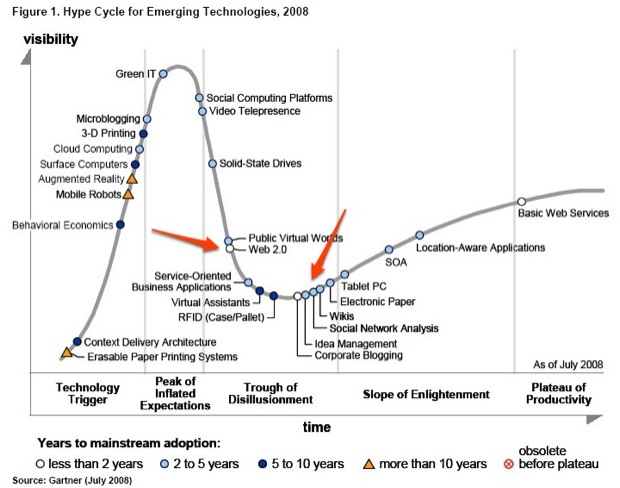
Ich habe mir soeben den „Garnter Hype Cycle“ 2008 angesehen und wie man sehen kann, ist neben dem dramatischen Fall von Web 2.0 und Privat Virtual Worlds besonders Microblogging (Twitter & Co) und auch Cloud Computing im Kommen.
Überrascht mich insofern, da ich noch nicht erwartet hatte, dass Cloud Computing quasi schon hinter den Twitter Anwendungen liegt, da es ja öfters auch schon als Nachfolger von Web 2.0 gehandelt wird. Über Cloud Computing hatte ich auch schon einmal hier berichtet.
Gut wie auch immer, hier einmal die Grafik:

Gartner Hype Cycle 2008

Weiters habe ich noch ein weiteres Video gefunden über Cloud Computing (zwar etwas eigenartig, aber es geht ja um den Inhalt):

[tool] ShoutMix

Ich bin auf eine Applikation gestoßen, die es ermöglicht quasi einen Chat auf einer Homepage zu erstellen: ShoutMix.
Einfach registrieren und konfigurieren. Danach erhält man den Code den man auf seiner Seite einbauen kann:


Klicken Sie auf den unteren Button, um den Inhalt von www4.shoutmix.com zu laden.

Inhalt laden


Free chat widget @ ShoutMix

[video] Cloud Computing

Das Wort Cloud Computing macht immer mehr die Runde und umschriebt mehr oder weniger, dass zukünftig alles im Netz stattfinden soll/wird. Man kann sich das so vorstellen, dass man nur mehr mit Clients arbeitet, die über eine Internet Verbindung verfügen, der Rest der Arbeit wird mit serverseitiger Software und serverseitigen Dokumenten erledigt. Die Frage nach den verschiedensten Diensten und wie diese kombiniert werden ist freilich noch offen.
Diese Gedanken sind jetzt zwar nicht neu und revolutionär, aber schön langsam kann man darüber nachdenken es tatsächlich umzusetzen. Auch bei mir persönlich ist eigentlich lange schon so, dass der Browser die wichtigste Anwendung ist und ich dort den Großteil meiner Arbeit erledige.
Also hier gibt es ein nettes Video wo verschiedenste Experten zum Thema Cloud Computing befragt wurden:

Hier noch ein paar weiterführende Hinweise.

(via HeyJude)