Im Rahmen der Interpädagogica in Graz darf ich heute die Keynote halten und habe mir dabei das Thema „Maker Education“ vorgenommen. Hier gibt es die Folien dazu:
Klicken Sie auf den unteren Button, um den Inhalt von www.slideshare.net zu laden.

Digitale Lehre an und rund um der Technischen Universität Graz
Im Rahmen der Interpädagogica in Graz darf ich heute die Keynote halten und habe mir dabei das Thema „Maker Education“ vorgenommen. Hier gibt es die Folien dazu:
Klicken Sie auf den unteren Button, um den Inhalt von www.slideshare.net zu laden.
Auf Englisch haben wir es auf der EduRobotics 2018 in Rom vorgestellt, für den Praxisblog dann gleich ins Deutsche übertragen:
I am very happy to be again responsible for the Special Interest Group (SIG) about „Emerging Technologies for Learning and Teaching“ at next year ED-Media Conference in Amsterdam. I also changed the program a little bit, from just a discussing part to a more interactive one. Our main goal will be to establish guided tours for those who are interested in emerging technologies.
Procedure of the SIG
- June 2019: Scanning of research work within the conference program which might be from interest for SIG participants
- June 25th: SIG meeting at the conference where SIG chair will introduce to those works and provide a possible conference guide to those presentations. Discussion about the chosen research work
- Conference 2019: SIG participants will participate the suggested presentations and vote for them online from the perspective of an innovative and emerging technologies.
Anyway, I would love to see you in Amsterdam 🙂
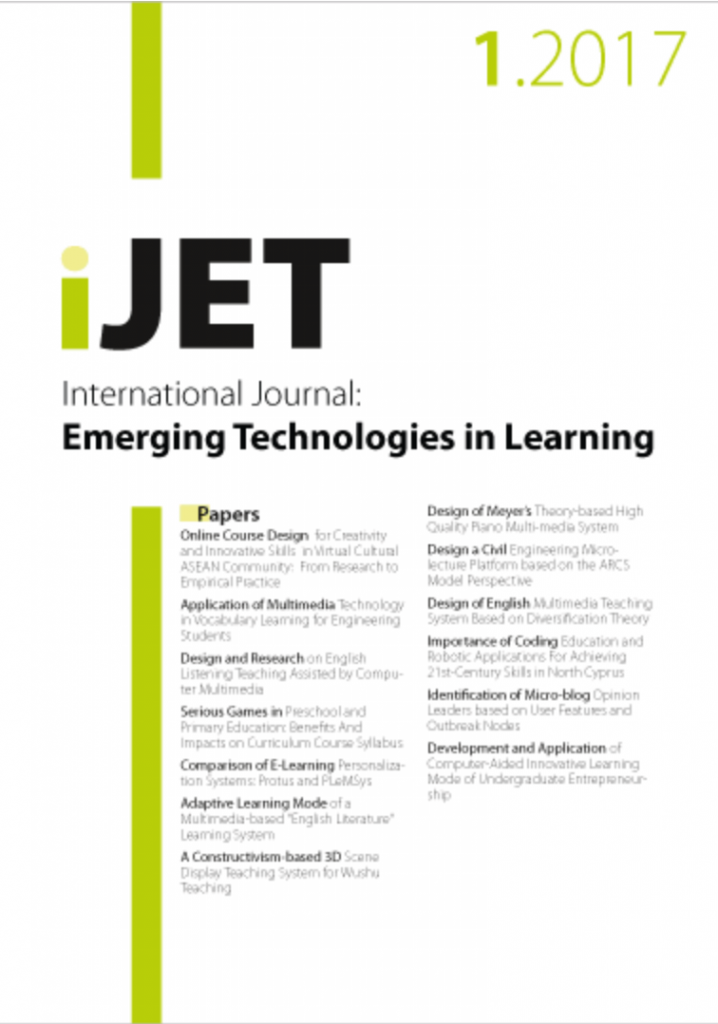
Issue 13(11) of our journal on emerging technologies for learning got published. Enjoy the readings as usual for free :-).
Table of Contents:
Nevertheless, if you are interested to become a reviewer for the journal, please just contact me :-).
Im Rahmen einer Veranstaltung in Thüringen (Bad Blankenburg) bin ich gebeten worden zum Thema „Bildungstechnologien, Digitalsierung, Schule …“ zu reden. Hier meine Folien dazu:
Klicken Sie auf den unteren Button, um den Inhalt von www.slideshare.net zu laden.
Our publication about „A Mobile Application for School Children Controlled by External Bluetooth Devices“ got published in the new issue of the International Journal of Interactive Mobile Technologies (iJIM).
Abstract:
The didactic method of digital, game-based learning includes integrating educational content or learning standards into video games with the objective to engage pupils. The method combines instructional content with computer or video games and can be used with all subjects and at all ability levels. Exponents of digital game-based learning argue that it provides learning opportunities which involve learners in interactive teaching and encourages them to take part in the technological society of the 21st century. The necessity of digital, game-based learning arose in the last decades of the 20th century as world-wide improvements in innovation took place. Today’s learners live their lives with easy access to technology. This paper discusses the need for, motivation for and adjustment of digital, game-based learning to meet the needs of contemporary and the future generations of learners. Specifically, a game prototype for pupils of 9 to 10 years of age was implemented and evaluated. A simple mathematical game was created to help children practice mathematical skills in a fun, logical, thoughtful, enjoyable, amusing and light-hearted way. The results of the evaluation showed that children were interested in using mobile devices to learn mathematics, and especially the multiplication table. During the study, children tried both to achieve positive results and enjoyed the game. Our findings indicate that using mobile-based games encourages a positive mental outlook in pupils toward mathematics, ensures their dynamic, noteworthy participation and supports the acquisition of mathematical knowledge.
[Article @ Journal’s Homepage]
Reference: Maloku, V., Ebner, M., Ebner, M. (2018) A Mobile Application for School Children Controlled by External Bluetooth Devices. International Journal of Interactive Mobile Technologies. 12(5). 81-96 ISSN: 1865-7923
Wir biegen in die Zielgerade bei unserem MOOC „Learning to Code: Programmieren mit Pocket Code„. Und wir wollen, dass man das bisherige Gelernte einsetzt und damit einfach Spaß hat:
In diesem Kapitel bist du an der Reihe, du hast die Aufgabe euer eigenes Programm von Grund auf zu entwickeln. Dieses Programm kann ein Spiel, Animation oder auch ganz was anderes sein. Du kannst natürlich alte Programme oder Konzepte von der vorigen Kapiteln verwenden.
Wie macht man mit? Das geht immer und jederzeit, einfach auf iMOOX registrieren und hier anmelden – viel Spaß allen.
Markus did a Keynote speech in Portoroz (Slovenia) about our experiences with Learning Analytics with a special focus to secondary and higher education. Find his slides right here:
Klicken Sie auf den unteren Button, um den Inhalt von www.slideshare.net zu laden.
Issue 13(10) of our journal on emerging technologies for learning got published. Enjoy the readings as usual for free :-).
Table of Contents:
Nevertheless, if you are interested to become a reviewer for the journal, please just contact me :-).
Es geht weiter, bereits Woche 4 im MOOC „Learning to Code: Programmieren mit Pocket Code„. Diesesmal wollen wir Punkte und Highscore umsetzen, dazu kommen erstmals Variablen zum Einsatz:
Wir werden Variablen kennenlernen und sehen was dadurch als möglich wird – Level, Punktestände, Countdown und vieles mehr! Außerdem lernen wie wir uns die Eigenschaften von Objekten zunutze machen können!
Wie macht man mit? Das geht jederzeit, einfach auf iMOOX registrieren und hier anmelden – viel Spaß allen.