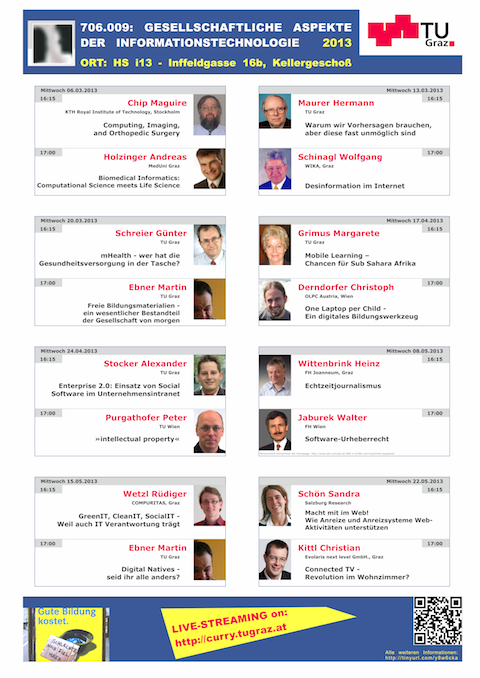
Die heurige Vorlesung „Gesellschaftliche Aspekte der Informationstechnologie“ setzt sich wieder aus 16 spannenden Vorträgen zusammen. Neben den exzellenten Vortragenden werden auch wieder viele spannende Themen adressiert und diskutiert wie sich Informationstechnologie auf das heutige Leben auswirkt bzw. zukünftig noch auswirken wird.
Auch heuer werden wieder alle Vorträge live gestreamt (Curry Server) und wir hoffen wieder auf großes Interesse. Unten einmal das Plakat zur Veranstaltung und hier geht es zur Webseite (wo auch dann die archivierten Vorträge gesammelt zur Verfügung stehen).
[keynote] Keynote „Ist der Touchscreen der Füller von morgen?“
Im Rahmen der Fachtagung Professional eLearning an der Bildungsmesse didacta in Köln werde ich am 19. Februar 2013 einen Vortrag halten mit dem Titel „Ist der Touchscreen der Füller von morgen?„.
Selbstverständlich freue ich mich über eine rege Teilnahme und die anschließende Diskussionen vor Ort 🙂 .
[CfP] Interaction in Massive Courses
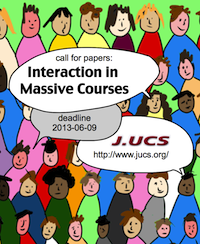 Together with my colleagues from the University of Munich I like to call for submissions on the topic „Interaction in Massive Courses„. The contributions will appear as Special Issue of the journal J.UCS (Journal of Universal Computer Science) which is an open access journal and holds an Impact Factor.
Please consider to send us a scientific contribution on 9th June 2013 at latest, if the following sounds interesting and meet you research interests as well:
The Special Issue aims to gather research works in the field of massive courses with a special focus on enhancing interaction between lecturers-students or students-student in face-to-face situations or completely online by using different kind of technologies (MOOC). For example, some few information systems created some years ago, summarized by the term Audience Response Systems (ARS). Here students are able to make votes on lecturers’ questions by using mostly special hardware (Anderson et al, 2003). Other possibilities are the use of Web 2.0 technologies (Purgathofer & Reinhard,
2008) or Social Media (Ebner, 2011) to enhance students’ engagement in live-lecturing-situations. In the last years, the above-mentioned MOOCs attracted the interest of thousands of students. Obviously this leads to new challenges on how to overcome the management of a huge number of occurring interactions and makes new strategies necessary.
Assuming that rich interactions in large groups of learners are even more critical in the development of academia this Special Issue of the Journal of Universal Computer Science is dedicated to research on media fostering interaction in massive courses.
Here you will find the detailed Call for Paper (CfP).
[vodcast] Zukunft von Lern- und Lehrmaterialien
Die Aufzeichnung meines Vortrages über die „Zukunft von Lehr- und Lernmaterialien“ ist nun online verfügbar. Die Folien sind bereits hier veröffentlicht.
[project] Innovativer Lehrraum
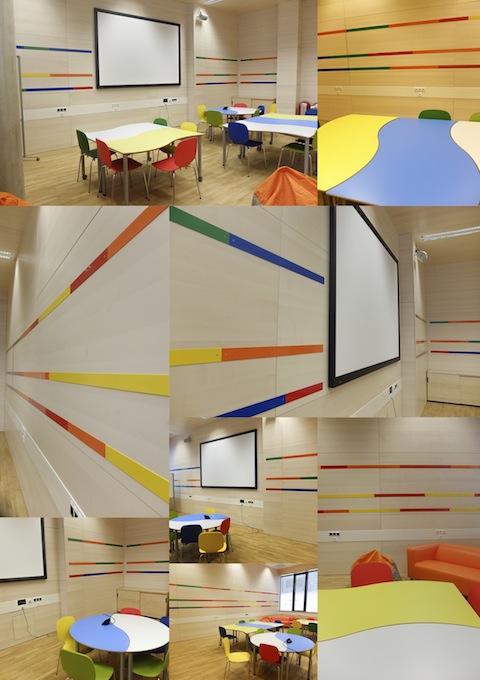
Es wurde an der TU Graz unter meiner Leitung letztes Jahr ein Projekt gestartet mit dem Ziel einen innovativen Lehrraum auszustatten, sodass Lehre auch anders als in typischen Face-to-face-Situationen stattfinden kann.
Wir haben dazu einen Workshop mit Studierenden, Lehrenden sowie ExpertInnen organisiert und dabei versucht festzustellen wie ein solcher Raum auszusehen hat bzw. welche Erwartungen man an diesen stellt. Die Ergebnisse waren durchaus beachtenswert und vor allem jenseits von Technik und innovativen Lehr- und Lernmittel.
Daraufhin haben wir versucht den Raum zu konzipieren und das Endergebnis wird ein wenig durch das Bild vermittelt: Ein Raum mit mobilen Mobilar, WLAN-Projektor, Sitzsäcken und Sofa, sowie einem mobilen Whiteboard und Magnetleisten rundherum.
Vor allem auch sehr farbenfroh und gut beleuchtet (was so eingefordert wurde).
Wer dazu mehr wissen will, bitte einfach mich kontaktieren. Dann hab ich vielleicht auch schon die ersten Berichte aus der Praxis dazu.
[presentation] Zukunft von Lehr- und Lernmaterialien
Im Rahmen der IBOBB 2013 (Messe für Information, Beratung und Orientierung für Bildung und Beruf) in den Kammersälen der Arbeitkammer Graz werde ich heute über die bisherigen Erkenntnisse auf dem Sektor der Zukunft von Lehr- und Lernmaterialien reden. Die Frage ob das Lehrbuch von heute noch zeitgemäß ist und wohin die Reise gehen könnte, steht im Mittelpunkt meiner Betrachtungen.
Hier einmal die Vortragsfolien:
Klicken Sie auf den unteren Button, um den Inhalt von de.slideshare.net zu laden.
[onlinediscussion] #MMC13 Warum sind MOOCs offen?
Im Rahmen des gerade statt findenden MOOC „Der deutschsprachige MOOC Maker Course„, kurz MMC13, wurde ich eingeladen in einer kleinen Diskussionsgruppe zu Openess allgemein und auch Open Educational Resources zu reden.
Wie schon öfters hier im Blog hab ich versucht darauf hinzuweisen, dass OER ein wesentliches Thema für das digitale Klassenzimmer von morgen ist und dass es vor allem darauf ankommt eine Bewusstseinsbildung zu betrieben.
Hier einmal die gesamte Diskussion auf YouTube:
Weitere interessante Dinge zu OER:
- Buchreiche zum Thema
- Zahlreiche Initiativen von BIMS e.V. zum Thema OER auf deren Homepage
- Die Open-Content-Strategie der TU Graz
- Artikel zu „Offene Lernressourcen: Frei zugänglich und einsetzbar„
- Rund um OER in meinem Weblog
- Und ein Call For Papers zum Thema Open Access und OER für die Zeitschrift ZFHE
„Alles was in Zukunft nicht OER ist, wird es schwer haben zu bestehen.“
Zugegeben der Titel meines Interviews über Open Educational Resources für das Magazin DIGITAL LERNEN ist provokant. Aber oft ist es ja so, dass nur so Diskussionen angeregt werden können. Unzweifelhaft für mich ist jedenfalls, dass wir an dem Thema arbeiten müssen um es voran zu bringen.
Das gesamte Interview mit mir gibt es hier.
[CfP] Open Access und Open Educational Resources
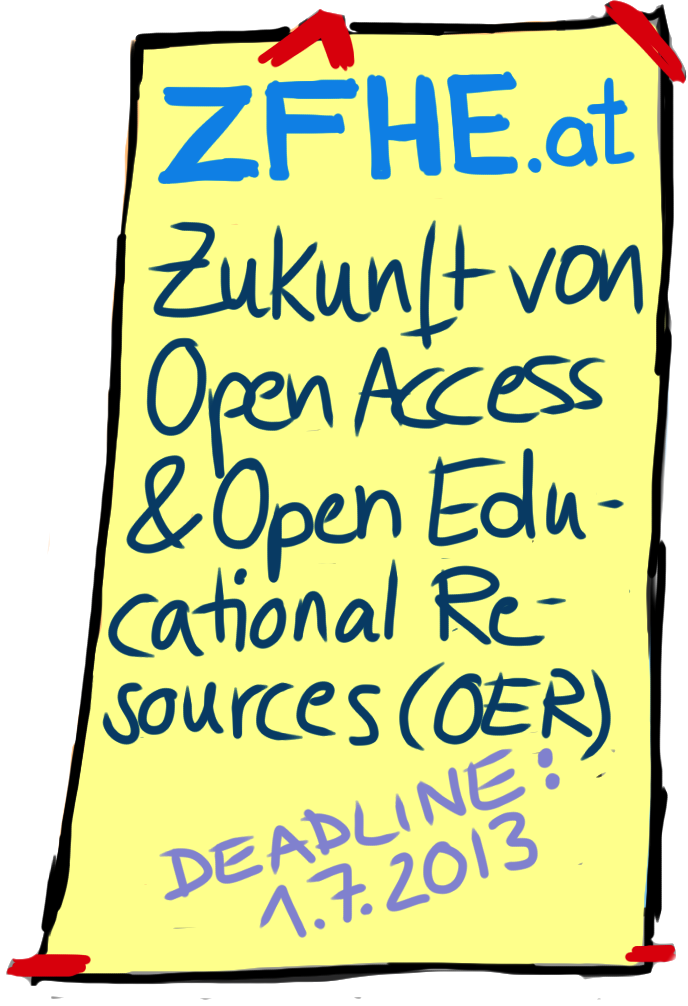 Zusammen mit Sandra Schön, Lambert Heller und Rudolf Mumenthaler freue ich mich über Einreichungen zur Schwerpunkt-Ausgabe der Zeitschrift für Hochschulentwicklung (ZFHE): „Wie gestalten wir die Zukunft mit Open Access und Open Educational Resources?„
„Open Access (OA) und Open Educational Resources (OER) sind in den letzten Jahren immer häufiger als Themen in den Printmedien und in der wissenschaftlichen Debatte vertreten. Beide verändern zentrale Prozesse an Hochschulen. Steht Open Access für den freien Zugang primär zu wissenschaftlichen Forschungsergebnissen, diskutiert man im OER-Sektor über die Verfügbarkeit und Nutzbarkeit von freien Bildungsinhalten in der Lehre und für das Lernen. Beide Bewegungen sind zwar unabhängig voneinander, aber beeinflussen und inspirieren sich gegenseitig und verwenden auch ähnliche Argumente. …
Der vollständige Call als [pdf].
Wir freuen uns auch jetzt schon über alle, die sich bereit erklären, Einreichungen zu begutachten. Bitte kurze Mail an uns 🙂
[bachelor] Implementing the Auphonic Web Application Programming Interface
Andre did his bachelor thesis about the implementation of the Auphonic API to allow different third-party applications access to the genius software Auphonic.
Here is the written part of his work:
Klicken Sie auf den unteren Button, um den Inhalt von de.slideshare.net zu laden.